
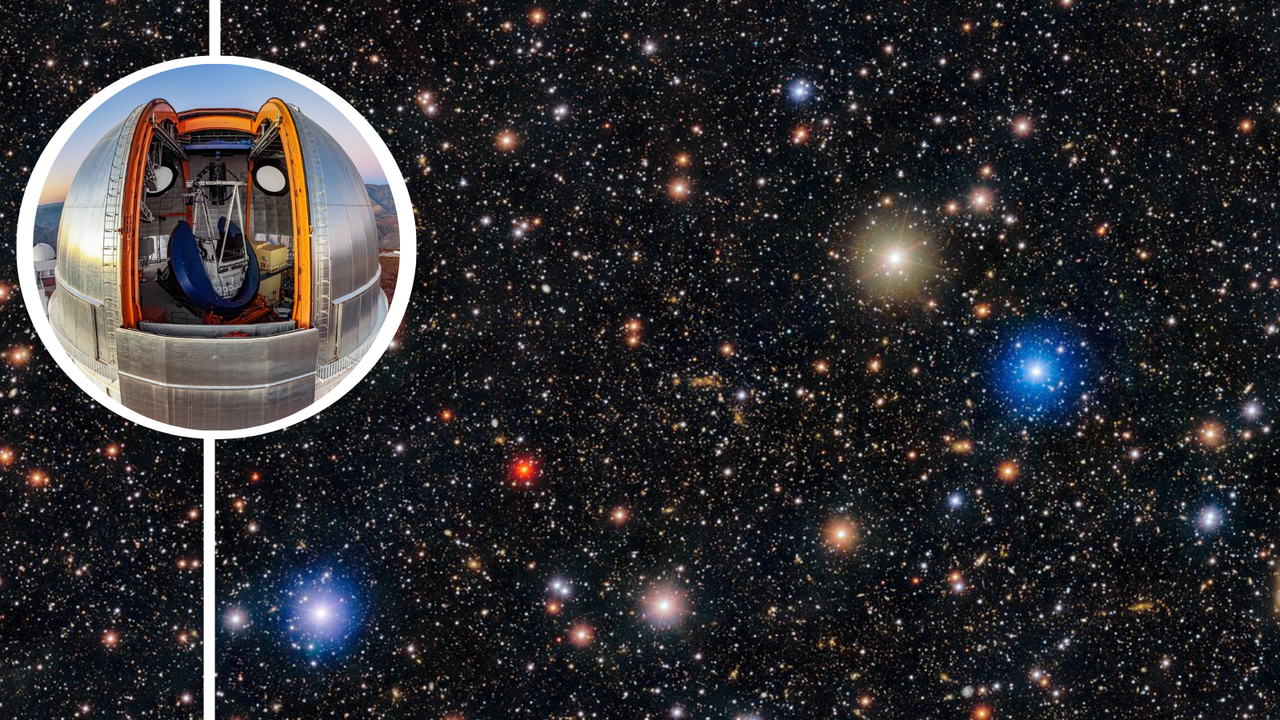
Scientists have achieved a significant breakthrough in understanding the universe’s expansion and the enigmatic force of dark energy. This advancement is the result of analyzing six years of data collected by the Dark Energy Camera (DECam), mounted on the U.S. National Science Foundation’s Víctor M. Blanco 4-meter telescope. The data encompasses 758 nights of observations from the Dark Energy Survey (DES), conducted between 2013 and 2019, which examined one-eighth of the sky, recording information from approximately 669 million galaxies located billions of light-years away from Earth.
This comprehensive analysis marks the first occasion in which four distinct methods of studying dark energy have been integrated into a single framework. As a result, researchers have doubled the strength of constraints on dark energy’s effects, a critical step toward unraveling the true nature of this mysterious component that comprises roughly 68% of the universe.
Expanding Knowledge of Dark Energy
The concept of dark energy emerged in 1998 when two independent teams of astronomers observed distant supernovas. They discovered that galaxies further away from Earth were receding at an accelerated pace, confirming that the universe is expanding, as originally proposed by Edwin Hubble a century ago. The revelation that this expansion is accelerating led to the term “dark energy,” a placeholder for the unknown force driving this phenomenon.
Over the past 28 years, scientists have determined that dark energy plays a crucial role in shaping the cosmos. Notably, its influence is believed to have become dominant between 3 and 7 billion years ago, overpowering the attractive force of gravity at large scales. This understanding underscores the urgent need to clarify the nature of dark energy.
The recent analysis utilized Type-Ia supernovas, the same type used in the original discovery of dark energy, alongside three additional methods to probe cosmic structure and expansion. These methods include weak gravitational lensing, where light from distant sources is bent by massive foreground objects; galaxy clustering; and baryon acoustic oscillations, which are fluctuations in density from the early universe caused by pressure waves shortly after the Big Bang.
Significant Findings and Future Directions
Yuanyuan Zhang, a member of the DES Collaboration from NOIRLab, expressed the excitement surrounding these results. “It is an incredible feeling to see these results based on all the data, and with all four probes that DES had planned,” Zhang stated. “This was something I would have only dared to dream about when DES started collecting data, and now the dream has come true.”
Using data from DECam and the aforementioned techniques, the DES team reconstructed the distribution of matter over the past 6 billion years. They then compared these findings against two prevailing cosmological models: the Lambda Cold Dark Matter (LCDM) model, which posits that dark energy remains stable over time, and the evolving model (w CDM), where dark energy changes over time. The results aligned well with both models; however, they also highlighted a discrepancy regarding the predicted clustering of matter in the modern universe.
This discrepancy suggests that the clustering of modern galaxies does not conform to the predictions of either the LCDM or w CDM models, revealing an even greater difference between observations and theoretical expectations.
Looking ahead, the DES team plans to integrate DECam data with observations from the upcoming Vera C. Rubin Observatory. This observatory will conduct a decade-long Legacy Survey of Space and Time (LSST) aimed at observing approximately 20 billion galaxies, promising to deliver an even clearer picture of the universe’s history and the nature of dark energy.
Chris Davis, Program Director at the National Science Foundation, commented on the transformative impact of DES. “Rubin’s unprecedented survey of the southern sky will enable new tests of gravity and shed light on dark energy,” he stated.
The research findings have been submitted to the journal Physical Review D and are also available on the arXiv paper repository, contributing to the ongoing dialogue about the universe’s most profound mysteries.