
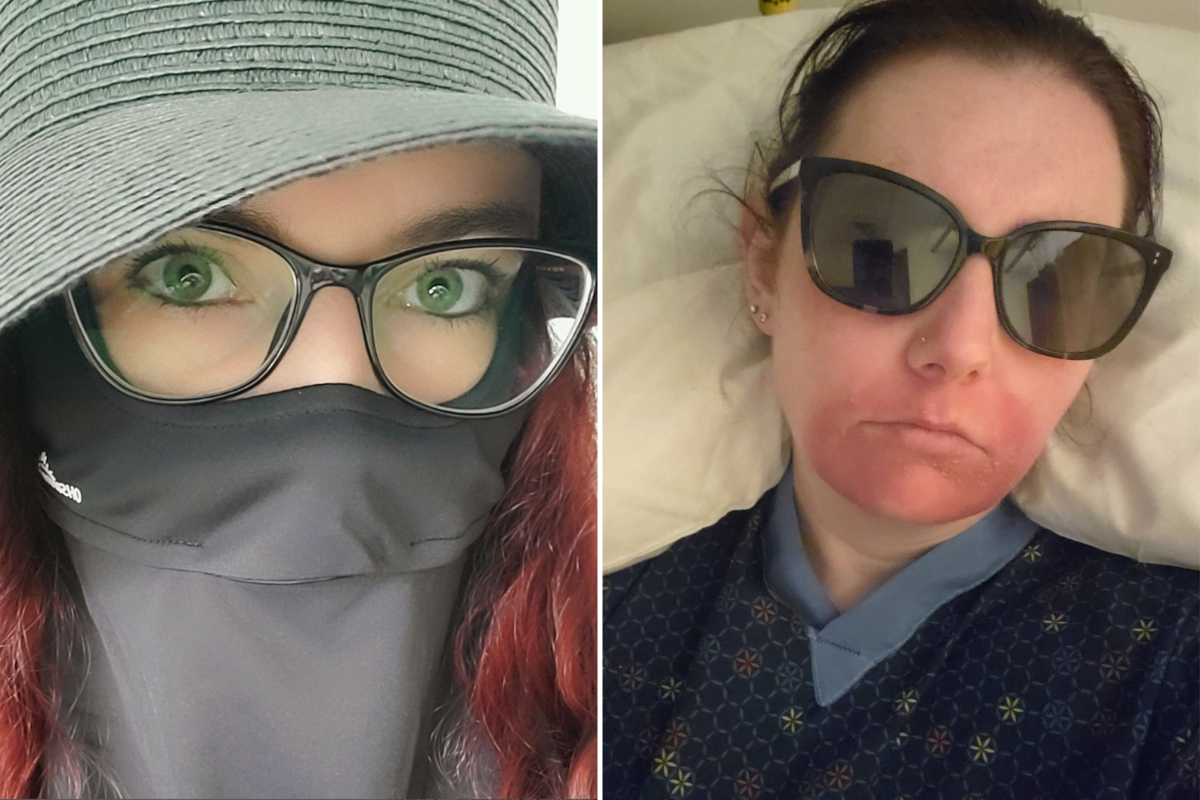
Emily Richardson, a 36-year-old resident of Murfreesboro, Tennessee, has been thrust into the spotlight after revealing her lifelong struggle with a rare condition known as Stevens-Johnson Syndrome (SJS), which has left her highly sensitive to sunlight. Diagnosed only last year, Richardson has endured severe reactions to UV exposure for most of her life, with just 30 seconds of sun potentially sending her to the hospital.
Richardson’s initial reaction to SJS occurred when she was just one year old, resulting in painful mouth ulcers. At that time, medical professionals attributed her symptoms to a herpes outbreak, believing that a cold sore from someone else had caused her condition. Similar misdiagnoses followed when she experienced reactions at the ages of 13 and 27. “By the time I was 27, I started to question whether it was herpes or not, but I still had no idea what was going on,” Richardson shared.
SJS is a serious disorder affecting the skin and mucous membranes, leading to painful rashes and blisters. The top layer of affected skin dies and eventually sheds, a process that can take several days. Although the syndrome is often triggered by medication, Richardson’s case is particularly complicated as it has also been linked to her sensitivity to sunlight.
Years of Misunderstanding and Medical Trauma
After contracting COVID-19 in 2021, Richardson was hospitalized four times due to SJS. Her symptoms escalated, leading to persistent ulcers in her mouth and throat, causing her to be warned that she might require a feeding tube in the future. “Each reaction has broken my immune system down, allowing more reactions to occur,” she explained. Despite her insistence that sunlight was a trigger, many doctors were reluctant to accept this claim.
Richardson’s journey for answers involved numerous tests, including scans, biopsies, and bloodwork. It was only through the Undiagnosed Disease Network (UDN) that a specialist proposed the diagnosis of SJS in early 2024. “My initial reaction was overwhelming joy and tears, but that has since turned into anger,” she said, reflecting on the years of being dismissed by medical professionals.
Dr. Daniel Atkinson, a clinical lead for Treated.com, noted that sunlight sensitivity related to SJS is uncommon, making it difficult to diagnose. “SJS is often triggered by medications or infections that cause the immune system to overreact,” he stated. “Managing this can be difficult when the trigger is sunlight, especially since there are no specific tests for sun exposure.”
Living in the Shadows: Life with SJS
Richardson has experimented with several immunosuppressant medications but has faced adverse reactions to each. As a result, her treatment options have become limited, with morphine and Valium being her primary choices for managing symptoms. “All I can do is avoid any UV exposure and hope that the longer I go between mild reactions, the more time it gives my immune system to recover,” she said.
To protect herself from the sun, Richardson dons full UV protection gear whenever she leaves her house. She described her life as “living on a double-edged sword,” as even minimal sun exposure can lead to severe reactions. “Just 10 seconds of sun exposure would cause a reaction, and 30 seconds would put me in the hospital,” she explained.
The reactions have not only affected her health but also her mental well-being. Richardson experiences anxiety due to the constant vigilance required to avoid UV exposure. She only ventures outside about once a week, often facing uncomfortable stares from passersby. Despite this, she strives to educate others when asked about her condition.
In an effort to raise awareness about SJS, Richardson has begun documenting her life on TikTok under the username @vampireisem. She hopes her story will help others who face similar challenges and encourage them to advocate for their health. “I operate on survival mode most of the time, and I tend to forget how shocking my story is because I’m just trying to make it through the day,” she stated.
Additionally, Richardson has set up a GoFundMe page to assist with mounting medical bills, as her condition has severely impacted her ability to work. “If doctors aren’t going to make sure that their patients aren’t developing a severe allergic reaction when they come in with mouth ulcers or genital itching, then it’s up to the patients to be informed,” she said, emphasizing the importance of self-advocacy.
Emily Richardson’s journey highlights the critical need for greater awareness and understanding of Stevens-Johnson Syndrome and its triggers. Her experience serves as a reminder that patients must often fight for their voices to be heard in the medical community.