
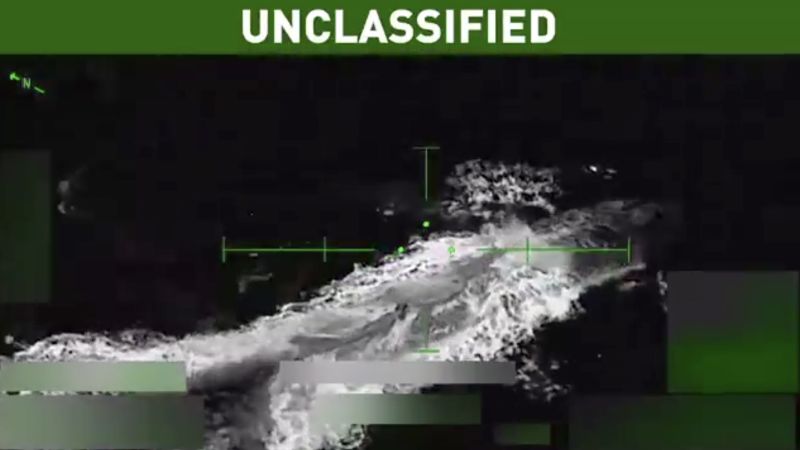
The United States military has launched a series of strikes against alleged drug boats in the Caribbean Sea and eastern Pacific Ocean, resulting in the deaths of 87 individuals across 23 vessels. In these strikes, at least five survivors have emerged from the water, raising significant concerns regarding the treatment of these individuals. The varied responses to their situations have prompted scrutiny from lawmakers and human rights advocates.
On September 2, 2023, a strike by US forces reportedly left two survivors clinging to the wreckage of their boat after an initial attack. These individuals were killed in a follow-up strike ordered by Adm. Frank “Mitch” Bradley, who commanded the operation. This decision has sparked allegations that the US military may have violated international law, which prohibits targeting individuals who are “hors de combat,” or unable to fight due to injury or surrender.
Bradley defended his actions during a closed-door meeting with lawmakers, explaining that the second strike aimed to destroy the remains of the vessel, which he believed still contained cocaine. He argued that allowing the survivors to float could potentially enable them to resume drug trafficking. Critics, including Sarah Harrison, a former associate general counsel at the Pentagon, have expressed serious concerns about the legality of this decision. Harrison stated, “They’re breaking the law either way… if somebody is ‘hors de combat’ and no longer able to fight, then they have to be treated humanely.”
The contrasting treatment of survivors became evident in subsequent operations. Following an October 16 strike on a submarine alleged to be carrying narcotics, two survivors were rescued and returned to their home countries of Ecuador and Colombia. According to a US official, these men were the only survivors after their vessel sank, and they were found on life rafts, devoid of access to any drugs.
Secretary of Defense Pete Hegseth explained that handling of survivors adhered to established protocol, asserting that the circumstances surrounding the October 16 strike were distinct from earlier operations. Hegseth indicated that the survivors from the submarine strike posed no immediate threat, allowing for their rescue. “We didn’t change our protocol, it was just a different circumstance,” he stated.
The treatment of survivors also raises legal implications for the US military. Detaining these individuals could have led to complications regarding their legal status, particularly given the uncertainty surrounding the military’s authority to hold them.
In another incident on October 27, 2023, a strike on four boats resulted in the death of 14 crew members, with one survivor reported. The Mexican Navy was informed by the Pentagon about the possibility of a survivor, prompting a search operation. However, three days after the attack, Mexican President Claudia Sheinbaum stated there was “no new information” on the survivor, who is now presumed dead. The Pentagon had initially not included this individual in its casualty count, a decision that has since been reversed.
The pace of US strikes has notably slowed, with the most recent attack occurring on December 4, 2023, following a gap of 19 days. Hegseth acknowledged this reduction in activity but maintained that the US military’s campaign against drug trafficking will continue. “We’ve only just begun striking narco boats,” he affirmed, emphasizing the ongoing commitment to combat drug trafficking in the region.
As the situation develops, lawmakers are calling for greater transparency and adherence to international law in the US military’s operations. The ongoing scrutiny highlights the complexities of military engagement in drug enforcement and the implications for human rights and legal standards.