
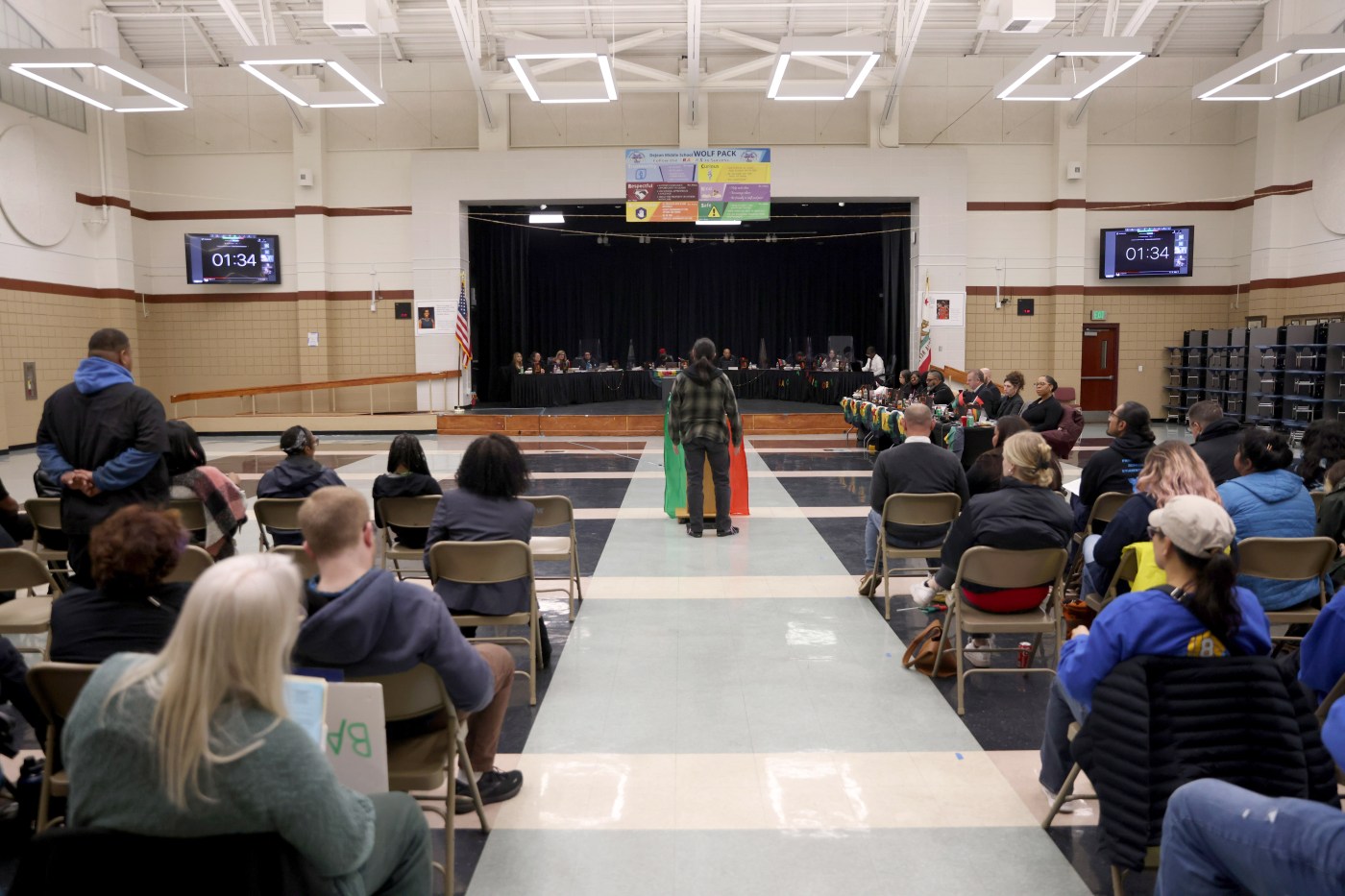
UPDATE: Millions in budget cuts are set to impact the West Contra Costa Unified School District as officials confront a staggering $127 million deficit. The Board of Education made urgent decisions during a meeting on Wednesday, marking a critical moment for students, staff, and families in Richmond.
With a projected $60.4 million in reductions for the fiscal year 2026-27, the district plans to merge middle schools, reduce staffing, and draw from reserve funds. Board President Guadalupe Enllana emphasized the importance of stabilizing district finances while still supporting the educational needs of the community. “Taking action now allows us to maintain local control and make these decisions with community voices at the table,” Enllana stated.
The cuts will see nearly $23 million taken from reserve and retiree benefit funds, along with $5.1 million in material and service reductions, $15.1 million from staffing attrition, and $17.3 million from departmental restructuring. Another $27.2 million in cuts is anticipated for fiscal year 2027-28, further straining resources.
The district’s challenges are compounded by declining enrollment, currently at 24,792 students, down from 28,247 pre-pandemic levels. Associate Superintendent Katherine Acosta-Verprauskus acknowledged the personal stakes involved, stating, “The impacts of all of these concepts are real and they’re deeply personal for our students, our staff and our families.”
Criticism arose during the meeting, as Trustee Jamela Smith-Folds questioned the approval of new contracts with the United Teachers of Richmond and Teamsters Local 856, which included an 8% raise. “Board members knew that yes votes for the contracts would lead to layoffs, campus mergers, and other cuts,” she asserted. “We have to make opportunities out of chaos now. There is no choice.”
Students voiced their concerns as well, highlighting the value of programs like music and arts. Richmond High School student Bella Mariscal passionately stated, “Without music I would not have found my confidence, my community or myself.” Her remarks underscored the emotional impact of potential program cuts, urging the board to consider the long-term effects on student development.
In response to the impending financial crisis, the district plans to utilize $4 million from Proposition 28, a state tax dedicated to supporting arts in schools. However, this may lead to difficult decisions for school administrators regarding which programs to retain.
Historically, the West Contra Costa Unified School District has struggled with financial management, having previously declared bankruptcy and required a $28.5 million state bailout in 1991. Despite repaying the loan in 2012, the district has faced ongoing challenges with budgetary constraints.
To address the fiscal crisis, board members have agreed to temporarily revive a contract review committee, aimed at scrutinizing spending and exploring options like renewing Measure T, a 2016 parcel tax generating $9.8 million annually. Future state budget allocations for special education and community schools may also play a crucial role in mitigating financial pressures.
As discussions continue, community members stress the need for transparency and collaboration in decision-making. Jason Lau, Principal of Betty Reid Soskin Middle School, emphasized, “I just hope that whatever happens, our community… is well taken care of.”
With the district facing these urgent challenges, the local community is left grappling with uncertainty about the future of education in West Contra Costa. Immediate action from district leaders will be crucial in shaping the next steps for the students and families they serve.