
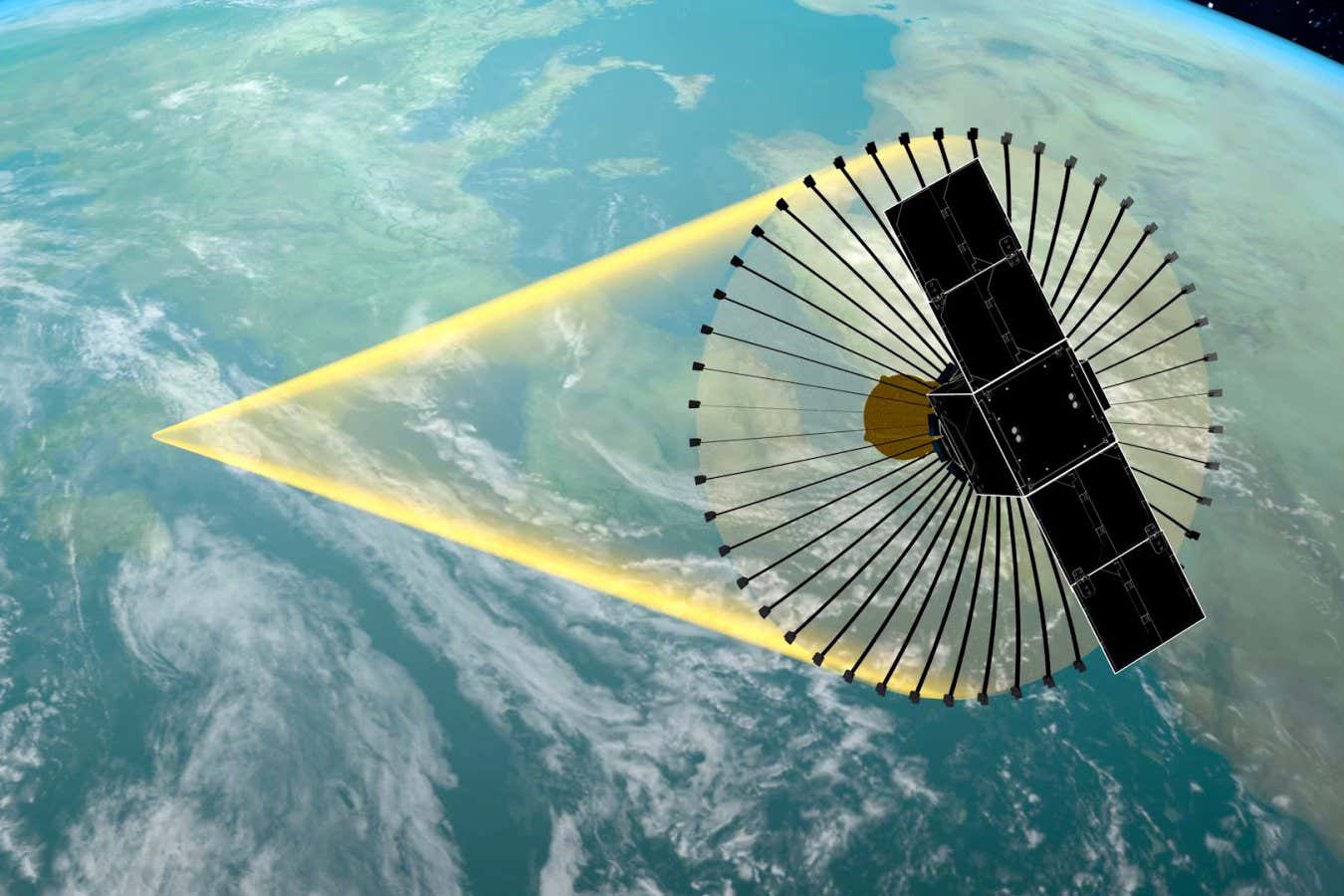
A new satellite, known as CarbSAR, is set to launch from the UK on March 2024, equipped with a cutting-edge mesh radar antenna. Developed by Oxford Space Systems (OSS) in collaboration with Surrey Satellite Technology Limited (SSTL), CarbSAR aims to capture high-resolution images of Earth’s surface, even in challenging weather conditions.
The innovative antenna is produced using a machine typically found in textile factories. According to Amool Raina, production lead at OSS, “It’s a very standard, off-the-shelf industrial machine used for knitting jumpers. All we’ve done is add some bells and whistles to let it stitch our special yarns.” This unique approach allows for the creation of a radar system that is both lightweight and efficient.
CarbSAR’s antenna is made from an ultra-fine tungsten wire coated in gold. The machine produces long sheets of mesh fabric, which can be cut and assembled into a parabolic dish. When deployed, this design allows the satellite to capture images of objects as small as 50 cm, making it capable of identifying military vehicles, such as tanks and planes.
Innovative Design and Launch Preparations
The satellite features a groundbreaking design that enables it to collapse to a diameter of just 75 cm for launch. The carbon-fibre ribs of the antenna are wound radially around a central hub, resembling coiled tape measures. This wrapped-rib design is crucial for reducing the volume of the 140-kilogram CarbSAR satellite during its ascent. Once in orbit, the stored strain energy will allow the ribs to extend and the mesh to form the dish needed for radar imaging.
Sean Sutcliffe, chief executive of OSS, emphasized the importance of precision during the unfurling process: “But for the imaging we want to do, we also need to unfurl with precision – to get that perfect parabolic shape.” Testing results have shown that the mesh sheets maintain their shape to within a millimetre of the ideal configuration.
The demand for small radar satellites is on the rise, particularly due to their ability to operate under various weather conditions and at night. This capability has garnered significant interest from military organizations globally, especially in light of the ongoing Russia-Ukraine war.
Reinvigorating UK’s Space Industry
Historically, the UK has faced challenges in competing with international space radar advancements. The launch of CarbSAR, along with the planned Oberon constellation for the UK Ministry of Defence (MoD), represents an opportunity for British aerospace engineers to reclaim their position in the space technology sector. This constellation is part of a broader program named ISTARI.
Andrew Cawthorne, managing director of SSTL, noted the growing interest from foreign governments in the radar technology being developed. “Obviously, the first thing we need to do is deploy this antenna and prove we can take an image,” he stated.
The significance of CarbSAR is further highlighted by Major General Paul Tedman, commander of UK Space Command, who remarked, “CarbSAR is a testament to the innovation and collaboration of one of the UK’s most forward-thinking space companies.” UK Space Command is keenly monitoring the mission, looking forward to integrating CarbSAR’s advanced capabilities into the Oberon programme and the wider ISTARI satellite initiative.
As CarbSAR prepares for its launch, attention will be focused on its performance and the potential impact it could have on global satellite surveillance capabilities.