
Ukrainian and European officials have firmly dismissed allegations from Moscow claiming that Ukraine launched a drone attack targeting Russian President Vladimir Putin‘s residence this week. These assertions come at a critical moment, as they could potentially disrupt ongoing peace negotiations led by the United States as the new year approaches.
On Monday, Russian Foreign Minister Sergei Lavrov alleged that Ukraine attempted to strike Putin’s residence located in the northern Novgorod region using a swarm of drones. Lavrov indicated that this incident would prompt Moscow to reassess its negotiating stance. Nevertheless, a report from the Wall Street Journal revealed that U.S. national security officials had determined that Ukraine did not target Putin or his residences during any drone strike. This assessment was reportedly corroborated by the CIA, which also found no evidence supporting Moscow’s claims.
President Donald Trump, who initially expressed sympathy towards Russia’s accusations, stated that Putin had informed him about the alleged drone strike and appeared “very angry.” However, by Wednesday, Trump seemed to adopt a more skeptical view, sharing an opinion piece from the New York Post that accused Russia of obstructing peace efforts in Ukraine.
Ukraine has categorically denied the allegations, labeling them as part of a Russian disinformation campaign aimed at creating divisions between Kyiv and Washington after a recent meeting between Trump and Ukrainian President Volodymyr Zelenskiy. In a briefing paper circulated to European Union delegations, Ukraine suggested that the Russian claims were intended to “sabotage” the agreements reached during the South Florida discussions.
Reactions from EU Officials and Independent Verification
On Wednesday, Kaja Kallas, the EU’s chief diplomat, characterized Russia’s accusations as “a deliberate distraction.” She emphasized that unfounded claims from an aggressor, responsible for the indiscriminate targeting of Ukraine’s infrastructure and civilians, should not be accepted. As of now, there has been no independent confirmation of the alleged attack on Putin’s residence.
The situation highlights the ongoing battle for narrative control surrounding the conflict in Ukraine, which has now persisted for nearly four years. Kurt Volker, a former U.S. ambassador to NATO and special representative for Ukraine negotiations during Trump’s first term, asserted, “There is no evidence” suggesting that Putin seeks peace or desires Ukraine’s success, directly contradicting Trump’s recent statements following his conversation with the Russian leader.
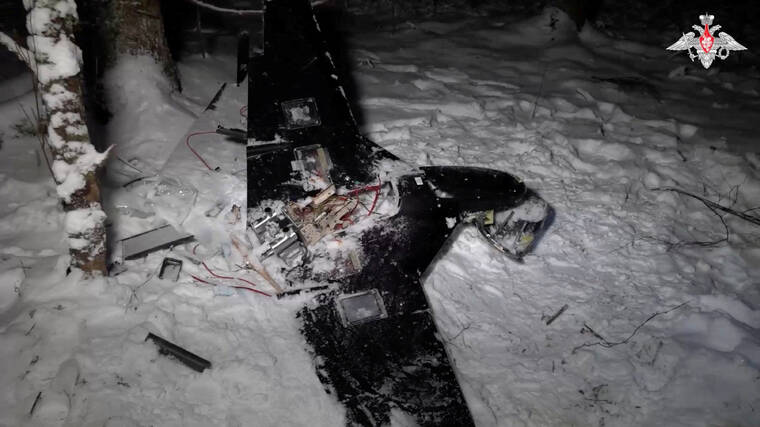
The Russian defense ministry responded by releasing video footage purportedly showing details of the alleged attack. Major General Alexander Romanenkov described how Ukrainian forces supposedly targeted Putin’s residence, presenting footage of a downed drone. Ukraine’s foreign ministry dismissed this footage, asserting strong confidence that no attack took place.
Before the allegations were made, Novgorod Governor Alexander Dronov stated that air defenses and fighter jets were engaged in intercepting Ukrainian drones, but there was no indication of any attack on Putin’s residence during that time.
Concerns Over Coordination and Intelligence Assessments
Trump speculated that the alleged attack could have been a Russian false flag operation, although he has sometimes accepted controversial statements from Putin without scrutiny. Earlier in the year, Trump echoed claims from the Russian leader regarding encircled Ukrainian forces, despite U.S. intelligence contradicting those assertions.
Further complicating the narrative, Western intelligence officials have suggested that Russia may be attempting to delay punitive measures from Washington, intended to push Moscow towards a peace agreement. The extent of the U.S. intelligence community’s assessment regarding the alleged attack has yet to be determined, as Reuters has been unable to establish whether relevant findings have been shared with Congress.
In the briefing paper, Ukraine noted the synchronized public statements made by various Russian officials shortly after the alleged incident, suggesting a high level of pre-coordination. Additionally, local residents near Putin’s Novgorod residence reported to media outlets that they heard no air defense activity on the night in question.
The Russian defense ministry has provided conflicting accounts of the supposed drone attacks. In a statement, it claimed interception of 89 long-range Ukrainian drones within a specific timeframe, including 18 over the Novgorod region. However, further statements later indicated that 91 drones, allegedly all targeting Putin’s residence, had been intercepted, including 41 over Novgorod.
As diplomatic tensions continue to rise, the situation remains fluid, and the implications of these allegations could impact the ongoing dialogue surrounding peace in the region.