
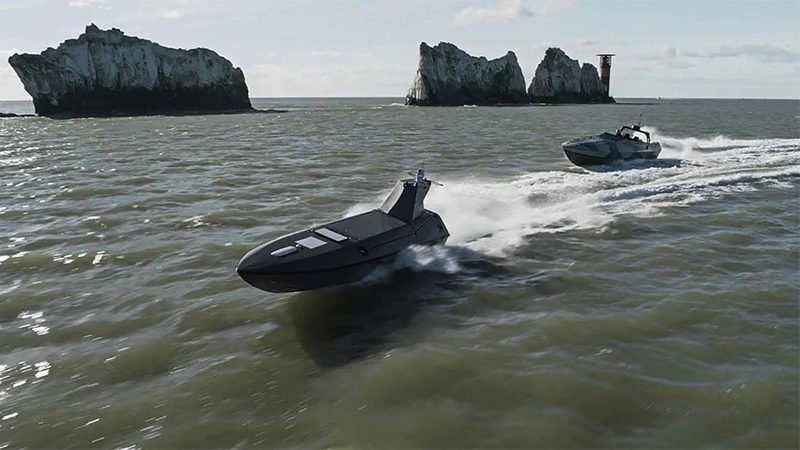
The United Kingdom’s Royal Navy has announced plans to enhance its maritime capabilities by purchasing 20 K3 Scout Medium Unmanned Surface Vessels (USVs) from Kraken Technology Group. This acquisition aims to bolster operational safety and effectiveness, particularly in light of recent geopolitical tensions, including Iran’s closure of the Strait of Hormuz.
On November 22, 2023, the Royal Navy confirmed that these USVs will be deployed by the Coastal Forces Squadron and 47 Commando Royal Marines. The vessels are intended for various operations, training, and development activities as part of the navy’s larger initiative, Project Beehive. This project seeks to establish a testing ground for future hybrid naval technologies while simultaneously providing immediate operational capabilities.
Enhancing Operational Flexibility
Second Sea Lord Vice Adm. Paul Beattie highlighted the potential for the Beehive capability to function alongside existing crewed and uncrewed systems. This could include applications in mine hunting and other maritime operations. While specific deployment scenarios, such as assisting in mine-clearing operations in the Strait of Hormuz, have not been confirmed, a Ministry of Defence spokesperson did emphasize the operational flexibility that the K3 USV offers.
“For operational security reasons, specific payloads will not be discussed. However, the flexibility of the K3 allows rapid integration of a large number of different payloads, providing operational flexibility for the Royal Navy,” the spokesperson stated.
The K3 Scout can operate over Beyond Visual Line of Sight Communications Systems or local mesh networks, facilitating both independent missions and collaborative operations with crewed units. The vessels will be deployable from various platforms, including Type 31 and Type 26 vessels, allowing commanders to select the optimal capabilities for their missions.
Specifications and Training
The K3 Medium USV measures 8.4 meters (27.5 feet) in length and can support a maximum displacement of 2,500 kg (5,511 lbs.). Capable of reaching speeds of up to 55 knots and operating at distances up to 650 nautical miles, the vessel can carry a payload of 600 kg while being adaptable for various missions, including logistics, search and rescue, and intelligence, surveillance, and reconnaissance (ISR).
As part of the rollout, personnel from the Royal Navy and Royal Marines are currently undergoing training in preparation for the operational deployment of these vessels within the coming months. Kraken Technology Group has previously collaborated with the Ministry of Defence on numerous exercises and has recently been awarded a contract worth up to 49 million USD by the US Special Operations Command for its K4 Manta system.
This strategic move towards unmanned surface vessel technology aligns with the vision articulated by First Sea Lord Gen. Sir Gwyn Jenkins during his address at the DSEI expo in London in September 2023. He emphasized the Royal Navy’s transformation into a “new hybrid navy” that will feature a digitally connected fleet of crewed and uncrewed platforms.
This investment reflects the Royal Navy’s commitment to modernizing its operations and enhancing maritime security in a rapidly changing global landscape.