
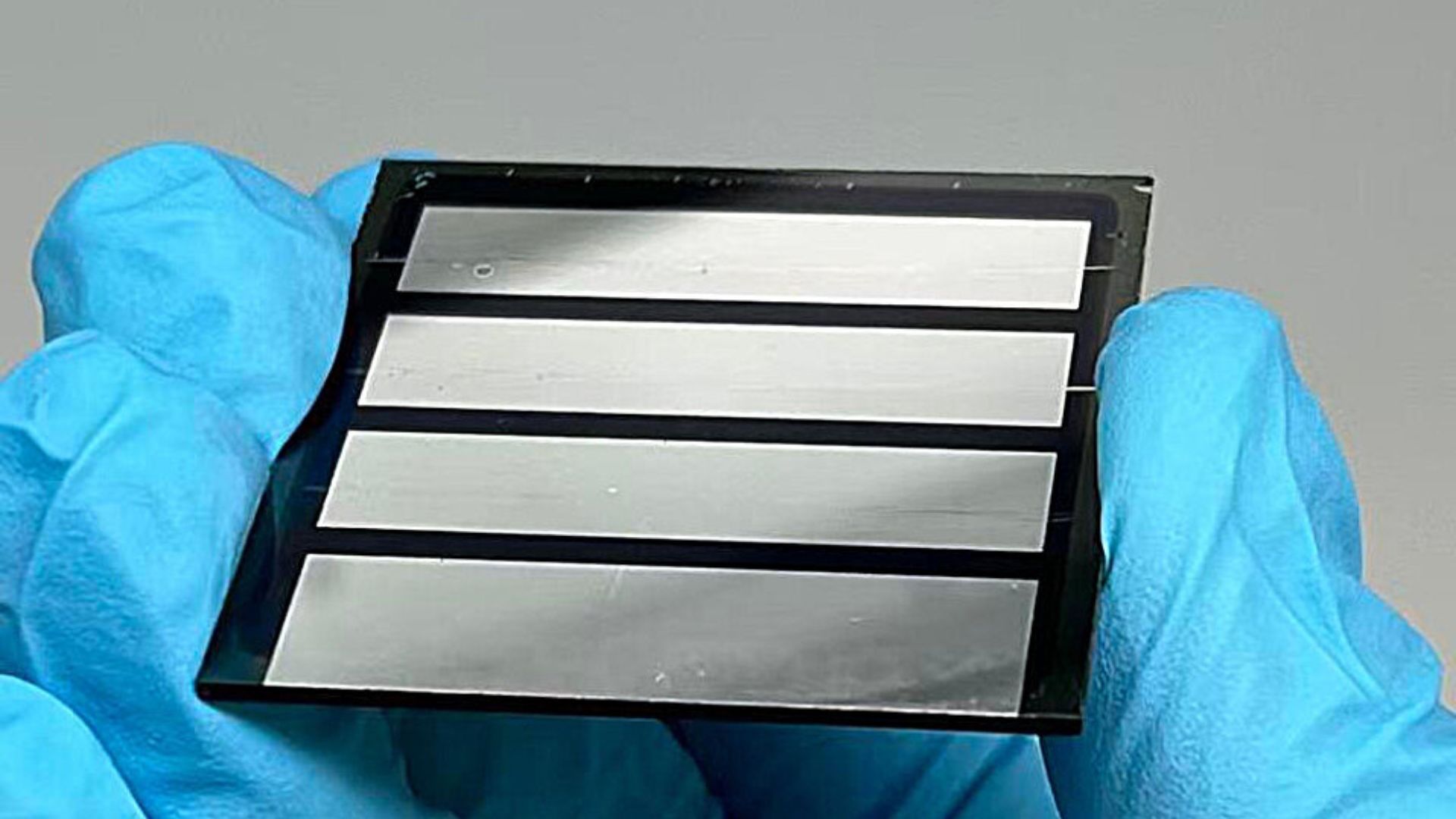
Researchers at the University of Manchester have developed a new generation of perovskite solar cells capable of retaining over 95% efficiency after extensive testing. Led by Professor Thomas Anthopoulos, this breakthrough could significantly enhance the viability of perovskite technology in the global renewable energy market. The cells, which achieved a power conversion efficiency of 25.4%, are designed to withstand extreme temperatures, marking a critical advancement for this promising alternative to traditional silicon solar panels.
Perovskite solar cells have long been recognized for their potential due to their lightweight and flexible properties. However, their widespread adoption has been hindered by rapid degradation and stability issues. The newly developed cells incorporate a novel molecular glue that smooths the surface and eliminates microscopic defects that previously plagued earlier models.
Enhancing Stability and Performance
Historically, perovskite cells have struggled with instability under heat and light exposure, often degrading in just a few days. This rapid deterioration has kept them from reaching commercial viability. Professor Anthopoulos explained the challenges, stating, “Current state-of-the-art perovskite materials are known to be unstable under heat or light, causing the cells to degrade faster.”
The research team addressed these concerns by employing small-molecule ligands that create a protective seal across the solar cells. This innovation not only smooths the surface but also organizes the material into stable, low-dimensional layers. The result is a structural shield that maintains efficient energy flow while preventing degradation under high temperatures.
Testing has shown that these stabilized perovskite solar cells retain more than 95% of their performance after 1,100 hours of continuous operation. More impressively, they remain stable at temperatures up to 85°C (185°F), a level that would have caused previous iterations to fail.
A Broader Impact on Renewable Energy
The implications of this development extend beyond just improved efficiency. The enhanced durability of perovskite cells could revolutionize how solar technology is integrated into various applications. Their lightweight and flexible nature allows for potential uses on curved surfaces, such as windows, and even in wearable technology.
Professor Anthopoulos noted, “The amidinium ligands we’ve developed, and the new knowledge gained, allow the controlled growth of high-quality, stable perovskite layers. This could overcome one of the last major hurdles facing perovskite solar cell technology and ensure it lasts long enough for large-scale deployment.”
The race to commercialize perovskite technology is gaining momentum, with innovative methods emerging globally. For instance, researchers in China have introduced a three-dimensional electrical imaging technique that allows for the direct observation of charge-carrier migration in perovskite films. This advancement could further help identify and eliminate hidden defects, enhancing overall material performance.
The study detailing these findings was published in the journal Science on January 8, 2025. As researchers continue to refine perovskite technology, the potential for a more efficient, cost-effective solar solution appears increasingly promising, heralding a new era in renewable energy.