
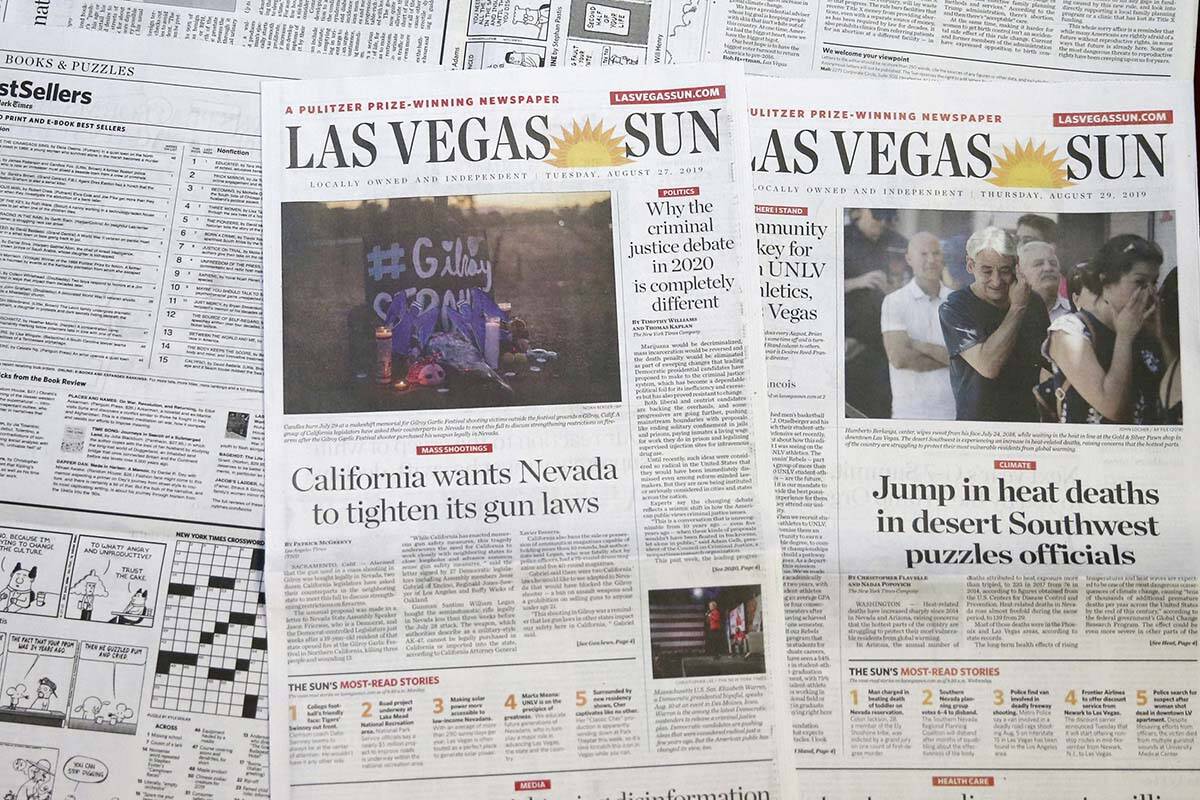
The U.S. Supreme Court has declined to hear an appeal from the Las Vegas Sun, effectively upholding a previous ruling that favored the Review-Journal in a long-standing dispute over their joint operating agreement (JOA). The court’s decision on October 30, 2023, affirms an August ruling by a three-judge panel from the 9th U.S. Circuit Court of Appeals, which found the JOA to be “unenforceable” due to a lack of necessary approval from the U.S. attorney general as mandated by the Newspaper Preservation Act.
This legal skirmish centers on the 20-year-old agreement that allowed the Review-Journal to publish a separate section for the Sun. The appellate panel ruled that the arrangement was illegal because it was never signed by the attorney general, nullifying its enforceability. The Supreme Court’s decision means the case will return to the 9th Circuit, which previously directed the lawsuit back to the U.S. District Court in Las Vegas for further proceedings.
Ben Lipman, chief legal officer of the Review-Journal, expressed satisfaction with the Supreme Court’s decision, stating, “We never thought there was any basis for the Sun to ask the Supreme Court to review and overturn the 9th Circuit’s well-reasoned opinion.” He added that the parties are now closer to resolving the lengthy and costly litigation.
Background of the Joint Operating Agreement
The joint operating agreement between the Review-Journal and the Sun originated in 1989, when the Sun was facing financial difficulties and was on the brink of closure. At that time, both newspapers produced separate morning editions. Under the 1989 agreement, the Sun transitioned to an afternoon publication from Monday to Friday and became a section within the morning Review-Journal on weekends and holidays.
In 2005, the two newspapers negotiated a new agreement, which eliminated the Sun’s status as an independent newspaper entirely, incorporating it as a daily section within the Review-Journal. The situation took a legal turn in 2017 when the Sun filed an antitrust lawsuit against the Review-Journal, alleging a breach of the JOA stemming from the Review-Journal’s claims that the Sun had failed to meet quality standards.
The lawsuit revealed critical issues during the discovery phase, including the fact that the 2005 agreement had never been formally approved by the U.S. Department of Justice. According to the Newspaper Preservation Act, any joint operating arrangement requires prior written consent from the attorney general to be considered lawful.
Implications and Future of the Agreement
In 2024, U.S. District Judge Anne R. Traum denied the Review-Journal’s motions to dismiss the case and dissolve a preliminary injunction that upheld the terms of the JOA. The Review-Journal then appealed, and the 9th Circuit judges, including Daniel P. Collins, Lawrence VanDyke, and Salvador Mendoza Jr., ruled in favor of the Review-Journal, declaring the 2005 JOA unenforceable.
David Singer, counsel for the Review-Journal, emphasized the significance of the Supreme Court’s decision, asserting, “The Sun’s entire case was premised on claims that the RJ breached the 2005 JOA. Now it is finally settled that the 2005 JOA is void and can never be enforced against the RJ.” This ruling effectively dismantles the Sun’s claims, indicating that the agreement, originally set to expire in 2040, is nearing its conclusion.
The Las Vegas JOA stands as the last of its kind in the United States. At its peak, there were nearly 30 such agreements across the country, aimed at preserving multiple print newspapers and their editorial diversity. These arrangements typically combined business and production functions while keeping editorial operations independent.
Review-Journal Publisher Keith Moyer commented on the evolving media landscape, stating that the days of limited competition among print newspapers have ended. “JOAs began at a time when print newspapers had little if any competition other than each other. Those days, as everyone knows, are long gone,” Moyer said.
As the media industry continues to pivot towards digital platforms, the implications of this ruling may resonate far beyond the courtroom, signaling a significant shift in how local news is produced and delivered. This ongoing story will continue to develop as further legal proceedings unfold.