
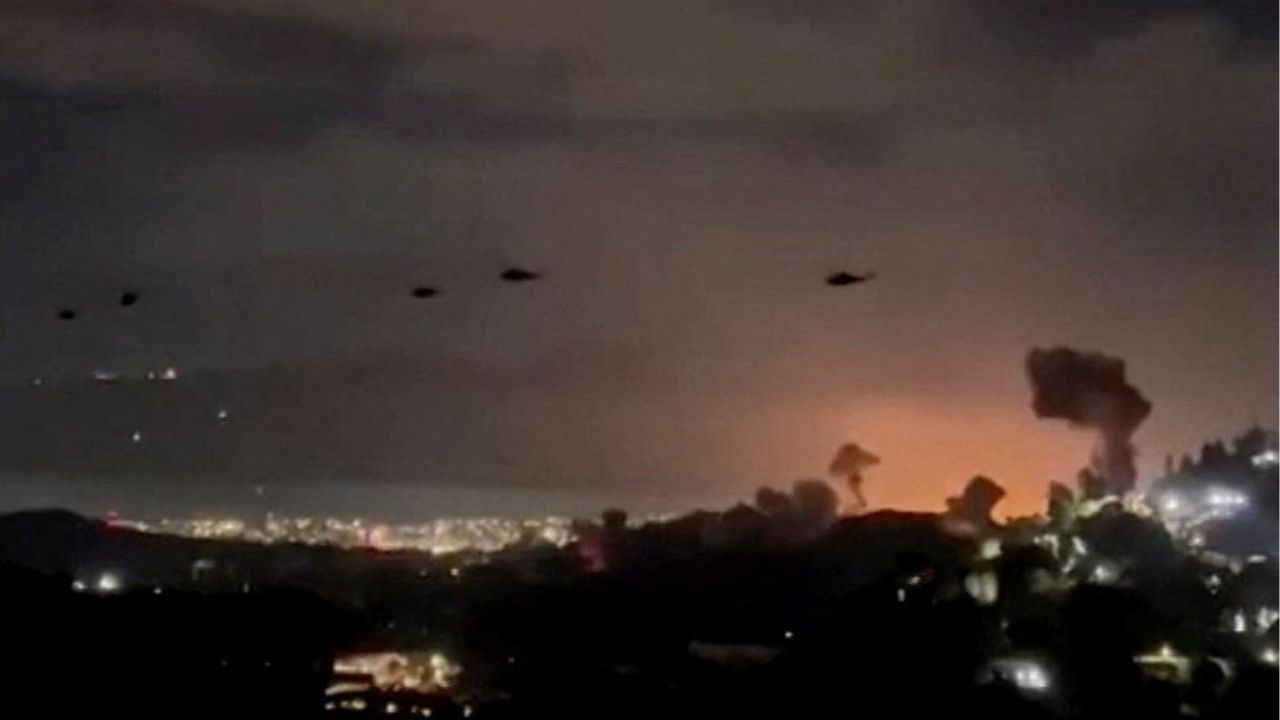
The United States conducted a military operation on March 2, 2024, resulting in the capture of Venezuelan President Nicolás Maduro. This operation marks the most significant U.S. intervention in Latin America since the 1989 invasion of Panama. President Donald Trump described the action as “one of the most stunning, effective and powerful displays of American might and competence in American history” during a press conference at his Mar-a-Lago resort in Florida.
Trump announced that Maduro is now in custody, stating that U.S. officials will take control of Venezuela until a “safe, proper and judicious transition” can occur. He emphasized the need to prevent a successor who may not prioritize the interests of Venezuelans.
Uncertain Future for Venezuela
Despite the dramatic operation that disrupted electricity in parts of Caracas and captured Maduro, the U.S. forces currently lack control over the country. Maduro’s government appears to remain in place, raising questions about governance and stability in the aftermath of his removal. Venezuelan Vice President Delcy Rodriguez, who is seen as the likely successor, was reported to be in Russia, although this claim has been disputed by Moscow as “fake.”
The uncertainty surrounding the leadership in Venezuela has heightened concerns about a potential power vacuum in a country of approximately 28 million people. Trump’s intervention echoes similar U.S. actions in the past, which have often resulted in prolonged conflicts.
The operation also brings to mind the challenges faced by the U.S. in Afghanistan and Iraq, where regime change led to significant turmoil. The U.S. has accused Maduro’s government of running a “narco-state” and manipulating the 2024 elections, allegations that Maduro has vehemently denied, asserting that the U.S. aims to seize control of Venezuela’s vast oil reserves.
Mixed Reactions in Venezuela and Abroad
As dawn broke in Venezuela following the operation, the streets remained relatively calm. Some military personnel were observed patrolling, and small pro-Maduro gatherings formed in Caracas. Yet, there were also voices of relief among citizens. Carolina Pimentel, a merchant from Maracay, expressed her joy, stating, “I doubted for a moment that it was happening because it’s like a movie.”
Official reactions from Venezuela have been critical of the U.S. intervention. Defense Minister Vladimir Padrino released a video message asserting, “In the unity of the people, we will find the strength to resist and to triumph.” While several Latin American governments have opposed Maduro, the direct involvement of the U.S. has reignited memories of past interventions, which are generally met with skepticism and opposition from regional governments and populations.
Trump’s actions revive the historical context of the Monroe Doctrine, which claimed U.S. influence over the region, and the “gunboat diplomacy” associated with early 20th-century interventions. Allies of Venezuela, including Russia, Cuba, and Iran, condemned the military action, with Tehran calling for the U.N. Security Council to address what it termed “unlawful aggression.”
Amidst these developments, international responses have varied. Argentina’s President Javier Milei praised the newfound “freedom” in Venezuela, while Mexico condemned the operation. Brazil’s President Luiz Inacio Lula da Silva criticized the intervention as crossing “an unacceptable line.”
As the situation evolves, the implications of this intervention will be closely watched both in Venezuela and around the world.