
Recent findings from two major scientific experiments have shed light on why matter exists in the universe, despite predictions that matter and antimatter should have annihilated each other after the Big Bang. The experiments, conducted by the NOvA collaboration at Fermilab in Illinois and the T2K experiment in Japan, combined their results for the first time, revealing insights into the elusive particles known as neutrinos.
According to Tricia Vahle, a professor of physics at William & Mary and co-spokesperson for the NOvA collaboration, understanding neutrinos is crucial to answering the question of why matter survived. Neutrinos, often described as “ghost-like” particles, are produced through fusion reactions in the sun. Vahle recalls her initial exposure to neutrinos in high school, when scientists were puzzled by the apparent deficit of these particles reaching Earth, leading to what was termed the “solar neutrino problem.”
Neutrino Oscillation and Experimental Collaboration
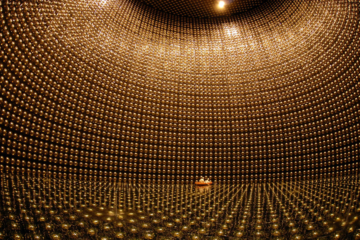
The two experiments focus on a phenomenon called neutrino oscillation, where neutrinos change their identity as they travel. Through their collaborations, scientists have discovered that neutrinos can transform from one flavor to another over long distances. The NOvA experiment fires an intense beam of neutrinos from Fermilab, traveling through the Earth to a detector in Ash River, Minnesota, while the T2K experiment sends a neutrino beam 295 kilometers from Tokai to the Super-Kamiokande detector.
Vahle emphasized the importance of combining results from both experiments, stating that they measure neutrino oscillations in different ways, utilizing distinct detectors, travel distances, and energy levels. This collaboration enhances their understanding of neutrinos beyond what either team could achieve individually.
The recent joint analysis, which incorporated data spanning six years from NOvA and eight years from T2K, has provided the most precise measurement to date regarding the mass differences among neutrinos. However, two potential scenarios remain: if the neutrinos follow an inverted mass order, they could break a fundamental rule known as charge-parity symmetry, which might explain the dominance of matter over antimatter. Conversely, if they follow a normal mass order, the role of neutrinos in addressing this asymmetry remains uncertain.
Future Directions for Neutrino Research
As the collaboration continues, Vahle anticipates ongoing efforts to gather new data and integrate upcoming neutrino experiments. She remarked, “Nature is revealing that our current models of nature are lacking. We are learning something new, something that we got wrong, and that will lead us to think about the problem in different ways and come up with new solutions.”
This groundbreaking research, published in the journal Nature in October 2023, not only advances the field of particle physics but also holds the potential to reshape our understanding of the universe’s origins. With more than 250 scientists and engineers involved in the NOvA collaboration and over 560 members in T2K, the international effort underscores the significance of collaborative scientific inquiry in addressing some of the most profound questions about existence.