
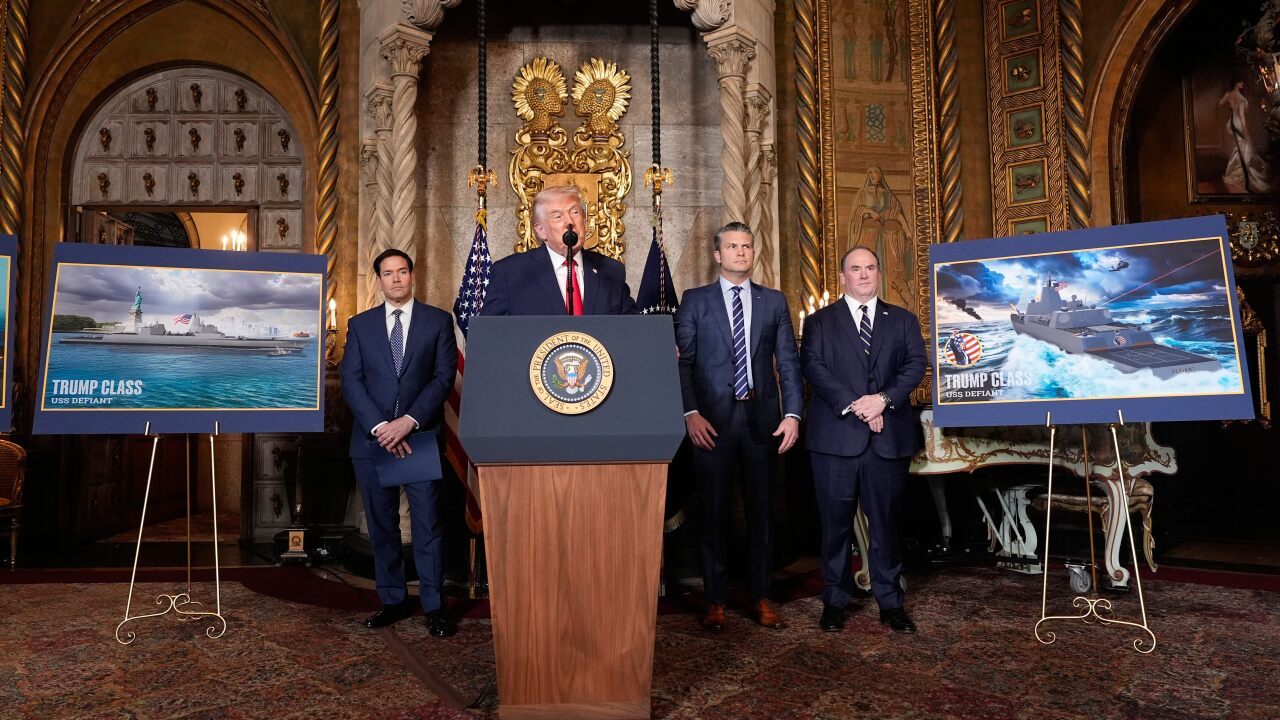
President Donald Trump has announced a transformative initiative for the U.S. Navy, proposing the construction of a new class of warships named the “Trump class.” This ambitious project, which includes the first ship to be called the USS Defiant, aims to redefine naval capabilities with advanced technology. During the announcement at his Mar-a-Lago resort in Florida, Trump emphasized that these vessels will be the “fastest” and “largest” ever built, boasting a power level he claims will exceed that of any battleship in history.
The proposed battleship is set to surpass the World War II-era Iowa-class ships in size and armament. Trump highlighted that the new vessels will be equipped with hypersonic missiles, nuclear cruise missiles, rail guns, and high-powered lasers, although many of these technologies are still under development. The announcement follows the Navy’s recent decision to abandon plans for a smaller warship due to delays and budget issues, opting instead for a modified version of a Coast Guard cutter.
In the context of this new plan, it is important to note that the U.S. Navy has faced challenges in delivering new ship designs, with projects like the Ford-class aircraft carrier and Columbia-class submarines encountering significant delays and cost overruns. The last battleship was decommissioned in the 1990s, marking a shift away from traditional battleships in favor of more versatile naval assets.
Details Surrounding the USS Defiant
The USS Defiant is projected to be around the same size as the Iowa-class battleships but will weigh approximately 35,000 tons, significantly less than its historical predecessors. It is expected to have a crew of between 650 and 850 sailors, reflecting modern naval staffing efficiencies. The primary armament will focus on missiles rather than traditional large naval guns, aligning with contemporary warfare strategies.
Despite the grand vision behind the Trump class, the Navy has struggled to implement some of the technologies Trump envisions for the new warship. Notably, the development of rail gun technology was halted after years and substantial investment, and while laser systems have seen some progress, their deployment remains limited. The integration of nuclear cruise missiles may also present legal challenges under international non-proliferation agreements.
According to a U.S. official who spoke on condition of anonymity, design efforts for the new ship are already underway, with construction slated to begin in the early 2030s. The Navy has traditionally named ship classes after states, rivers, or notable figures, such as the Gerald R. Ford-class carriers, reflecting a historical continuity in naval naming conventions.
Trump’s Involvement and Historical Context
Both Trump and Navy Secretary John Phelan regard the Trump-class warship as a spiritual successor to the battleships of the 20th century. However, the term “battleship” historically refers to heavily armored ships designed for direct engagement, a role that has diminished in modern naval strategy. The Iowa-class battleships, weighing around 60,000 tons, were prominent during World War II but were largely retired as naval warfare evolved.
Trump’s engagement with naval modernization has sometimes clashed with contemporary practices. He has previously advocated for the return to steam-powered catapults for aircraft carriers and expressed dissatisfaction over the aesthetic condition of Navy ships. Phelan noted that Trump has personally reached out late at night with concerns about ship maintenance and design.
On a visit to a shipyard in 2020, Trump claimed to have altered the design of the now-defunct Constellation-class frigate, stating, “I said, ‘That’s a terrible-looking ship, let’s make it beautiful.'” He reiterated his desire to be involved in the design of the USS Defiant, emphasizing his belief in the importance of aesthetics in naval design.
Phelan commented that the new USS Defiant “will inspire awe and reverence for the American flag whenever it pulls into a foreign port,” reflecting a vision of naval power that resonates with Trump’s broader agenda for American military strength. With the ambitious plans for the Golden Fleet underway, the U.S. Navy is poised to embark on a new chapter in its storied history.