
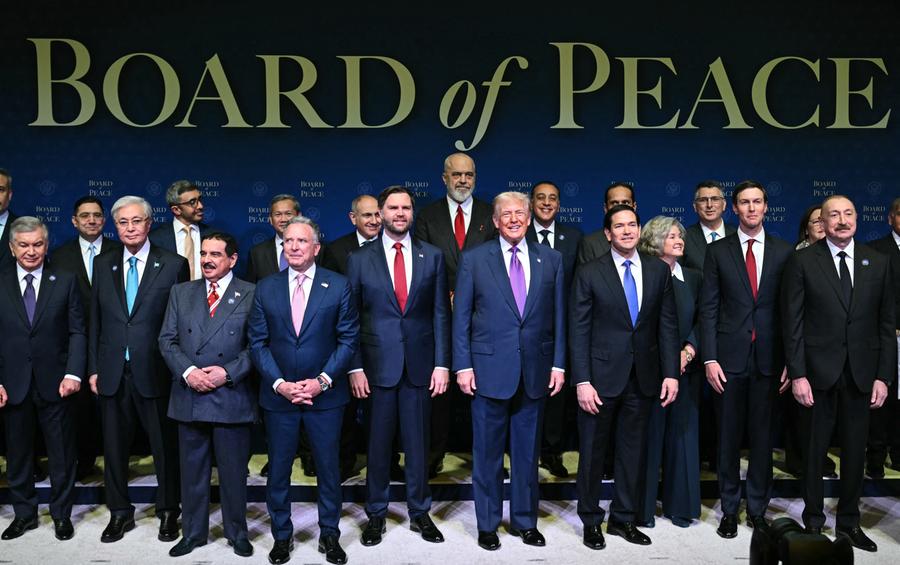
During the inaugural meeting of the US-led Board of Peace, President Donald Trump announced a significant commitment of $17 billion for the reconstruction of Gaza. The announcement, made on October 26, 2023, indicated that the United States would contribute $10 billion, while several key Arab nations would provide the remaining $7 billion. This financial support is aimed at rebuilding the region following the ousting of Hamas.
In addition to monetary pledges, Trump revealed that five nations have agreed to contribute troops to the newly formed International Stabilisation Force (ISF), which will oversee security in Gaza. The participating countries include Indonesia, Morocco, Albania, Kosovo, and Kazakhstan. Israel had previously expressed concerns regarding the ISF, particularly around the potential involvement of Turkish or Qatari troops.
Trump emphasized that the disarmament of Hamas is a prerequisite for the reconstruction process. He stated, “The IDF will not withdraw further from Gaza until this happens,” underscoring the importance of security in the region. In his extensive speech at the Board’s first summit in Washington, Trump reassured attendees, “We will help Gaza. We will straighten it out. We’ll make it successful.” He noted that the current situation is dependent on Hamas, which he described as “the only thing that’s right now standing in the way.”
Responses from Israeli Officials and Controversies
Israeli officials, including Foreign Minister Gideon Sa’ar, also addressed the audience. Sa’ar honored the memory of the 925 Israeli soldiers who lost their lives during the Gaza War and articulated Israel’s expectations for the ceasefire process. He stated that previous plans for Gaza failed because they did not address fundamental issues such as terrorism, hate, and incitement. Sa’ar insisted that any disarmament plan must encompass “all weapons, terror infrastructure, underground tunnel networks, and weapons production facilities.”
Shortly after Sa’ar’s address, a scandal erupted involving one of his coalition colleagues, far-right Member of Knesset Shimor Son Har-Melech. He was seen accompanying a group of settler activists who illegally crossed into Gaza, an action that has faced significant backlash. Since the 2005 disengagement, civilian entry to Gaza has been severely restricted, and it has been completely prohibited since the onset of the war in 2023. Har-Melech openly shared details of the crossing on social media, expressing his sentiments about re-establishing Jewish settlements in the territory.
The IDF condemned this act, citing that such crossings pose risks to soldiers. While they did not intervene to stop the group, they monitored the activists’ movements closely and later detained them upon their return to Israel.
Hamas Elections and Internal Dynamics
Meanwhile, in Gaza, Hamas is reportedly conducting long-delayed elections to select its new political leader. Since the death of Ismail Haniyeh in an Israeli strike in August 2024, the group has been managed by a five-person committee. This committee was temporarily led by Yahya Sinwar, who was also killed by the IDF shortly thereafter.
Recent reports indicate that voting is currently underway to elect a single leader, a practice typical for Hamas. The front-runners are believed to be Khaled Mashaal and Khalil al-Hayya, with key issues at stake being their respective approaches to relations with Iran and the pace of Israeli withdrawal from Gaza. Al-Hayya advocates for closer ties with Tehran and continued armed conflict with Israel, while Mashaal favors negotiated compromises and improved relations with Gulf states.
This election will determine the leader of Hamas’s political wing, which operates primarily from Qatar. The military wing, known as Gaza’s Al-Qassam Brigades, is thought to maintain a more hardline stance on the Israeli withdrawal, aligning more closely with al-Hayya’s aggressive approach. Observers have noted that previous peace negotiations faltered due to a lack of consensus between Hamas’s political leadership and its military counterparts, rather than disagreements with Israel.
As the situation evolves, both the reconstruction efforts and the internal dynamics within Hamas will significantly influence the future of Gaza.