
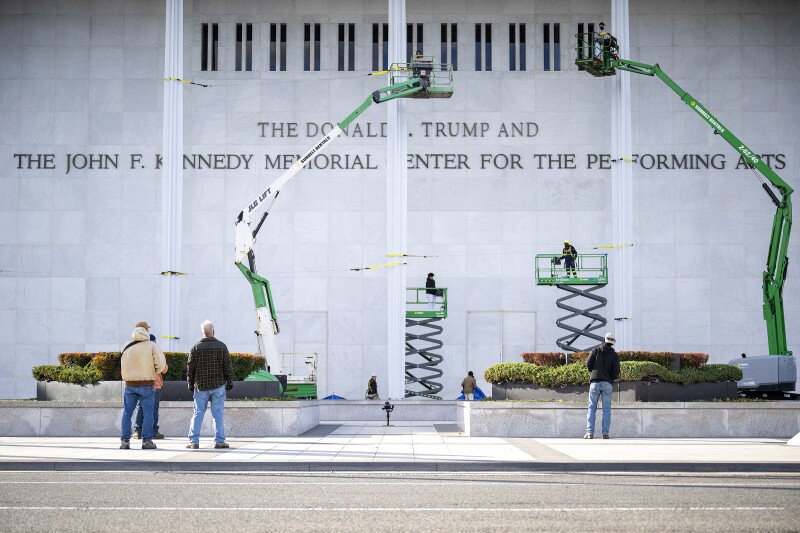
President Donald Trump has made headlines after the board of the John F. Kennedy Center for the Performing Arts, which he appointed, voted to rename the prestigious venue to include his name. The new title, “The Donald J. Trump and the John F. Kennedy Center for the Performing Arts,” has drawn sharp criticism and legal challenges. This decision raises questions about the respect and integrity of national memorials.
In a revealing Vanity Fair article, Trump’s chief of staff, Susie Wiles, expressed her belief in his unbounded authority, stating, “there’s nothing he can’t do.” This sentiment was evident as Trump’s associates swiftly executed the renaming, with large signage already in place before the supposedly unanimous vote took place. Rep. Joyce Beatty, an ex officio member of the board, attempted to voice her objections but was met with a muted microphone, prompting her to file a lawsuit to restore the center’s original name.
The board’s composition reflects a network of Trump allies, including influential figures such as Brian Ballard, a prominent lobbyist, and Attorney General Pam Bondi, among others. Their first order of business was to appoint Trump as chairman of the center’s board. Following this shake-up, several performances, including the acclaimed musical “Hamilton,” faced cancellations, leading to a significant drop in ticket sales. A Christmas Eve show was abruptly canceled when a performer refused to participate, highlighting the growing discontent among artists regarding the center’s new direction.
The implications of this renaming extend beyond public perception. The action appears to violate federal law concerning the Kennedy Center, which is designated as a memorial to President John F. Kennedy. Legislation stipulates that “no additional memorials or plaques in the nature of memorials shall be designated or installed in the public areas” of the center. Exceptions for major donors do not extend to this situation.
Maria Shriver, niece of John F. Kennedy, criticized the move on social media, emphasizing her uncle’s legacy of supporting the arts. She stated, “He brought the arts into the White House and he and my Aunt Jackie amplified the arts, celebrated the arts, stood up for the arts and artists.”
The renaming is part of a pattern of actions by Trump that some view as an alarming display of vanity. During his presidency, he has made headlines for other self-referential initiatives, including a pharmaceutical plan dubbed “Trump Rx” and the declaration of his birthday as a free admission day in national parks. He has also been criticized for plans involving military spending and other ventures that some consider self-serving.
Critics argue that Trump’s approach undermines the integrity of the office and the nation’s institutions. Allegations range from attempting to use federal funds to gain political loyalty to undermining international alliances through unpredictable tariffs and decisions. This has led to a perception that the presidency has become less a public trust and more a vehicle for personal gain.
As the legal and political ramifications of the Kennedy Center renaming unfold, there is growing concern about the broader implications for American governance and national symbols. The ability of the next president to reverse this decision remains contingent on potential court rulings or legislative action, but the situation underscores a troubling trend in the relationship between power and personal legacy in contemporary politics.