
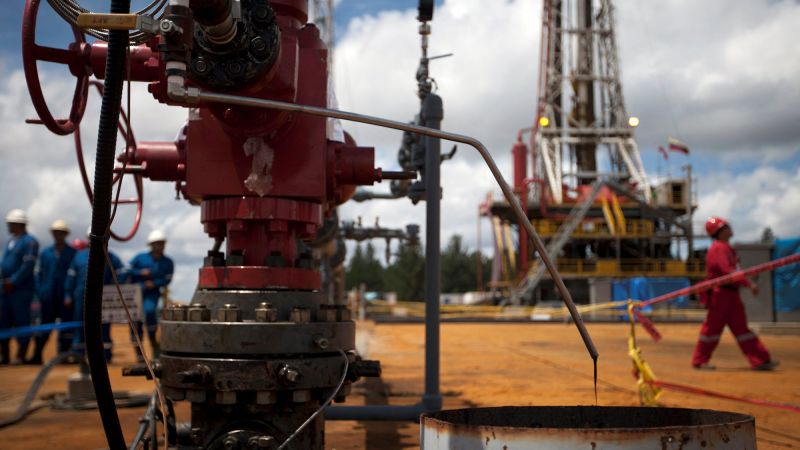
UPDATE: President Donald Trump is meeting with top oil executives today to discuss the urgent potential for U.S. companies to return to Venezuela, a country rich in oil reserves. This high-stakes gathering comes amid a week of intense negotiations aimed at revitalizing Venezuela’s beleaguered oil infrastructure.
Industry leaders are approaching this meeting with caution, expressing skepticism about investing the tens of billions of dollars needed to restore the country’s oil sector, currently facing significant volatility. Executives are expected to refrain from making firm investment commitments, citing concerns over political instability and safety risks for personnel in the region.
According to insiders, Trump and his administration have not yet provided a comprehensive plan to ensure the long-term stability necessary for such investments. “They’re making this up as they go along,” stated a source involved in the preparations for the meeting.
The oil industry recognizes the financial opportunity presented by Venezuela’s vast oil reserves but demands stringent conditions. Mike Summers, CEO of the American Petroleum Institute, emphasized the need to establish the rule of law before any substantial investment can occur. “There are going to be parameters that have to be put in place,” he said in a recent interview.
As the meeting unfolds, oil executives are pressing for clarity on how the U.S. government plans to protect their investments and personnel. The Trump administration has acknowledged the challenges but has yet to provide concrete answers. Energy Secretary Chris Wright mentioned to CNN that significant long-term investments hinge on improving Venezuela’s governance and national security.
To restore Venezuela’s oil production to pre-socialism levels, experts estimate that over $10 billion a year would be required for the next decade. This includes laying pipelines, setting up drilling rigs, and building essential infrastructure. However, with the political climate in flux, future administrations could alter the terms of investment, adding layers of risk for oil companies.
The Trump administration has indicated a willingness to lift certain sanctions as a prerequisite for U.S. oil companies to return, but strict laws governing foreign investment complicate matters. Companies must navigate a challenging fiscal regime that includes heavy royalty fees and taxes.
Moreover, past experiences have left a lasting impression on the industry. Companies like ExxonMobil and ConocoPhillips had their assets seized by Venezuela in 2007 and are still seeking billions in compensation. Observers note that any repatriation of funds will depend on a stable political and economic environment in Venezuela.
The administration has floated the idea of government-backed financing and political risk insurance to encourage investment. However, the effectiveness of these measures remains uncertain. As Dan Pickering, founder of Pickering Energy Partners, noted, “US government backstops could speed things up, but it’s very unclear if these will be offered.”
Despite the hurdles, there is significant interest from oil companies, with Wright stating he has been “barraged” with inquiries about Venezuela’s potential. Industry experts agree that if the right conditions are established, Venezuela could once again attract substantial investments due to its massive oil reserves.
As the meeting progresses today, all eyes will be on the outcome and whether Trump can convince oil executives that the risks are worth taking in Venezuela’s unpredictable landscape. The implications of this meeting could reshape the future of energy production in both Venezuela and the U.S., making it a pivotal moment for the industry.
Stay tuned for updates on this developing story as it unfolds.