
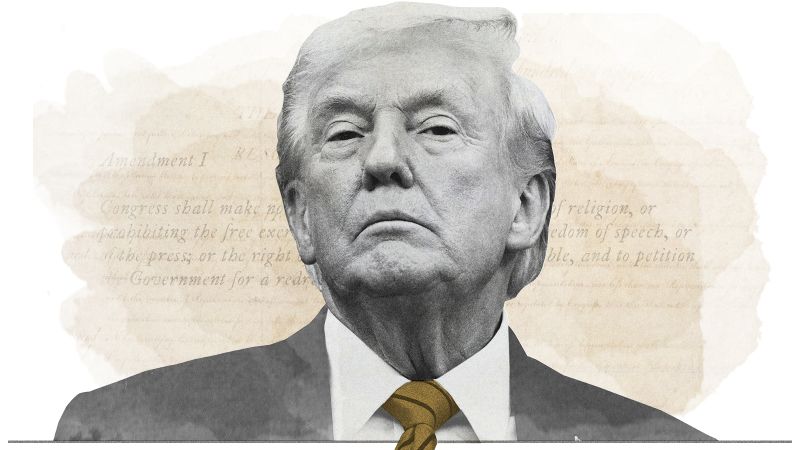
In recent years, former President Donald Trump has repeatedly tested the boundaries of the First Amendment, raising concerns among civil rights advocates and critics alike. Following his return to the White House, Trump claimed he had “brought free speech back to America.” Yet his administration has taken numerous actions that some argue undermine these fundamental freedoms, including targeting individuals and organizations that opposed him.
The First Amendment guarantees the freedom of religion, speech, and press; the right to peaceful assembly; and the right to petition the government for grievances. It also prohibits the government from enacting laws that restrict the free exercise of these rights. Despite this, the Trump administration has employed executive orders, lawsuits, and posts on Truth Social to challenge dissenting voices.
In a notable recent action, Trump filed a defamation lawsuit against the BBC in a Florida federal court. Legal experts characterize the suit as weak, suggesting it may be more about stifling criticism than seeking justice. This is not an isolated incident. Concerns have also arisen regarding the Federal Communications Commission (FCC) chair’s remarks in a recent hearing, where he implied that the agency lacked independence, prompting alarm among lawmakers.
Many of Trump’s initiatives have faced judicial challenges, resulting in several setbacks for his administration. However, some organizations have capitulated under pressure. For instance, ABC, owned by Disney, temporarily suspended Jimmy Kimmel‘s show following his comments about conservative activist Charlie Kirk after a violent incident involving Kirk.
Burt Neuborne, a civil liberties professor at New York University, expressed serious concerns about the implications of these actions. He stated that the First Amendment is “undoubtedly, unquestionably” being weakened. Neuborne pointed out that the administration is attempting to intimidate Americans into refraining from exercising their First Amendment rights by threatening to deny them benefits for actions that conflict with Trump’s preferences. He warned that this could lead to a society where individuals avoid exercising their rights due to perceived costs, stating that while the rights exist, the fear of repercussions may deter citizens from using them.
The timeline of Trump’s actions raises important questions about the future of free speech in the United States. As the former president continues to challenge the status quo, civil rights advocates will likely remain vigilant in defending the fundamental freedoms that the First Amendment guarantees.