
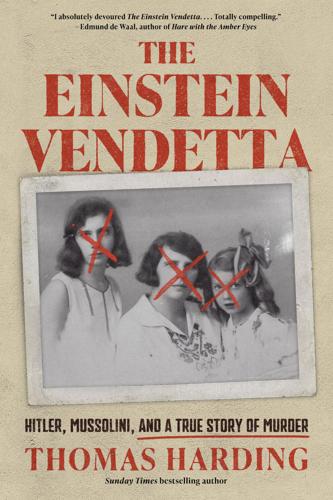
As the Allies advanced through Italy in the summer of 1944, Nazi reprisals against civilians escalated. This dark chapter in history saw the German military commit atrocities against innocent people in retaliation for partisan actions. Among the tragic incidents was the targeted killing of three members of the Einstein family, a case recounted in Thomas Harding’s latest book, The Einstein Vendetta: Hitler, Mussolini, and a True Story of Murder.
Harding, known for his previous work The House by the Lake, embarks on a challenging investigation into this grim event, highlighting the struggles to bring those responsible to justice. The narrative centers on Albert Einstein’s family, who became victims not merely because of their Jewish heritage, but specifically due to their connection to the world-renowned physicist, who had fled Germany after Adolf Hitler’s rise to power.
Albert Einstein, who grew up in Munich, had a close relationship with his first cousin, Robert Einstein, who remained in Italy. Robert, an engineer married to Italian Christian Nina Mazzetti, lived with their two daughters in a villa known as Villa Il Focardo. Despite the enactment of anti-Jewish laws under Benito Mussolini in 1938, the family initially experienced little immediate impact. It was not until the German invasion of Italy in September 1943 that their situation became precarious.
With news of Jews being rounded up, Robert and Nina faced a difficult decision. They chose to stay at their villa, surrounded by loyal staff and extensive farmland, rather than flee into a perilous unknown. However, on the morning of August 3, 1944, soldiers from the elite Hermann Göring Division arrived at their door, demanding to see Robert.
While Nina could truthfully say her husband was away, she later led the soldiers into the woods in a desperate attempt to protect him. Following this encounter, the Germans returned, breaking down the villa’s door. They imprisoned Nina, her daughters Luce and Cici, along with several relatives and staff, before separating the women from the rest.
The tragic culmination occurred that evening when the women were executed in the villa’s salon. Nina, aged 58, was shot alongside her daughters, aged 27 and 18. Once the massacre was complete, the Germans set fire to the villa and departed, leaving devastation in their wake.
Two days later, British soldiers liberated the area. Robert Einstein, wracked with grief, met a partisan soldier who later recounted his despair, believing he was responsible for his family’s fate. “He was convinced that he was responsible for his family’s end,” the soldier recalled.
In September 1944, Major Milton Wexler of the War Crimes Commission was assigned to investigate the killings. Harding notes that this was unusual, considering the relatively small number of victims compared to larger massacres, such as the one at Sant’Anna di Stazzema, where 560 Italians died. The reasons behind this investigation remain unclear, though Harding suggests a possible direct request from Albert Einstein himself.
The investigation into the murders did not yield substantial results. Robert Einstein, still mourning his family, tragically took an overdose of sleeping pills in 1945. Over the years, inquiries have identified several soldiers who may have participated in the killings, but definitive accountability has remained elusive.
By the mid-1950s, only thirteen Germans had been convicted for war crimes in Italy, highlighting the chaotic aftermath of the conflict and the challenges in addressing such heinous acts. Harding’s The Einstein Vendetta serves as a poignant reminder of the relentless pursuit of Nazi ideology, leading to the sorrowful end of a family connected to one of history’s most significant figures.
While the book may not provide all the answers, it sheds light on the enduring hope among surviving family members that the names of their loved ones’ killers will eventually be revealed, even eight decades later.