
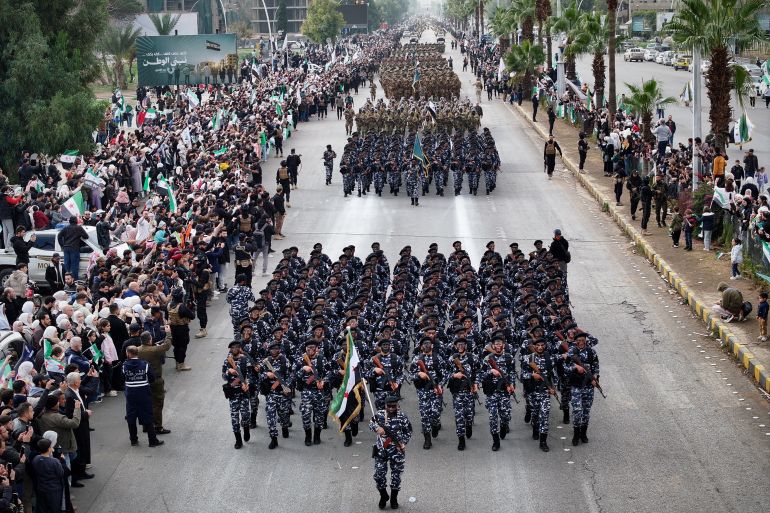
UPDATE: Syria’s interim government is urgently working to rebuild its armed forces following the December 8, 2024 collapse of Bashar al-Assad’s regime. The newly appointed Defence Minister Murhaf Abu Qasra announced significant restructuring and recruitment efforts during a military ceremony in Aleppo, emphasizing the need for a national army focused on loyalty to the country.
“We started the process of restructuring our military… to build an army that represents Syria,” Abu Qasra stated, pledging to enhance military preparedness and discipline. However, analysts warn that the road ahead is fraught with difficulties, including the challenge of integrating various armed groups into a cohesive, professional military force.
The new administration has initiated the recruitment of tens of thousands of soldiers, but the rapid pace raises concerns about proper vetting. Many young men, aged 18-23, are seeking these positions due to a lack of economic opportunities after years of conflict and sanctions. Samy Akil, a nonresident fellow at the Tahrir Institute, highlighted the delicate balance needed to maintain security amid this recruitment surge.
In the early hours following al-Assad’s departure, Israel conducted widespread airstrikes, claiming to have destroyed 80 percent of Syria’s military capabilities. Over the past year, Israel has attacked Syria more than 600 times, leaving the new government with a severely weakened military infrastructure.
President Ahmed al-Sharaa has dissolved the former army and merged several anti-Assad factions, including Hay’at Tahrir al-Sham, which boasts around 40,000 fighters. The Ministry of Defence is now tasked with overseeing the Syrian Armed Forces, while the Ministry of Interior manages internal security. This consolidation marks a critical step in the effort to stabilize the nation, but the integration of foreign fighters into the military remains contentious, as Western powers have warned against their inclusion in key positions.
As the new Syrian Army welcomes approximately 3,000 regime-era soldiers back into its ranks, significant gaps in leadership persist. Analysts estimate that around 70,000 Alawite officers from the previous regime are unlikely to return, leaving a vacuum of experienced military personnel.
International dynamics are also shifting, with Syria’s relations transforming post-Assad. The new government has garnered support from countries previously opposed to al-Assad, including Saudi Arabia and Qatar. In a significant diplomatic move, al-Sharaa recently visited the White House, indicating a warming of ties with the United States.
Despite this support, the Syrian military remains heavily reliant on Russian equipment and doctrine, posing challenges for its operational independence. Rob Geist Pinfold, a scholar at King’s College London, noted that Syria’s security forces must navigate complex relationships with both Russia and the U.S. as they seek to enhance their military capabilities.
As the situation develops, Syria faces the urgent task of building domestic legitimacy and trust. Reports of sectarian violence involving security forces have eroded confidence among minority communities, complicating the integration of the Kurdish-led Syrian Democratic Forces (SDF) into the national military framework.
The coming months will be crucial as Syria works to unify its armed forces and prevent fragmentation that could lead to renewed civil strife. Analysts warn that without a cohesive military structure, the nation risks ongoing insecurity and potential conflicts among various armed factions.
As developments unfold, the international community will closely monitor Syria’s efforts to establish a stable and effective military, with implications for regional security and foreign investment. The time for decisive action is NOW as Syria strives to overcome its formidable challenges in rebuilding its armed forces.