
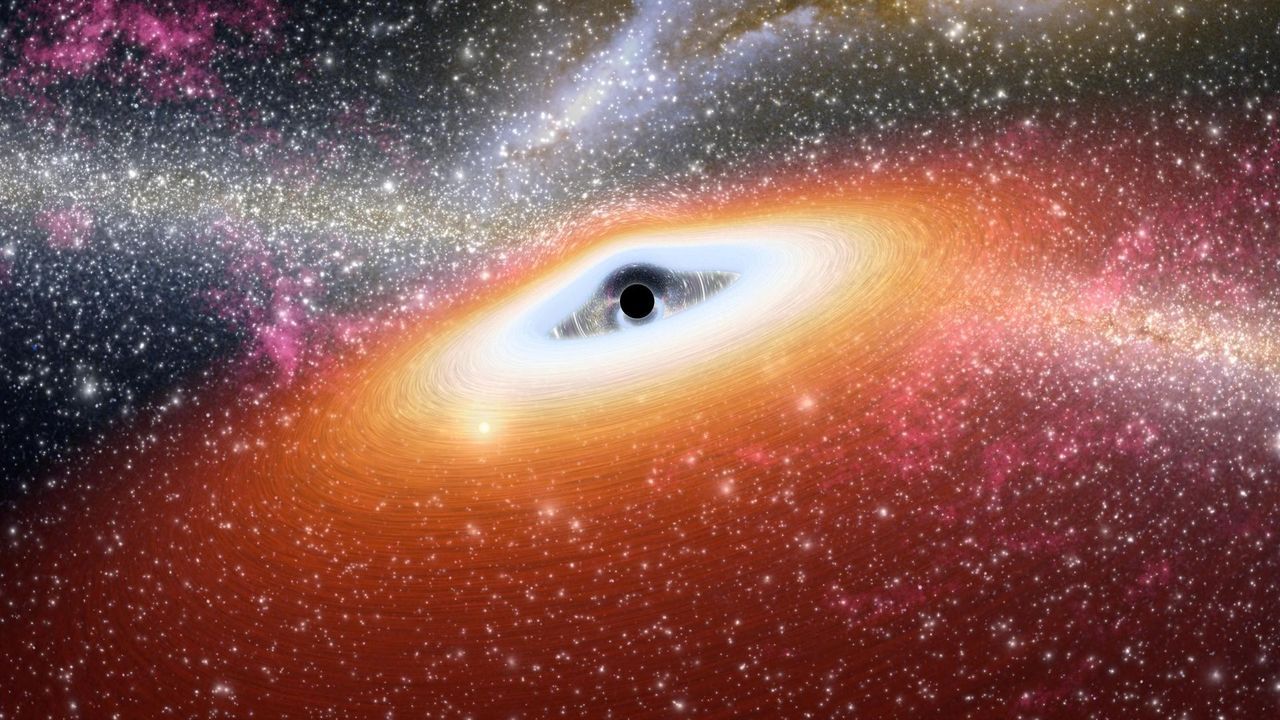
UPDATE: A pivotal moment in science history is being revisited as new insights into Stephen Hawking’s groundbreaking 1974 paper challenge our understanding of black holes. Published on March 1, 1974, in the journal Nature, Hawking’s work proposed that black holes are not the eternal prisons once thought but can emit radiation and ultimately evaporate.
The implications of Hawking’s theory, known as Hawking radiation, suggest that black holes lose mass over time, raising urgent questions about the fate of information that enters them. This revelation disrupts the long-held belief that information is permanently lost, a concept that violates the fundamental laws of quantum mechanics.
In his paper titled “Black hole explosions?“, Hawking illustrated how pairs of “virtual” particles form at the event horizon of a black hole, allowing one particle to escape while the other gets trapped. He noted that these particles could lead to what he termed “explosive” evaporation, describing it as equivalent to approximately 1 million 1 megaton hydrogen bombs.
Hawking’s findings have triggered intense debate within the scientific community, particularly regarding the information paradox. For decades, researchers, including Hawking himself, have grappled with the implications of his theories. In a 2015 lecture, he indicated that information could escape black holes through wormholes, a statement that reignited interest in the field.
Recent developments from the James Webb Space Telescope suggest that primordial black holes, formed by quantum fluctuations shortly after the Big Bang, might still exist. These could provide crucial evidence for Hawking’s theories and the possibility of detecting black hole explosions.
As scientists continue to explore the cosmos, the urgency to understand black holes grows. Researchers are now investigating whether the information consumed by black holes can leave detectable traces in gravitational waves. This could revolutionize our approach to astrophysics and deepen our comprehension of the universe.
Hawking’s legacy, rooted in his 1974 paper, remains a cornerstone of modern physics, and the quest to unravel the mysteries of black holes continues. As we stand on the brink of potential breakthroughs, the question remains: can we truly uncover what lies within these enigmatic cosmic giants? Stay tuned for more updates as research unfolds.