
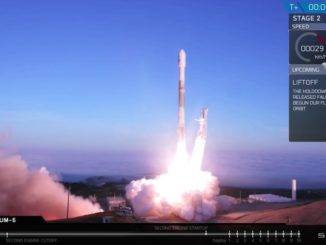
SpaceX is preparing to launch its Falcon 9 rocket for the Starlink 17-33 mission, marking a return to flight after a brief stand down lasting less than a week. This mission aims to deploy 25 additional Starlink satellites into the company’s growing megaconstellation in low Earth orbit, which currently comprises over 9,600 satellites, according to astronomer and orbital tracker Jonathan McDowell.
The launch is scheduled for February 7, 2024, at 09:21 PST (12:21 EST / 17:21 UTC) from pad 4E at the Vandenberg Space Force Base in California. The Falcon 9 will follow a south-southwesterly trajectory during its ascent.
Launch Details and Recovery Plans
SpaceX will utilize the Falcon 9 first stage booster with the tail number 1088 for this mission. This flight marks the booster’s 13th operational launch, which includes missions such as NASA’s SPHEREx, Transporter-12, and two batches of satellites for the National Reconnaissance Office.
Approximately 8.5 minutes after liftoff, booster B1088 will attempt to land on the drone ship ‘Of Course I Still Love You’, stationed in the Pacific Ocean. A successful landing will mark the 176th landing for this vessel and the 568th booster landing overall for SpaceX.
Return to Flight After Investigation
The return to flight comes after a rare period of inactivity for SpaceX, which saw some missions delayed. Following the launch of the Starlink 17-32 mission on February 2, 2024, SpaceX had planned to conduct the Starlink 6-103 mission shortly after. However, on the same day, the company reported an in-flight anomaly following the payload deployment.
“During today’s launch, the second stage experienced an off-nominal condition during preparation for the deorbit burn,” SpaceX stated. The company confirmed that the first two MVac burns were nominal, successfully deploying all 25 Starlink satellites to their intended orbit.
In response to the anomaly, SpaceX rolled the Starlink satellites back to its Hangar X facilities at NASA’s Kennedy Space Center. The company then prepared another booster, tail number 1101, for the upcoming Crew-12 launch set for the following week.
On February 6, 2024, the Federal Aviation Administration (FAA) announced the closure of its investigation into the incident, allowing SpaceX to resume its FAA-licensed flights. “The FAA oversaw and accepted the findings of the SpaceX-led investigation. The final mishap report cites the probable root cause as the Falcon 9 stage 2 engine’s failure to ignite prior to the deorbit burn,” the FAA stated. SpaceX has implemented technical and organizational measures aimed at preventing a recurrence of the issue, thus securing authorization for the Falcon 9 to return to flight.
This upcoming launch not only signifies SpaceX’s resilience but also reinforces its commitment to expanding global internet access through its Starlink satellite network. As the countdown to liftoff continues, the space community eagerly anticipates another milestone for the aerospace company.