
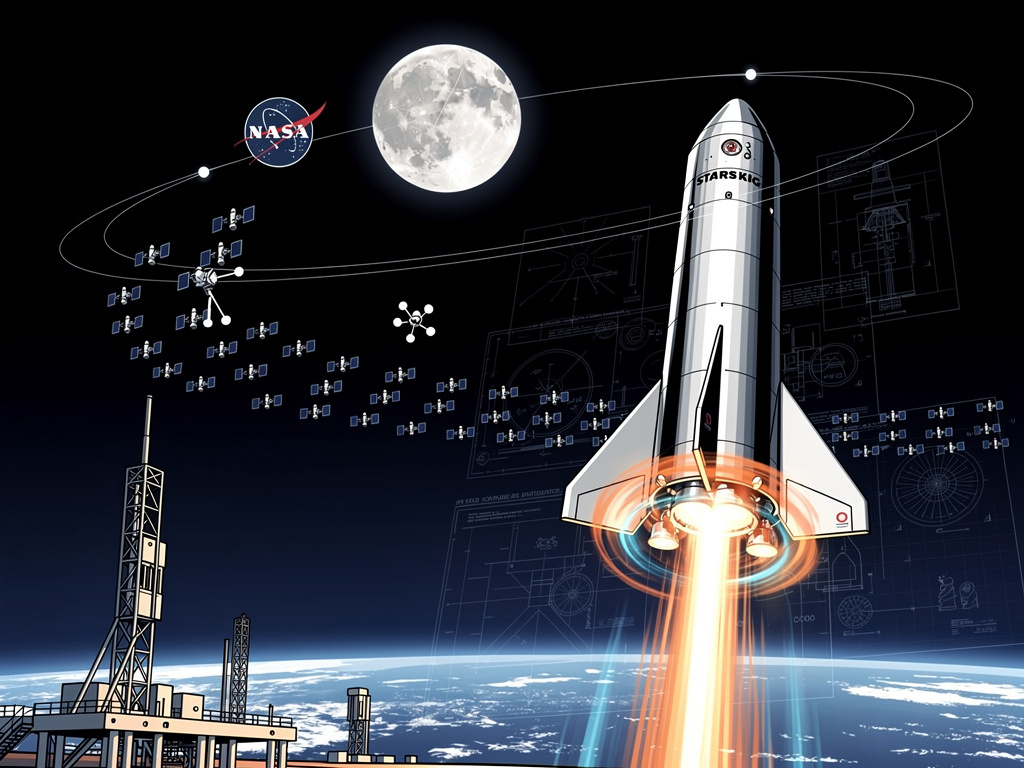
SpaceX is gearing up for its fourth integrated test flight of the Starship rocket, a critical mission that aims to demonstrate the vehicle’s capability to survive reentry. The test, set against the backdrop of the Texas coast, represents a pivotal moment not only for the company but for NASA’s lunar ambitions as well. Following a successful ascent during its third test flight in March 2023, which saw the rocket achieve orbital velocity before losing both the Super Heavy booster and Starship upper stage, this upcoming launch will focus on a controlled return to Earth.
The primary objective for this flight is to ensure that the Starship can withstand the extreme conditions of reentry. SpaceX CEO Elon Musk emphasized this goal, stating, “Main goal of this flight is to get through max reentry heating.” Achieving this would validate the rocket’s hexagonal heat shield tiles, designed to endure temperatures exceeding 2,700 degrees Fahrenheit, while also ensuring stability through its large flight-control flaps.
High Stakes for SpaceX and NASA
Success in this endeavor is crucial for various high-stakes programs. SpaceX’s ability to recover the Starship intact is integral to its business model, which relies on rapid reusability. Unlike traditional rockets, both the Super Heavy booster and the Starship upper stage are engineered for repeated use, a feature that aims to revolutionize access to space. Following this test, the company aims to refine its landing technique, first through ocean splashdowns and eventually utilizing robotic arms for precision landings back at launch facilities.
The implications of this test extend beyond SpaceX. The company holds a $2.9 billion contract with NASA to develop a lunar-optimized version of Starship for the Artemis program. This program is critical to NASA’s plans to return astronauts to the Moon for the first time since the Apollo era, with missions slated for no earlier than late 2026. Delays in SpaceX’s testing schedule could jeopardize this timeline, as NASA officials have noted the ripple effects of any hold-ups.
Regulatory Hurdles and Production Innovations
While SpaceX engineers can assemble new rockets in a matter of months at their Boca Chica facility, the launch schedule is subject to the approval of the Federal Aviation Administration (FAA). Each test flight requires a license, and any anomalies, like those experienced in the third flight, necessitate formal investigations. The FAA has recently concluded its investigation into the previous flight, allowing SpaceX to proceed with the fourth test after confirming that necessary corrective measures have been implemented.
The production strategy at SpaceX contrasts sharply with government-led aerospace initiatives, which often take years and substantial funding to develop a single vehicle. SpaceX’s assembly line approach enables the company to incorporate lessons learned from each flight into subsequent models almost immediately. This iterative process is evident in the upgraded hardware slated for the fourth flight, which includes Booster 11 and Ship 29, reflecting the company’s commitment to rapid development.
The upcoming test is not merely a technical challenge but a comprehensive evaluation of SpaceX’s engineering philosophy. A successful reentry and splashdown would signal significant progress in overcoming one of the most challenging aspects of rocket reusability. Conversely, any failure could lead to further regulatory scrutiny and delays, impacting not only SpaceX but also its partners, including NASA.
With its ambitious goals, SpaceX is on the brink of potentially transforming space travel. If it can master reusability at this scale, it could significantly lower the costs of launching payloads into orbit. Such advancements could open avenues for more extensive space exploration and even the colonization of Mars, a vision long championed by Elon Musk.
As the fourth flight approaches, all eyes will be on the Gulf of Mexico. The stakes are unprecedented, and the outcome will profoundly impact the future of not only SpaceX but the entire aerospace industry.