
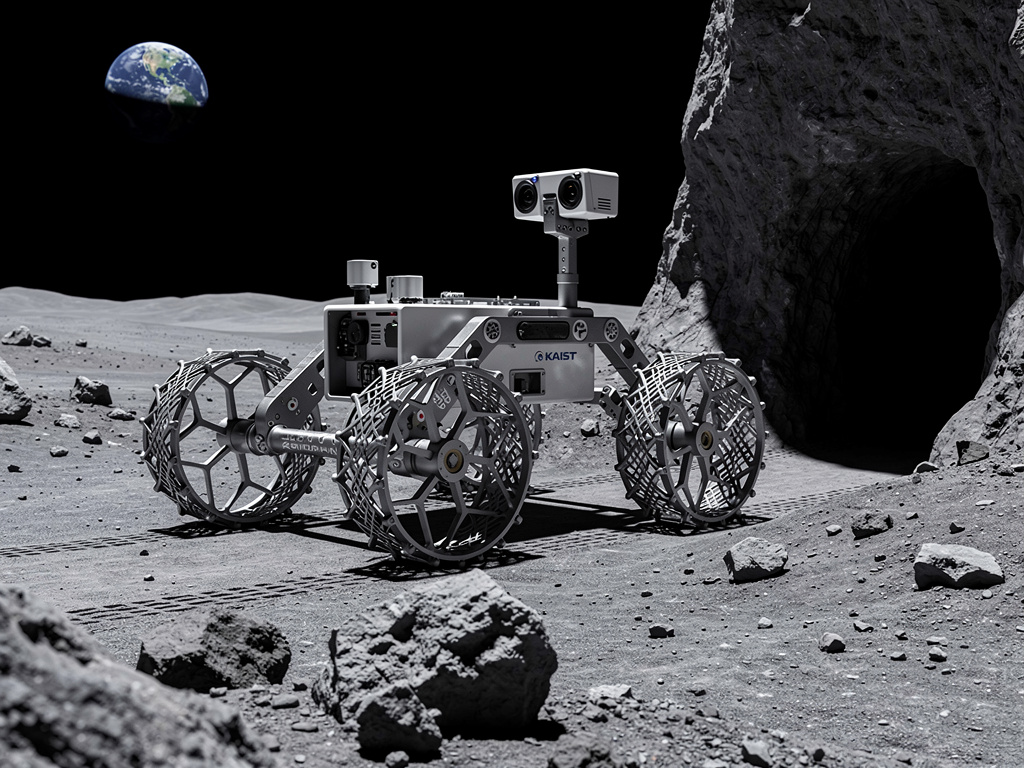
UPDATE: South Korea’s Korea Advanced Institute of Science and Technology (KAIST) has just unveiled a revolutionary lunar rover equipped with transformative wheels designed to navigate the moon’s most challenging terrains. This groundbreaking innovation, detailed in a recent study, positions South Korea as a key player in the global race for lunar exploration.
The newly developed rover features airless wheels made from interwoven carbon steel strips that can expand and contract, allowing it to maneuver through tight spaces and rugged landscapes. This capability is crucial for exploring lunar caves, which could serve as potential habitats for future human missions, shielding explorers from cosmic radiation and extreme temperatures.
With nations like the U.S. and China ramping up their lunar ambitions, KAIST’s prototype could redefine how we approach extraterrestrial environments. Researchers rigorously tested the rover on Earth, simulating harsh lunar conditions, including extreme cold and impacts from heights. Initial findings indicate that this innovative design significantly outperforms traditional rover wheels, which often struggle under lunar conditions.
The timing of this announcement is crucial for South Korea’s space program, which successfully launched its first lunar orbiter, Danuri, via a SpaceX Falcon 9 rocket in 2022. Danuri has already provided stunning images of the moon’s shadowed regions, marking a significant milestone for the country’s lunar exploration efforts.
The wheels’ unique construction is designed to absorb shocks and navigate uneven terrain while remaining robust against lunar extremes. Unlike conventional rigid wheels, KAIST’s design eliminates air entirely, reducing potential failure points. The research team notes that this innovation could be integrated into larger mission architectures, making it adaptable for future lunar missions.
As excitement grows within the space community, recent discussions on social media platforms highlight the rover’s potential for in-situ resource utilization, which could dramatically reduce the costs of lunar missions. This technology aligns with South Korea’s vision to enhance its independent space capabilities, as the nation prepares for a lunar lander launch by the early 2030s.
Industry insiders see this rover as part of a broader trend in space exploration, with South Korea actively participating in the NASA-led Artemis Accords. This collaboration could pave the way for deploying multiple smaller units to scout inaccessible areas of the lunar surface.
Despite these advancements, challenges remain. The moon’s fine dust, known as lunar regolith, poses a significant threat to mechanical systems. The unique woven structure of the rover’s wheels aims to mitigate this issue, but extensive testing in simulated lunar environments will be essential.
To validate the rover’s capabilities, KAIST researchers performed extensive trials in Earth caves, demonstrating the wheels’ ability to navigate obstacles and recover from falls, all while exposing the rover to extreme temperatures akin to lunar conditions. These tests confirm the design’s robustness and readiness for potential lunar deployment.
Looking ahead, South Korea’s space agency, KARI, is exploring integration of this rover into upcoming missions, potentially collaborating with China’s Chang’e-8 mission. This cross-border synergy underscores Asia’s rising prominence in space exploration, with South Korea emerging as a hub for innovative technologies.
The government’s recent budget request of $459 million for a robotic lander signals a strong commitment to advancing its space program. Despite recent setbacks, such as the failed orbital launch attempt by Innospace, the determination to innovate and explore remains steadfast.
As this pioneering rover prototype evolves, KAIST plans to conduct vacuum chamber tests to better replicate lunar conditions. Collaborations with NASA could further enhance the design’s maturity, potentially influencing future missions to Mars or asteroids.
The prospect of exploring the moon’s caves not only holds scientific promise but also represents a critical step toward sustainable human presence on the lunar surface. With ongoing advancements in robotic technology, South Korea’s rover may play a vital role in unlocking the moon’s secrets, paving the way for a new era of exploration.
As the global community anticipates the next steps in lunar exploration, innovations like KAIST’s morphing wheels are set to define the future of space discovery.