
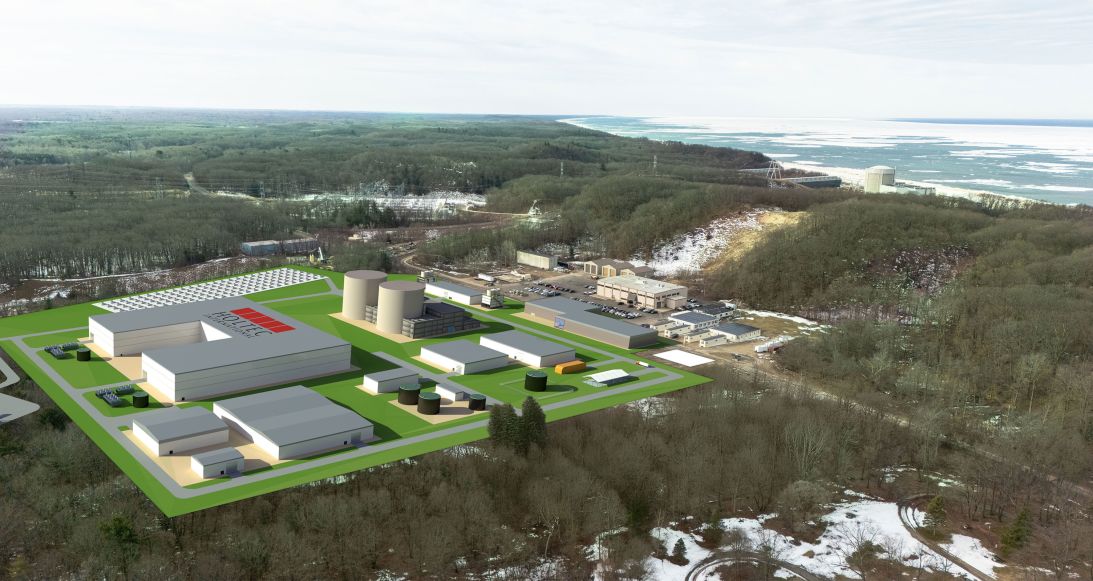
On the shores of Lake Michigan, the Palisades Nuclear Plant is poised to become a significant player in the revival of the U.S. nuclear industry. After its decommissioning in 2022 due to economic challenges, Florida-based company Holtec plans to restart the facility, marking the first time a closed nuclear plant in the United States will resume operations. This initiative aims to introduce the country’s first commercial small modular reactors (SMRs), which proponents claim could offer a safer, more economical alternative to traditional nuclear power.
The potential benefits of SMRs are attracting considerable attention. These advanced reactors promise to be cheaper and quicker to build while providing a steady supply of clean energy. As demand for reliable energy sources grows, particularly with the increasing energy needs of data centers fueled by artificial intelligence, SMRs are seen as a viable solution. Investors from the tech sector, including major companies, are already committing resources to this emerging technology.
Michael Craig, an associate professor at the University of Michigan, expressed optimism about the current landscape for SMRs, stating, “They’re in this perfect ground where there’s lots of great ideas … and they have a lot of promise and potential.” However, the enthusiasm surrounding SMRs comes with cautionary notes from experts.
While the total costs associated with SMRs are projected to be lower than those of conventional plants, they still represent a significant investment. Consequently, experts warn that the electricity generated by SMRs may not compete favorably with that produced from renewable sources like wind and solar. Currently, there are only three operational SMRs worldwide, none of which are located in the United States. The existing units include one on a Russian barge and two in China, underscoring the challenges ahead for U.S. companies.
Historically, the U.S. nuclear industry has experienced setbacks due to the economic impracticalities of building mega-projects. The shift toward larger reactors aimed to achieve economies of scale, but this often resulted in delayed timelines and increased costs. The renewed focus on smaller reactors represents a strategic pivot, with companies claiming advancements in technology and materials that could enable more cost-effective solutions.
Holtec plans to revive the Palisades facility by restarting its 800-megawatt conventional reactor while introducing two 300-megawatt SMRs produced at its factory in Camden, New Jersey. The company has initiated the licensing process with the Nuclear Regulatory Commission and aims for approval by 2029, with the SMRs expected to be operational by 2031. Holtec’s long-term vision includes building a fleet of SMRs across North America during the 2030s.
Despite the ambitious plans, skepticism remains, particularly regarding Holtec’s lack of experience in operating nuclear plants. The company has historically been involved in nuclear waste management and decommissioning. Nevertheless, Holtec asserts that its staff possesses extensive operational experience, and its technology is grounded in conventional water-cooled nuclear systems, which should facilitate the regulatory process.
Holtec is not the only player in the race to deploy SMRs. California-based Kairos Power has commenced construction on a demonstration reactor in Oak Ridge, Tennessee, with plans to initiate operations by 2028. The company is pursuing an alternative design that utilizes molten fluoride salt as a coolant, differing from Holtec’s approach. This method of iterative development—building, testing, and refining—may yield valuable insights even if it takes longer than a more conventional build-and-deploy strategy.
Significant investment from tech giants further fuels the SMR sector’s growth. In 2024, Kairos Power signed a deal with Google to establish a fleet of reactors capable of producing 500 megawatts of power, sufficient for approximately 300,000 homes. This partnership is expected to enhance manufacturing capabilities and accelerate the learning curve for producing SMRs. Other companies, such as Amazon and Meta, are also investing in various SMR projects, underscoring the sector’s growing allure.
The U.S. government is supporting this nuclear renaissance as well. The Department of Energy has allocated $800 million for the development of SMRs, with Holtec receiving $4 million as part of this initiative. Rian Bahran, deputy assistant secretary for nuclear reactors at the Department of Energy, emphasized that the deployment of advanced reactors is a priority for the current administration.
Despite the optimism, critics caution against the potential pitfalls of rushing the development of SMRs. Edwin Lyman, director of nuclear power safety at the Union of Concerned Scientists, warns that despite the influx of funding, nuclear power must remain competitive with alternative energy sources. He noted, “An SMR is still a luxury… it may be more affordable in terms of its initial price tag, but that doesn’t mean it’s producing less expensive electricity.”
The Nuclear Regulatory Commission has authorized only one SMR design to date, developed by NuScale Power. However, a project in Idaho to construct these reactors was canceled in 2023 due to rising costs and insufficient utility commitment. The cost structures of both Holtec and Kairos remain undisclosed, adding to the uncertainty surrounding their economic viability.
Fuel supply is another critical concern. Some unconventional SMR designs necessitate high-assay low-enriched uranium (HALEU), which is currently in limited supply, primarily sourced from Russia. This dependency presents a significant risk as the U.S. seeks to expand its domestic capabilities.
Safety issues are also at the forefront of discussions surrounding SMR development. The current administration’s push to streamline licensing and regulatory requirements has raised alarms among experts. While some argue that expediting processes can be done safely, others caution that it may compromise thorough evaluations. The Department of Energy maintains that it upholds the highest standards of safety in its collaboration with the nuclear industry.
As the race to bring SMRs online intensifies, the future of this technology remains uncertain. Some experts question whether SMRs can meet the urgent demand for clean power, given the long timelines involved. Others argue that investing in SMRs now could pave the way for advancements that ultimately complement renewable energy sources.
Michael Craig highlighted the importance of action in this arena, stating, “Let’s build the reactor. Let’s turn it on, and let’s see if it actually runs well.” The debate surrounding the economic feasibility and safety of SMRs continues, reflecting the broader challenges facing the nuclear energy sector in the quest for a sustainable and reliable energy future.