
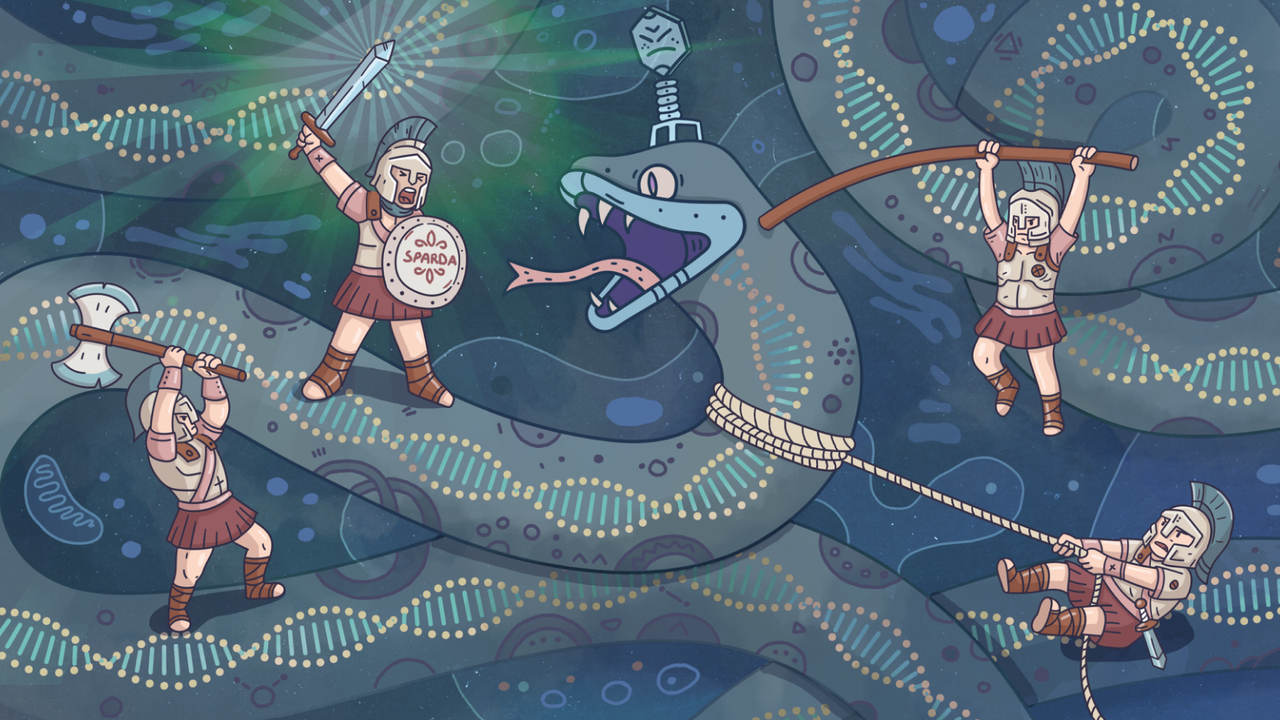
A recent study has illuminated the workings of a previously enigmatic bacterial defense system known as SPARDA (short prokaryotic Argonaute, DNase associated). The findings, published in the journal Cell Research, suggest that SPARDA could serve as a valuable tool in biotechnology, potentially enhancing existing CRISPR-based diagnostic methods.
While CRISPR has revolutionized genetic research by allowing precise gene editing, it is important to recognize that numerous natural systems offer untapped potential. Researchers, led by biochemist Mindaugas Zaremba from Vilnius University in Lithuania, have conducted comprehensive studies on SPARDA, revealing its unique mechanism of action.
SPARDA acts as a self-destruct and self-defense mechanism for bacteria, targeting foreign DNA such as plasmids and phages. Zaremba noted that this system employs a kamikaze-like strategy, where infected bacterial cells sacrifice themselves to prevent the spread of infection within the population. “SPARDA systems were demonstrated to protect bacteria from plasmids and phages by degrading the DNA of both infected cells and invaders,” Zaremba explained.
Understanding SPARDA at the molecular level posed challenges until Zaremba’s team utilized AlphaFold, an AI protein analysis tool. This technology predicts protein structures based on amino acid sequences, allowing researchers to visualize the 3D shapes of SPARDA proteins. The team focused on SPARDA systems from two bacterial species: Xanthobacter autotrophicus, a nitrogen-fixing soil bacterium, and Enhydrobacter aerosaccus, which was first identified in Michigan’s Wintergreen Lake.
By transferring the SPARDA systems into the commonly used model organism E. coli, researchers conducted a detailed molecular analysis. They discovered a vital “activating region” within the argonaute proteins, termed the beta-relay. This region functions like an electrical relay switch, changing shape in response to external threats. The reshaped proteins then form complexes that align in long, spiraling chains to degrade any encountered DNA, eliminating both the host and invaders.
Zaremba’s team further employed AlphaFold to identify beta-relays in similar proteins across different bacteria, revealing that these switches are likely a universal feature among argonaute proteins.
Beyond its role in bacterial defense, the SPARDA system holds promise for human applications. Zaremba suggests that the precision of SPARDA in recognizing foreign DNA could be harnessed for diagnostic purposes. In this context, the beta-relay could be engineered to activate only when specific genetic sequences, such as those from a virus, are detected.
Current CRISPR diagnostics face limitations, as they rely on specific DNA sequences, known as PAM sequences, to function effectively. Zaremba highlighted that SPARDA systems do not depend on these PAM sequences, positioning them as a universal adapter for future DNA diagnostics. This adaptation could enhance the flexibility and efficacy of tests aimed at detecting various pathogens.
As CRISPR research has garnered significant acclaim, including a Nobel Prize, the exploration of SPARDA is still in its early stages. Nonetheless, the insights gained from studying this bacterial system could provide crucial lessons for addressing some of the most pressing scientific questions today. The potential applications of SPARDA-derived tools in biotechnology may pave the way for breakthroughs in diagnostics and treatment strategies, marking a significant step forward in genetic research.