
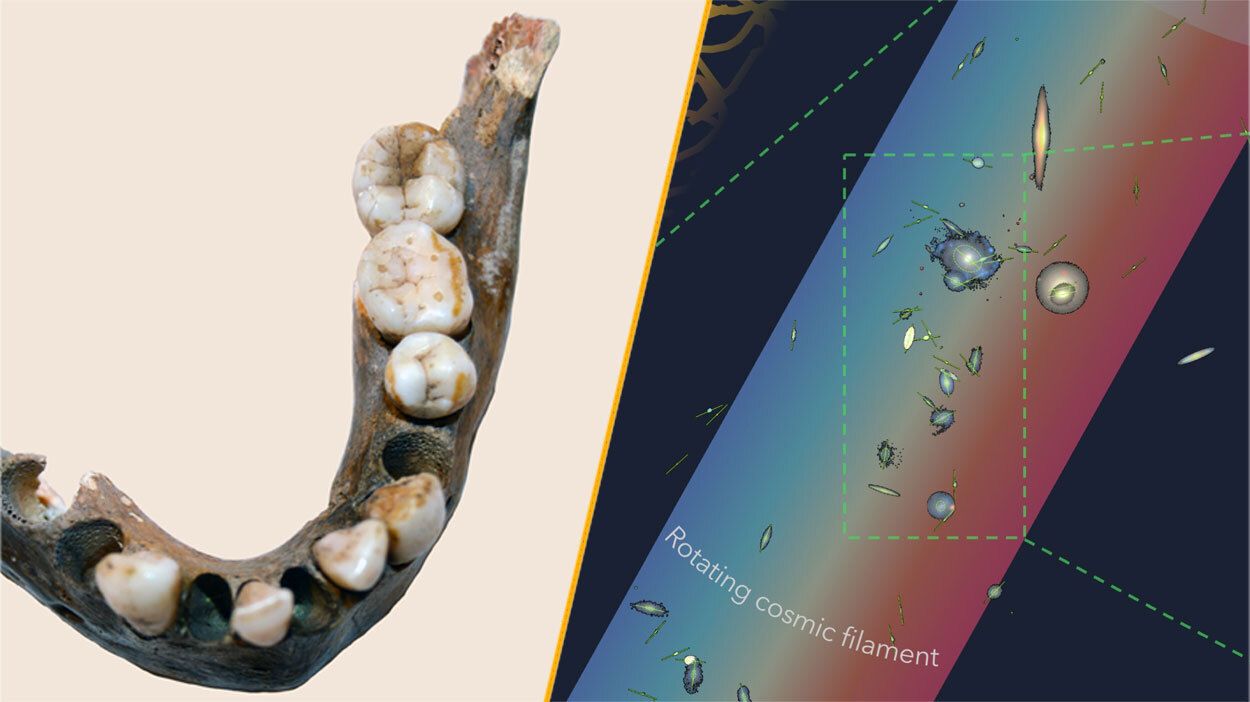
This week, significant discoveries in science have drawn attention to various aspects of our planet and the universe. Researchers uncovered a previously unknown human population that remained genetically isolated for 100,000 years, while astronomers identified the largest spinning structure ever observed in the cosmos, located 140 million light-years away. Additionally, archaeologists made intriguing finds in China and Greece, revealing insights into ancient human behavior and burial practices.
In southern Africa, a study focusing on human remains found south of the Limpopo River revealed that skeletons dating as far back as 10,000 years exhibited a strikingly different genetic makeup than contemporary humans. Researchers noted that these ancient individuals represent “an extreme end of human genetic variation.” The findings challenge existing narratives about human migration and adaptation.
Meanwhile, the cosmos has revealed remarkable phenomena. Scientists studying a cosmic filament linked to a chain of 14 galaxies discovered it to be the largest spinning object in the universe, rotating at approximately 68 miles per second (110 kilometers per second). This filament, wider than the entire Milky Way galaxy, was located through its gravitational effects on surrounding galaxies, marking a significant milestone in astronomical research.
Archaeological efforts in China have also yielded fascinating results. A massive pit filled with skulls was uncovered outside the gates of a city that thrived over 4,000 years ago. The unique finding stands out because nearly all the skulls belonged to males, deviating from typical human sacrificial patterns observed in other regional sites. This discovery has prompted questions about the social and cultural practices of ancient civilizations.
In a separate investigation, a 2,700-year-old tomb in Greece was discovered containing the remains of a woman adorned with an upside-down crown, further enriching the narrative of ancient burial customs.
Turning to contemporary issues, a large-scale environmental project in China known as the Great Green Wall has produced unexpected outcomes. Initially aimed at combating desertification through extensive tree planting, the initiative has altered rainfall and evaporation patterns across the country, resulting in reduced water levels in some densely populated regions. These findings underscore the complexities of environmental management and the need for careful evaluation of large-scale ecological interventions.
In the realm of meteorological studies, researchers are revisiting the record for the hottest temperature on Earth, set in Death Valley in 1913. New analyses suggest that human error may have played a significant role in this historic claim. Additionally, scientists warned that the collapse of a critical Atlantic current could usher in centuries of drought across Europe, raising concerns about future climate stability.
On a lighter note, interstellar comet 3I/ATLAS continues to intrigue astronomers as it displays signs of “ice volcanoes,” with spiral jets observed shooting from its surface. Observations using the Joan Oró Telescope at the Montsec Observatory in northeastern Spain revealed that the comet brightened rapidly as it neared the sun, indicating the sublimation of ice—a process familiar to other celestial bodies in our solar system.
In technological advancements, engineers at the Massachusetts Institute of Technology (MIT) have developed a groundbreaking method to extract drinking water from air, even in arid regions. The innovative technique employs sound waves to efficiently retrieve water, achieving results 45 times more effective than traditional evaporation methods. Although the device requires a power source, researchers are optimistic about integrating it with solar technology to enhance sustainability.
As the scientific community continues to advance our understanding of both ancient and modern phenomena, these discoveries highlight the ongoing quest for knowledge that shapes our understanding of humanity and the universe.