
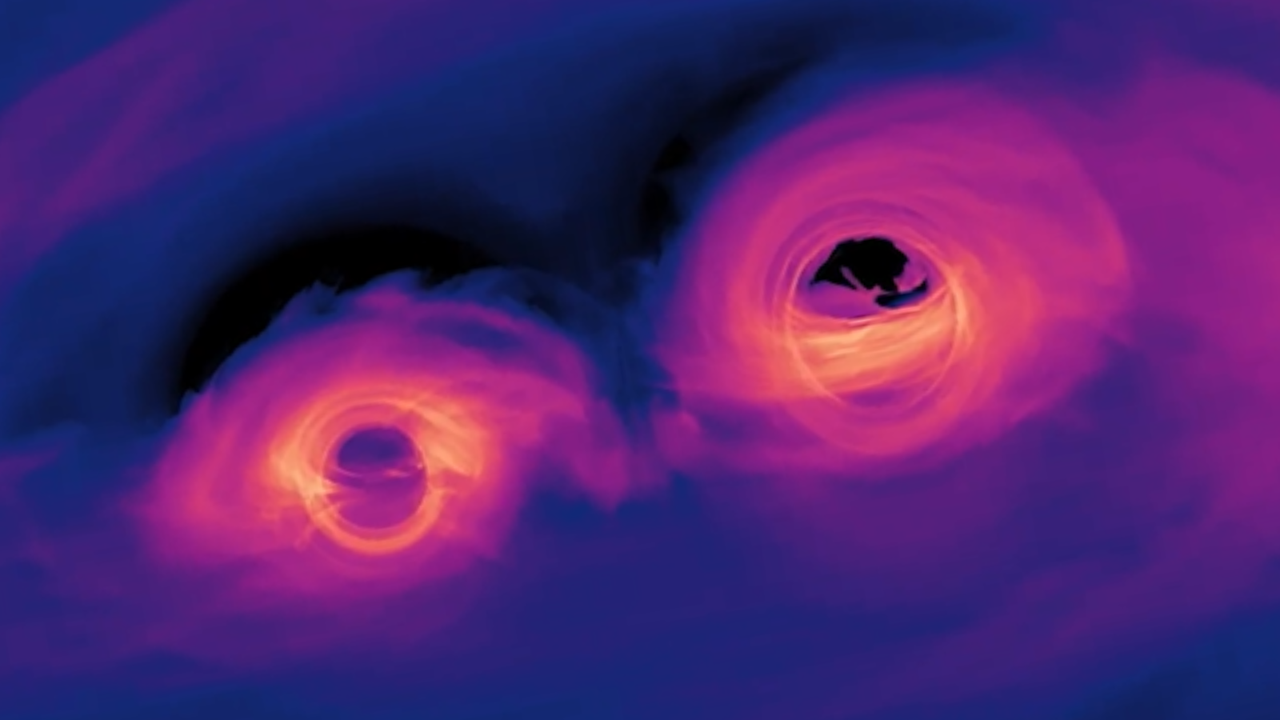
BREAKING: Scientists have just announced the discovery of two merging supermassive black holes, named after iconic locations from J.R.R. Tolkien’s “The Lord of the Rings.” The black holes, designated as Gondor (SDSS J0729+4008) and Rohan (SDSS J1536+0411), were identified by the North American Nanohertz Observatory for Gravitational Waves (NANOGrav) using innovative detection techniques.
This groundbreaking research, published on February 5, 2023, provides a new method for mapping these colossal cosmic entities and could revolutionize our understanding of gravitational waves and galaxy mergers. The implications of this discovery are immense, as it may help scientists create a cosmic map of merging black holes and improve detection protocols for gravitational wave sources.
Researchers utilized a unique technique that leverages the background hum of gravitational waves, which are ripples in spacetime caused by the interactions of supermassive black hole binaries. These black holes emit increasingly frequent gravitational waves as they spiral towards each other, akin to the way beacons signal for help. “If one of these beacons radiates gravitational waves, it indicates binary black holes are present,” said Chiara Mingarelli, a team member from NANOGrav.
The names chosen for these supermassive black holes have personal significance. Rohan honors Rohan Shivakumar, the Yale student who first analyzed the data, while Gondor reflects the moment when “the beacons were lit,” symbolizing hope and discovery in the scientific community.
In a systematic search, NANOGrav targeted 114 Active Galactic Nuclei (AGNs), which are the bright centers of galaxies where supermassive black holes consume surrounding material. The findings not only establish benchmarks for detecting gravitational waves but also highlight the potential for future discoveries.
Mingarelli added, “Our work has laid out a roadmap for a systematic supermassive black hole binary detection framework.” The NANOGrav team aims to identify a catalog of black hole mergers in the coming months, which could significantly enhance our understanding of galaxy evolution and the nature of gravitational waves.
This discovery marks a pivotal moment in astrophysics and opens up new avenues for research. As NANOGrav continues its search, the scientific community eagerly anticipates the next wave of findings from these cosmic beacons.
Stay tuned for more updates on this developing story as researchers push the boundaries of our knowledge of the universe.