
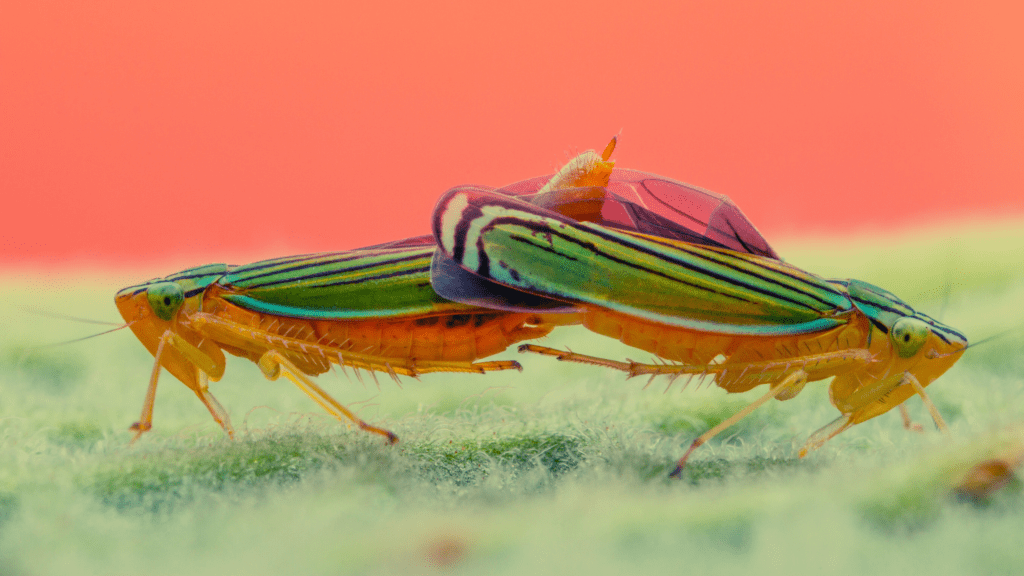
BREAKING NEWS: Scientists at Penn State University have successfully replicated a remarkable natural ability of leafhoppers, common insects known for their incredible camouflage. Their research, published in ACS Nano, reveals how these tiny insects can significantly reduce their visibility, and the implications are vast and urgent.
Leafhoppers achieve their disappearing act by coating themselves in microscopic particles called brochosomes, which drastically cut down glare and make them nearly invisible to predators that hunt using reflected light. The Penn State team has now managed to recreate this effect in a laboratory setting, potentially revolutionizing various industries.
The study reveals that these brochosomes can reduce reflected glare by an astonishing 80 to 96 percent across both visible and ultraviolet light. This remarkable reduction eliminates the flashes that typically expose the insects to predators.
Using an innovative chemical approach rather than traditional nanofabrication methods, the researchers engineered a microfluidic system that generates microscopic droplets containing dissolved polymers. As the solvent evaporates, these polymers form hollow spheres with precisely arranged pores, mimicking the structure found in nature. They successfully recreated five different brochosome designs from various leafhopper species, with sizes ranging from a few hundred nanometers to about two micrometers.
The production capabilities of this new method are astounding, generating over 100,000 particles per second. This speed outpaces most nanoscale manufacturing techniques, suggesting that such technology could soon extend beyond laboratory applications.
The potential uses for these particles are extensive. Surfaces that reflect less light could enhance the performance of energy devices and optical materials by improving glare control. While military camouflage applications have been proposed, the researchers caution that practical implementation will require further investigation. Additionally, the unique shape and surface properties of these particles open doors for biomedical applications, such as drug delivery, although this research is still in its infancy.
What makes this study particularly captivating is the simplicity of its origin. A common backyard insect has evolved a method to manipulate light that scientists are now on the verge of reproducing at scale. This breakthrough not only highlights nature’s ingenuity but also illustrates the potential for innovative solutions derived from seemingly mundane sources.
Stay tuned for further updates as the Penn State team continues to explore the implications of this groundbreaking work. This research may transform industries ranging from optics to medicine, marking a significant leap in the quest to harness nature’s strategies for human benefit.