
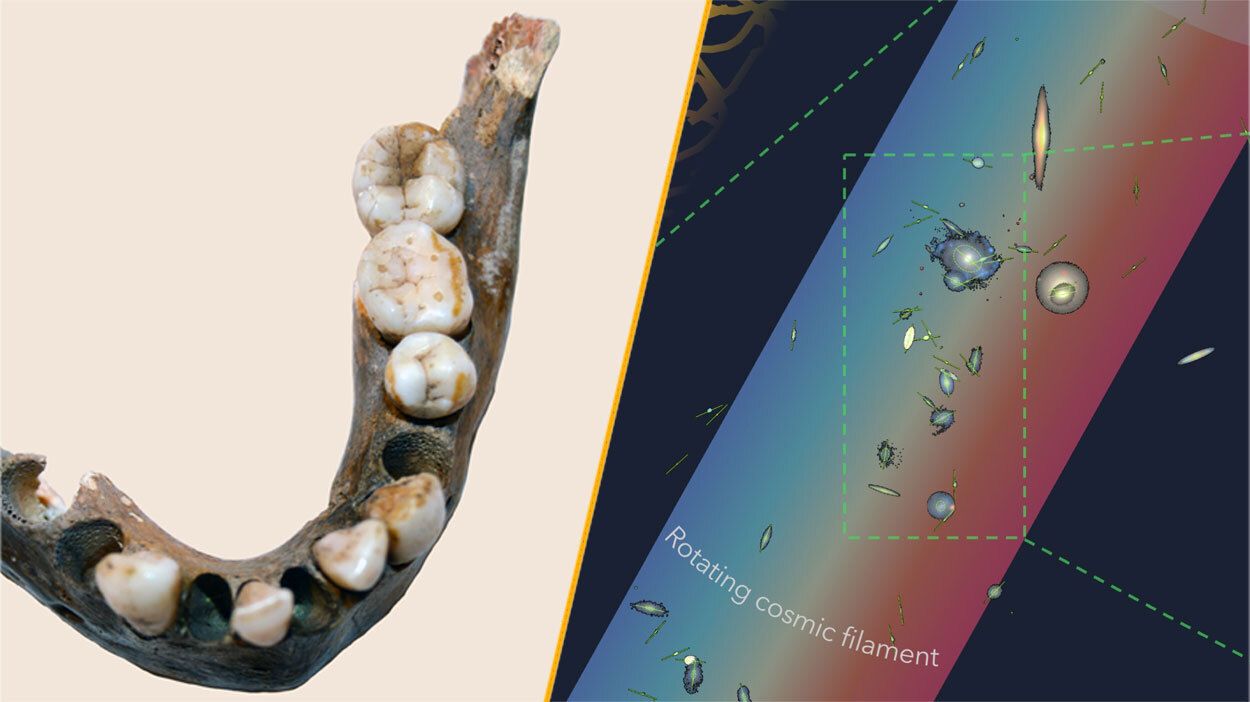
BREAKING: A stunning discovery has emerged from **140 million light-years away**, where scientists have identified the **largest spinning object** in the known universe. The colossal filament, wider than the **Milky Way**, is rotating at an astonishing **68 miles per second (110 kilometers per second)** and is linked to a chain of **14 galaxies**. This groundbreaking find is reshaping our understanding of cosmic structures.
Meanwhile, in a compelling human-interest story, researchers have unveiled that a group of humans in **southern Africa** remained genetically isolated for **100,000 years**. An analysis of skeletons discovered near the **Limpopo River** revealed these ancient people had a genetic makeup starkly different from modern humans. This population represents an extreme end of human genetic variation, highlighting the profound impact of isolation on human evolution.
On the other side of the globe, archaeologists have unearthed a disturbing **mass grave of skulls** near a **4,000-year-old city** in **China**. Surprisingly, almost all the remains belong to males, breaking from typical sacrificial patterns observed in nearby sites. This discovery raises questions about ancient practices and social structures in the region.
In a significant environmental update, China’s ambitious **Great Green Wall** project, aimed at combating desertification, has inadvertently altered rainfall and evaporation patterns. This has led to lower water levels in densely populated areas, necessitating urgent reassessment of the project’s long-term impacts.
In space news, interstellar comet **3I/ATLAS** is currently erupting with what scientists believe to be “ice volcanoes.” Observations from the **Joan Oró Telescope** in **Spain** reveal spiral jets shooting from the comet’s surface, indicating a dynamic and possibly volatile nature as it nears the sun.
In technological innovation, researchers at **MIT** have developed a groundbreaking method to extract drinking water from air, utilizing sound waves to efficiently harvest moisture. This new approach is **45 times more efficient** than previous methods, presenting a potential solution to water scarcity issues, especially in arid regions.
Moreover, a remarkable discovery in **Bolivia** has unveiled over **18,000 dinosaur tracks**, setting a new record for fossilized footprints. This significant find emphasizes the region’s importance in paleontological research and offers fresh insights into ancient life.
As these stories unfold, the implications are vast, ranging from cosmic revelations to historical insights and environmental challenges. Stay tuned for further updates on these urgent developments, which continue to shape our understanding of both the universe and our planet.
For more immediate science updates, follow us on social media or subscribe to our newsletter.