
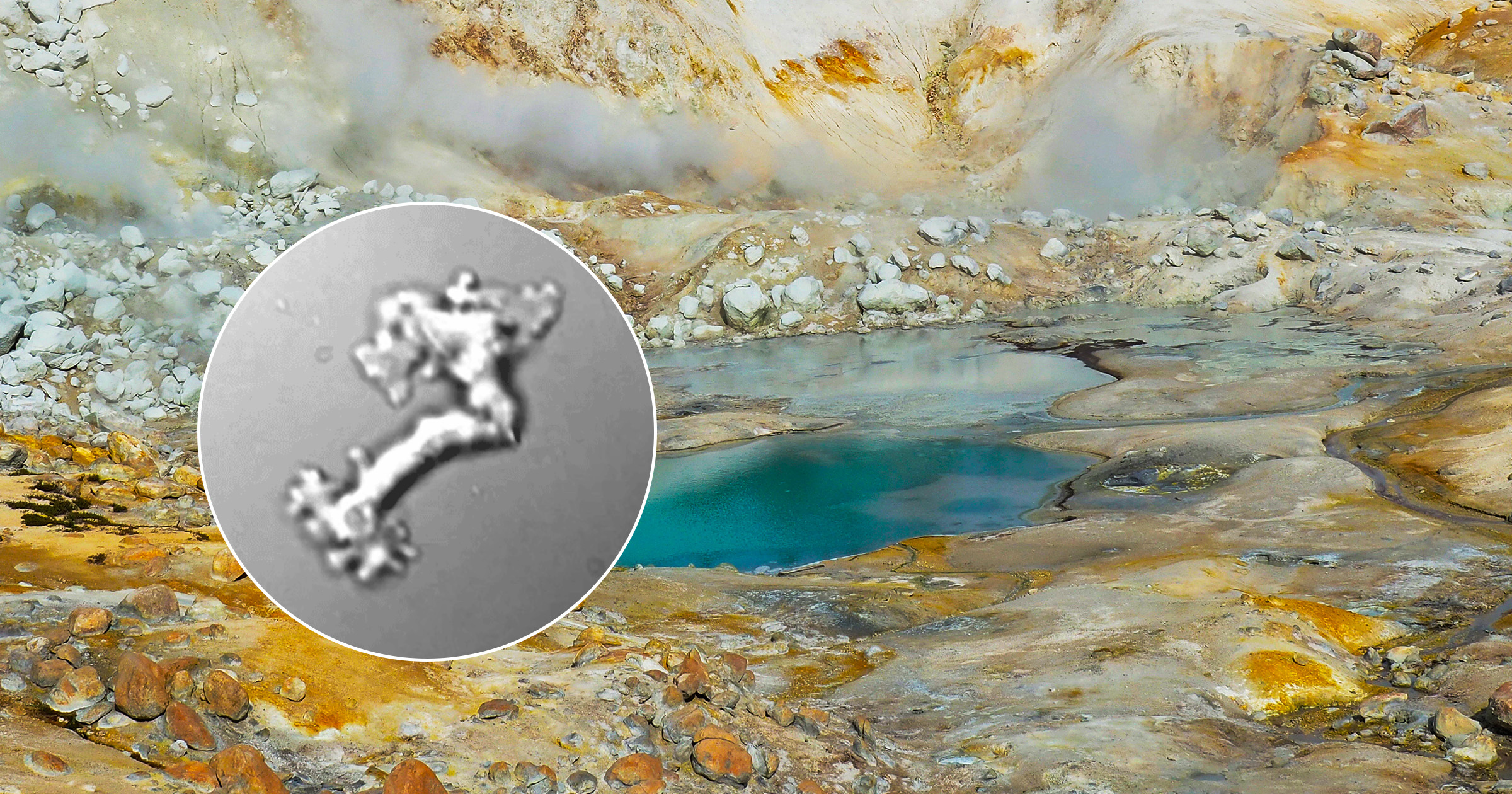
A groundbreaking study has revealed the existence of a remarkable organism known as the “fire amoeba,” which can thrive in extreme temperatures. Found in the Lassen Volcanic National Park in California, this single-celled organism, scientifically named Incendiamoeba cascadensis, can survive and replicate at temperatures reaching 145.4 degrees Fahrenheit. This discovery challenges existing beliefs about the limits of life in extreme environments.
Lassen Volcanic National Park is characterized by its harsh geothermal features, where boiling water and bubbling mud can reach scalding temperatures of up to 464 degrees Fahrenheit. While such conditions are lethal to most life forms, the fire amoeba has demonstrated an extraordinary ability to endure them. The findings were reported by a team of scientists from America and Europe, with results published in a study that is yet to be peer-reviewed.
The existence of Incendiamoeba cascadensis is significant as it sets a new record for the upper temperature limit for complex organisms on Earth. Previously, the upper limit for eukaryotes—organisms with complex cells, including animals and fungi—was thought to be between 131 and 140 degrees Fahrenheit. In contrast, prokaryotes, which include bacteria, can endure temperatures between 149 and 221 degrees Fahrenheit and are known for their resilience in extreme conditions.
Researchers, including Angela Oliverio, a microbiologist from Syracuse University, emphasize the importance of this discovery. “We need to rethink what’s possible for a eukaryotic cell in a significant way,” she stated. The fire amoeba was found in a hot spring with a neutral pH, differing from the acidic pools more commonly associated with geothermal activity.
During their investigation, the scientists observed that the amoeba began to move and replicate when heated to 134.6 degrees Fahrenheit. Remarkably, it continued to thrive even as temperatures increased to 145.4 degrees Fahrenheit. At temperatures above this point, the amoeba entered a dormant state known as encystment, forming a protective cyst-like ball that allows it to withstand harsh environmental conditions.
The research team also analyzed the amoeba’s genome and discovered an enrichment of genes related to proteostasis, genome stability, and environmental sensing. These findings provide insights into the hidden mechanisms that allow this unique organism to survive extreme temperatures while maintaining cellular integrity.
The discovery of the fire amoeba is exciting for several reasons. It opens avenues for further research into other high-temperature-loving eukaryotes, a field that has primarily focused on heat-tolerant prokaryotes known as thermophiles. “We looked in one stream. Maybe we got extremely lucky and there’s nothing else out there, but we really don’t think that’s the case,” Oliverio remarked.
Moreover, the proteins found within the fire amoeba may offer potential applications in biotechnology due to their thermostable qualities. The implications extend even further, as researchers speculate that similar microorganisms could exist in extreme environments beyond Earth, such as the ancient riverbeds and ice caps of Mars.
The study not only highlights the adaptability of life on Earth but also raises fundamental questions about the potential for life in other extreme environments across the universe. As the late actor Jeff Goldblum famously said in the film Jurassic Park, “Life finds a way.” The ongoing exploration of such resilient organisms may expand our understanding of biological limits and the possibilities for life beyond our planet.