
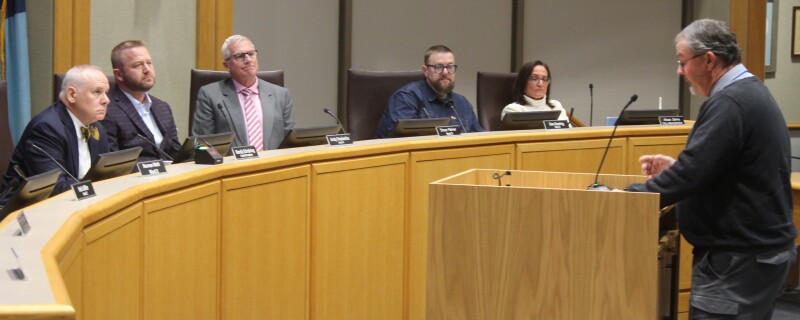
Supporters of Rochester’s planned sports and recreation complex gathered on March 15, 2024, to advocate for the project’s initial phase, which is estimated to cost $65 million. The Rochester City Council reviewed a proposal to override a veto from Mayor Kim Norton, which had sought to halt $52.2 million in construction contracts and material purchases. Advocates, including Clark Jones, Head Baseball Coach at Rochester Community and Technical College, argued that the facility would allow local teams to host March tournaments, significantly reducing travel costs and logistical challenges.
During the council meeting, Jones emphasized the financial benefits, stating, “This would save our program $20,000 to $30,000 in annual expenses.” His remarks resonated with a gathering of 12 other supporters who spoke in favor of the facility. The council ultimately voted 5-2 to move forward, allowing construction to commence in the spring.
Despite the support, Norton expressed concerns that the current project does not align with what the community expected. “The project before you is not a year-round, community-focused facility,” she stated, urging the council to reconsider its approach. Norton’s vetoes highlighted a perceived disconnect between the original proposal, which included both indoor and outdoor facilities, and the current focus on outdoor amenities.
Local resident Jane Shellum echoed Norton’s sentiments, explaining that her decision to support the project was based on prior information that suggested a comprehensive sports complex. She voiced disappointment at the shift in plans, stating, “If you are going to pivot so much from what was promised publicly to the voters, it should go back to the voters.”
Former council member Ed Hruska, who had previously helped present the proposal to the Minnesota Legislature, defended the adjustments, stating that the initial project was based on a $50 million facility in Bettendorf, Iowa, built in 2018. He noted that rising costs necessitated a reevaluation of the local project, which now aims to be financially viable without imposing excessive tax burdens.
Council member Mark Bransford added that the plans presented to voters in 2023 were never final, allowing for necessary adjustments as circumstances changed. “Plans were presented as drafts of what could be, not promises of what will be,” he explained, underscoring the flexibility inherent in the proposal.
Community representatives from the hospitality sector also supported the project, highlighting its potential economic impact. Kristine Ihrke, area director of sales at Kahler Hospitality Group, noted, “The original goal of this facility was to be a local economic development for the hospitality industry.”
Supporters pointed out that the complex would serve a variety of sports, providing benefits beyond just baseball. Mike Vance, a board member of Rochester Youth Baseball, emphasized that the facility would accommodate multiple sports, including soccer and lacrosse. He argued that the planned turf fields would provide a reliable playing surface, reducing cancellations due to weather conditions.
Yet, concerns remained among some residents. AJ Colapinto questioned the adequacy of the scaled-back complex, suggesting that the reduced focus on indoor facilities might limit the usability of the space throughout the year. “If the local use is that half the year I can play pickleball, I don’t think it’s really serving the local use,” he remarked.
On the contrary, Chris Lukenbill, a volunteer for Rochester Area Lacrosse, supported the project, highlighting the potential benefits of the new turf fields. “Turf fields provide a safer, more consistent surface that allows practices and games to happen, even when conditions are less than ideal,” he said.
As the council deliberated, resident Joseph LaForge urged members to consider whether the decision reflected the community’s values. “Will it be the citizens’ interests or the interests of monied individuals?” he asked, emphasizing the importance of community engagement in the decision-making process.
Council President Randy Schubring defended the council’s decision, pointing out that the majority of voters had approved the project in 2023. He noted, “There are very few, if any, other issues that come to this council where the voters have voted.” Schubring reiterated the need to advance the project while ensuring future discussions would address community access to recreational facilities.
With the council’s decision to proceed, the project aims to provide a multifaceted sports complex that balances local use with broader economic benefits. As construction approaches, many community members remain hopeful that the facility will fulfill its promise of enhancing Rochester’s recreational landscape.