
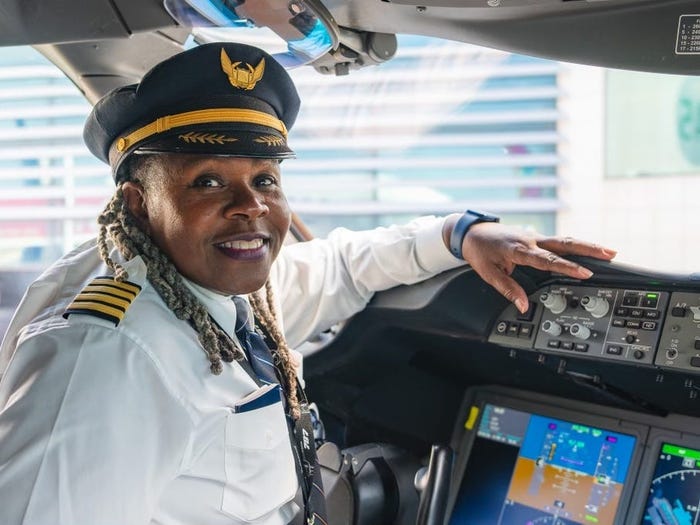
UPDATE: A viral TikTok video featuring retired United Airlines captain and USAF veteran Theresa Claiborne is making waves, highlighting her groundbreaking career as the first Black woman pilot in the United States Air Force. The video has garnered millions of views, thrusting Claiborne into the spotlight at a time when diversity in aviation is facing significant challenges.
The urgency of this story cannot be overstated. As aviation struggles with a critical shortage of pilots, efforts to diversify the field are increasingly threatened. Claiborne, now 66 years old, flew a variety of Boeing aircraft at United from 1990 to 2024, breaking the mold in an industry dominated by white males.
Claiborne’s remarkable journey began when she was commissioned as a second lieutenant in the Air Force in 1981. She became the service’s first Black woman pilot, navigating a challenging path in a male-dominated environment. “It was a hard road,” Claiborne said, reflecting on how she was selected for pilot training at a time when only 10 women were admitted annually.
Despite her history-making status, Claiborne has faced ongoing bias throughout her career. “There’s always going to be some bias,” she states, emphasizing the need for women and people of color to prove their qualifications at every turn.
Statistics reveal the stark reality of gender and racial representation in aviation: only 7% of US airline pilots are women, with just 1 in 40 being Black. Claiborne is part of a movement to change these numbers through her organization, Sisters of the Skies, which mentors young women of color in aviation.
The growing conversation around diversity is particularly relevant today, as recent political discourse has questioned the inclusion of women in aviation roles. Claiborne criticized these narratives as “damaging,” stating that they undermine the skills and dedication that women and minorities bring to the industry. “No airline is going to hire people just because,” she asserted, reaffirming her qualifications and those of her peers in the cockpit.
Claiborne’s career at United Airlines saw her flying nearly every major Boeing model, including the 747 and 787 Dreamliner. Her experiences have not only reshaped her own life but have the potential to inspire a new generation of aviators. “If you can see it, you can be it,” she emphasizes, highlighting the importance of representation.
As aviation continues to evolve, the need for diverse voices and experiences remains critical. Claiborne’s story serves as a powerful reminder of the barriers that can be broken and the future that can be forged when diversity is embraced.
What happens next? Claiborne hopes her viral moment will encourage more women, especially women of color, to pursue careers in aviation. With a critical shortage of pilots looming, the aviation industry must embrace diversity now more than ever.
Stay tuned for further developments on this inspiring story and the ongoing efforts to diversify the skies. This is not just a moment in history; it is a call to action for the future of aviation.