
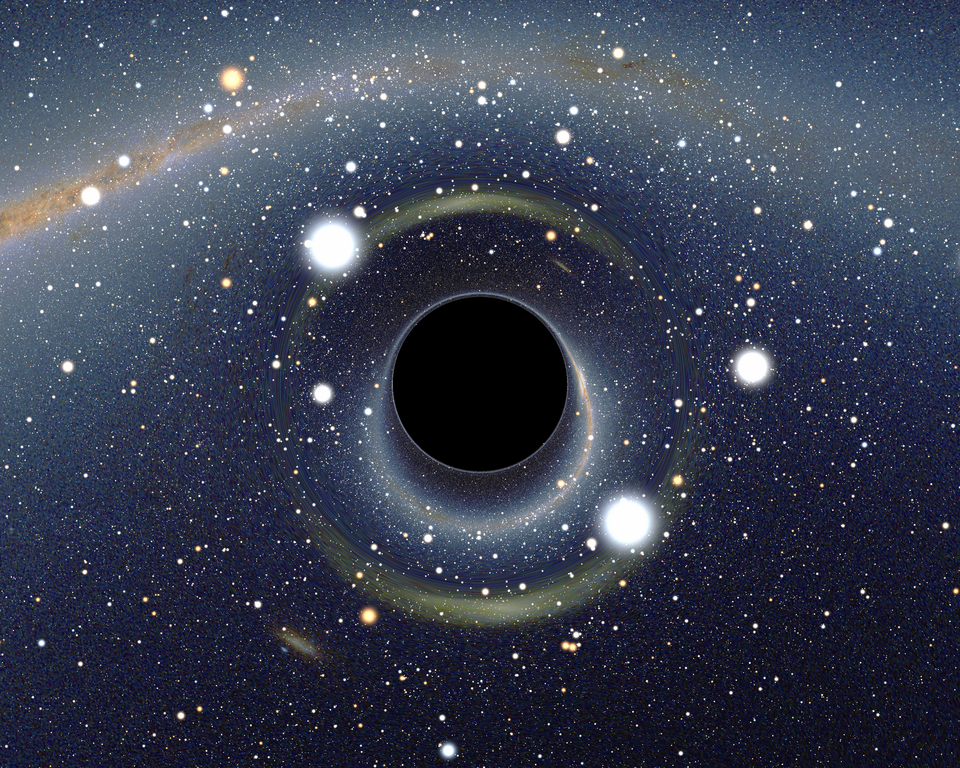
Capturing images of black holes has long posed a significant challenge in astronomy. Traditional methods using telescopes have limitations due to the extreme distance and compactness of these cosmic phenomena. Researchers at KAIST in South Korea have developed an innovative solution that utilizes laser technology to improve the precision of black hole imaging.
This new approach replaces conventional electronic reference signals, which have historically been used to synchronize multiple radio telescopes. Instead, the team led by Professor Jungwon Kim has introduced optical frequency comb lasers. These lasers emit tens of thousands of highly accurate frequencies, creating a stable reference system analogous to a ruler with precisely spaced markings.
By integrating these laser combs directly into radio telescope receivers, the researchers have established a common reference for signal processing. This marks a significant departure from traditional electronic coordination methods, which struggle to maintain stability, particularly at higher radio frequencies. As astronomers aim to observe finer details at shorter wavelengths, the limitations of electronic signals become increasingly apparent.
Advancements in Telescope Synchronization
The challenge of aligning signals from multiple telescopes has previously hindered the clarity of black hole images. The new laser system effectively resolves this issue by leveraging the inherent stability of light itself. The team conducted successful tests at the Korea VLBI Network’s Yonsei Radio Telescope, where they detected stable interference patterns between telescopes. Recently, they expanded their testing to include the KVN Pyeongchang Radio Telescope, demonstrating that the technology works across multiple sites simultaneously.
The implications of this research extend beyond black hole imaging. The precision timing technology derived from this work could facilitate intercontinental atomic clock comparisons with unprecedented accuracy. Additionally, it may enhance space geodesy measurements, which track subtle movements of the Earth, and improve the tracking of deep-space probes.
Professor Kim emphasizes that their innovation overcomes the fundamental limitations of electronic signal generation by harnessing optical precision. For astronomers, this represents a significant step toward making distant radio telescopes function as a single, exceptionally large instrument.
As the field of radio astronomy continues to evolve, the integration of laser technology could herald a new era of discovery, allowing researchers to capture sharper images of black holes and other distant celestial objects. This breakthrough not only enhances our understanding of the universe but also sets the stage for advancements in various scientific fields reliant on precise measurements.