
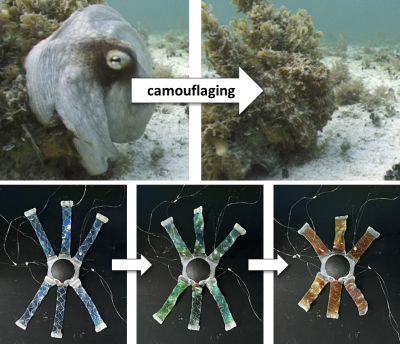
A research team at the Korea Institute of Science and Technology (KIST) has developed an innovative soft robot named ‘OCTOID’, which can change its color and shape, mimicking the camouflage and movement of octopuses. Led by Dr. Dae-Yoon Kim at the Functional Composite Materials Research Center, this project represents a significant advancement in soft robotics, blending aesthetics with functionality.
The OCTOID is not just a simple soft robot that bends or stretches. It can alter its color in response to electrical stimulation, enabling it to adapt to its environment effectively. The robot can also move to align itself with its surroundings and grasp objects, showcasing its versatility and potential applications across various fields.
Innovative Features and Applications
The ability of OCTOID to change color and move fluidly opens up numerous possibilities in both industrial and consumer applications. For example, it could be used in fields such as search and rescue operations, where the robot’s ability to camouflage may allow it to blend into diverse environments, making it less detectable.
Moreover, the soft robot’s design allows it to manipulate delicate objects without causing damage. This feature could be advantageous in industries that require careful handling of fragile items, such as electronics or pharmaceuticals.
The research team’s work is part of a broader effort to enhance the functionality and adaptability of soft robots. As Dr. Kim pointed out, the inspiration drawn from octopuses not only informs the robot’s movement but also its capacity for color change, representing a significant leap forward in robotics inspired by nature.
Future Prospects in Robotics
The development of OCTOID is a promising step towards creating robots that are not only more effective in performing complex tasks but also capable of interacting with their environments in a more natural and intuitive manner. As robotics technology continues to evolve, projects like this highlight the potential for soft robots to play vital roles in various sectors.
The implications of this research extend beyond mere functionality. By integrating advanced materials and intelligent design, researchers hope to pave the way for future innovations in the field of robotics, which may lead to more adaptable and responsive machines capable of performing tasks in unpredictable environments.
In summary, the unveiling of OCTOID by Dr. Dae-Yoon Kim and his team at KIST marks a significant milestone in the development of soft robotics, combining color-changing abilities with sophisticated movement. This innovative technology could redefine how robots interact with their surroundings and open new avenues for research and application in the field.