
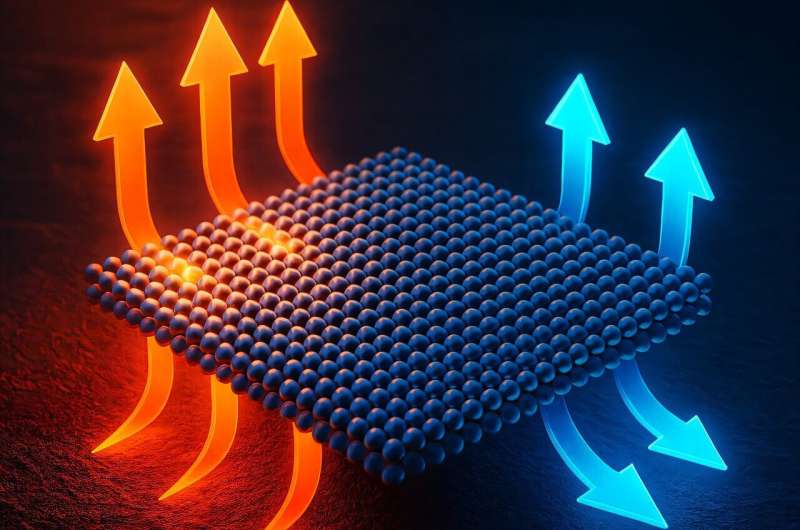
Researchers have made significant strides in understanding heat flow in ultrathin materials, specifically silicon films just a few nanometers thick. In a groundbreaking study published in the Journal of Applied Physics on December 14, 2025, Dr. Alessio Zaccone explores how traditional theories of thermal conductivity fail to explain unexpected behaviors observed in these materials. The findings reveal that these nanoscale phenomena could have broad implications for technology in fields such as electronics and quantum computing.
New Insights into Thermal Conductivity
For years, scientists have noted that reducing the thickness of materials to the nanoscale alters their physical properties. In the case of ultrathin silicon films, molecular dynamics simulations have indicated a perplexing behavior: thermal conductivity reaches a distinct minimum at thicknesses of around one to two nanometers, which equates to only a few atomic layers. As thickness continues to decrease, thermal conductivity unexpectedly increases, defying classical models that suggest otherwise.
Traditional theories, including the Boltzmann transport equation and the Fuchs–Sondheimer boundary-scattering framework, predict that reducing thickness should diminish thermal conductivity. This expectation arises from the assumption that fewer phonons—quantized vibrations of the atomic lattice—can travel freely in thinner materials. Yet, the research team at Carnegie Mellon University led by Alan McGaughey demonstrated results that contradicted these established models, prompting further investigation into the underlying mechanisms.
Revisiting Phonon Behavior
In his recent paper, Dr. Zaccone approaches the issue of phonon behavior from a geometric perspective rather than through conventional quantum well models. He conceptualizes the relationship between the allowed momentum states of phonons and the material’s confinement in reciprocal space. As materials thin, phonons whose wavelengths exceed the film thickness can no longer exist in the confined direction. Dr. Zaccone visualizes this as creating two spherical “holes” within the Debye sphere, a region in reciprocal space where phonon states are no longer permitted.
This geometric distortion impacts the vibrational states of the material, pushing many phonons toward lower frequencies. Consequently, the density of vibrational states increases cubically with frequency, in contrast to the normal quadratic increase predicted by the Debye model. This shift results in a dominance of low-frequency, long-wavelength phonons, which are particularly effective at conducting heat.
“When we approach the limits of dimensionality, we need to rethink the problem at a fundamental level,” said Dr. Zaccone. “New behaviors can arise not from exotic effects but from simple geometric constraints.”
By integrating this new understanding of phonon density with established formulas for thermal conductivity, Dr. Zaccone’s model aligns closely with the simulation results, successfully predicting the observed minimum in thermal conductivity without needing adjustable parameters. This achievement emphasizes the necessity of reevaluating existing theories when dealing with nanoscale phenomena.
Broader Implications and Future Directions
The findings extend beyond ultrathin silicon films. Similar effects have been observed in silicon nanowires, suggesting that understanding heat flow at the nanoscale is crucial as electronics shrink in size—a trend guided by Moore’s Law. Efficient thermal management is vital to prevent overheating in increasingly compact devices. Furthermore, in quantum computing, where even minor heat fluctuations can disrupt coherence, precise control of phonon populations becomes paramount.
Dr. Zaccone’s research also opens avenues for future exploration. Possible extensions include examining additional scattering mechanisms, applying the model to various thin films and membranes, and investigating how confinement influences systems relevant to superconducting devices and quantum information technologies.
Ultimately, this research not only deepens our understanding of thermal physics but also highlights the surprising behaviors that emerge when materials are constrained to their smallest dimensions. As scientists continue to push the boundaries of material science, each new discovery paves the way for innovative technologies yet to be conceived.