
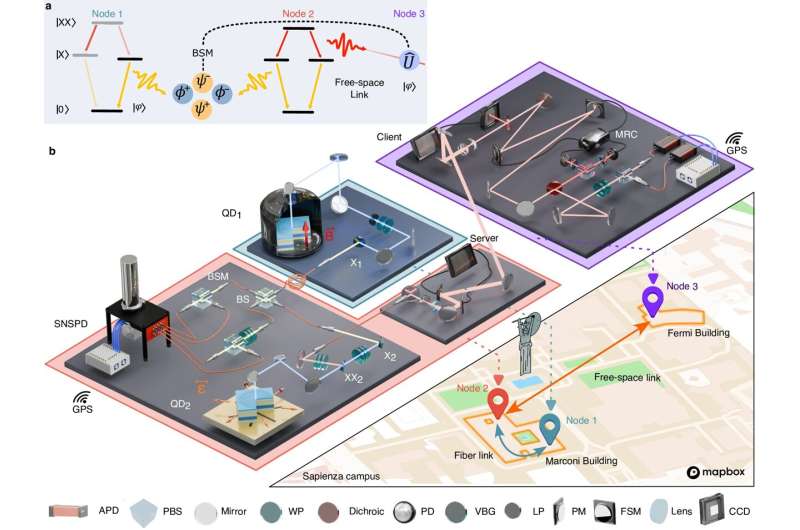
An international research team, including scientists from Paderborn University, has successfully teleported the polarization state of a single photon emitted from a quantum dot to another quantum dot located at a distance. This landmark achievement, reported on December 2, 2025, represents a significant step toward the realization of a quantum internet and has been detailed in the journal Nature Communications.
The experiment utilized a 270-meter free-space optical link to connect the two quantum dots, demonstrating the potential for future quantum communication networks. The findings underscore the viability of using semiconductor quantum dots as key technologies for advanced quantum communication systems. Professor Klaus Jöns, head of the Hybrid Photonics Quantum Devices research group at Paderborn, emphasized the experiment’s implications for scalable quantum relays and the practical implementation of a quantum internet.
### Long-Term Collaboration Yields Results
The research is the culmination of nearly a decade of collaboration between doctoral and postdoctoral students at Paderborn University and a team led by Professor Rinaldo Trotta from Sapienza University of Rome. Professor Jöns noted that the experiment illustrates how entangled systems, composed of multiple quantum particles, can enhance quantum communication capabilities. Rather than relying on a single state’s properties, these systems utilize multiple states, which can be pivotal in areas such as data security and quantum computing.
Historically, previous experiments had sourced photons from the same emitter. The breakthrough in using distinct quantum emitters for quantum teleportation marks a notable advancement in the field. Reflecting on their journey, Professor Jöns stated, “This result shows that our long-term strategic planning has paid off.”
### A European Endeavor in Quantum Research
The project relied on a collaborative effort across multiple European institutions. Quantum dots were meticulously developed at Johannes Kepler University Linz, while the nanofabrication of resonators was handled by partners at the University of Würzburg. The teleportation experiments were conducted at Sapienza University, featuring advanced technology such as GPS-assisted synchronization and ultra-fast single photon detectors to mitigate challenges posed by atmospheric turbulence.
The quality of the teleportation achieved was impressive, with a fidelity reaching up to 82 ± 1%, surpassing classical limits by more than ten standard deviations. This high fidelity indicates that the quantum states were effectively preserved during teleportation, a critical factor for practical applications in quantum communication.
### Looking Ahead: The Future of Quantum Relays
The current success paves the way for future research aimed at demonstrating “entanglement swapping” between two quantum dots, which would represent the first quantum relay utilizing two deterministic sources of entangled photon pairs. These deterministic sources are designed to produce reliable single photons on demand, a capability that has posed significant challenges until now.
Coincidentally, another research team from Stuttgart and Saarbrücken achieved similar results using frequency conversion, marking a significant milestone for European quantum research. The combined efforts of these teams highlight the collaborative spirit driving advancements in quantum technologies.
For more detailed insights, refer to the study by Alessandro Laneve et al., titled “Quantum teleportation with dissimilar quantum dots over a hybrid quantum network,” published in Nature Communications (2025). The implications of this research are profound, signaling a promising future for quantum communication technologies.