
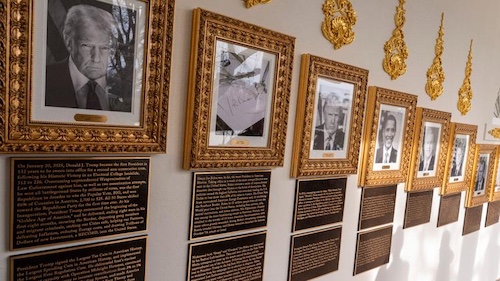
President Donald Trump has introduced a new exhibit at the White House known as the Presidential Walk of Fame, aiming to reshape the narrative surrounding U.S. presidential history. This initiative, launched on January 3, 2026, has stirred significant debate regarding its implications for how past leaders are remembered.
According to the Associated Press, this display represents Trump’s effort to remold the White House in his image, challenging traditional norms about presidential legacies. The exhibit consists of two sections dedicated to Trump’s two terms, filled with self-congratulatory language, including claims of having created “the Greatest Economy in the History of the World.” The plaques also highlight Trump’s Electoral College victory in 2016, which he describes as a “landslide,” despite receiving fewer popular votes than his opponent.
The introductory plaque claims that the Walk of Fame will endure as a tribute to “the Greatness of America,” suggesting that it will remain a significant feature of the White House, even after Trump’s presidency ends. White House Press Secretary Karoline Leavitt described the plaques as “eloquently written descriptions” of each president’s legacy, with many authored by Trump himself.
The content of the plaques reflects Trump’s contentious views on his predecessors. He has labeled Joe Biden as “Sleepy Joe” and the “worst President in American History,” attributing various national crises to his administration, including the ongoing conflict in Ukraine. The plaque for Barack Obama criticizes him as “one of the most divisive political figures in American History,” while dismissing his signature healthcare initiative as “highly ineffective.”
In contrast, George W. Bush receives some praise for establishing the Department of Homeland Security but is criticized for initiating wars in Afghanistan and Iraq. Bill Clinton, once considered an ally, is recognized only for the economic boom of the 1990s, with his plaque concluding with a reference to Trump’s own electoral victory in 2016.
While some presidents receive favorable mentions, others are not spared from criticism. Lyndon Johnson is noted for his role in the Civil Rights Act, while John F. Kennedy is celebrated as a “war hero” from World War II. The plaque for Richard Nixon acknowledges the Watergate scandal that led to his resignation, which Trump uses to further his critique of media treatment of presidents.
The unveiling of the Walk of Fame has drawn parallels to Trump’s previous business ventures, where his name has been prominently featured on various properties and products. A Reuters report from New Year’s Eve highlighted the extensive branding of Trump’s name across numerous sectors, from real estate to entertainment.
Critics, including Austin Sarat, a professor at Amherst College, have raised questions about the permanence of Trump’s name on these monuments, particularly if political power shifts in the future. As the political landscape evolves, the long-term impact of the Walk of Fame on public memory and historical narrative remains to be seen.
This initiative marks yet another chapter in Trump’s controversial presidency, underscoring his commitment to leave a lasting imprint on the nation’s history. As discussions continue regarding the implications of this exhibit, it becomes clear that the Presidential Walk of Fame is not merely a tribute but a bold statement about Trump’s vision of American greatness.