
A recent study reveals that natural plant extracts can significantly mitigate the risks associated with human bacterial pathogens in manure-amended soils. Conducted by a team led by Meizhen Wang from Zhejiang Gongshang University, the research demonstrates how these extracts interfere with bacterial communication, thereby reducing pathogenicity and the potential spread of antibiotic resistance genes.
The use of manure is crucial for maintaining soil fertility, yet it can introduce harmful microbes into farmland. These human bacterial pathogens (HBPs) may carry antibiotic resistance genes (ARGs) and virulence factor genes (VFGs), which can be transferred through mobile genetic elements (MGEs) such as plasmids. Once established in agricultural soils, these pathogens can migrate into crops, posing significant risks to human health and ecosystems.
Existing methods to combat these pathogens, including biochar and engineered nanoparticles, can be effective but often raise environmental concerns or are prohibitively expensive. In contrast, plant extracts present a promising and environmentally friendly alternative. While their potential has been studied for soil remediation and plant protection, their specific effects on soil-borne human pathogens have not been widely explored until now.
Study Details and Methodology
The findings, published on November 26, 2025, in the journal Biocontaminant, reveal a systematic examination of how plant extracts can disrupt the signaling mechanisms of HBPs. The researchers utilized manure-amended soil microcosms, complemented by metagenomic profiling, targeted gene quantification, pure-culture assays, and molecular docking analyses. A total of 323 HBPs were identified from a curated pathogen database, and the study assessed changes in their abundance, community composition, and diversity after treatment with three key plant-derived compounds: curcumin (CUR), andrographolide (AG), and thymol (THY).
In addition to evaluating pathogen abundance, the study quantified ARGs, VFGs, and MGEs to assess pathogenicity and transmission potential. Co-occurrence network analysis identified high-risk pathogens that co-host resistance and virulence traits.
Key Findings and Implications
The results indicate a notable reduction in total HBP abundance by approximately 25–28% following treatment with plant extracts. Specifically, pathogens associated with Actinobacteria and Proteobacteria were selectively suppressed. Overall richness of microbial communities declined without significant changes in alpha diversity.
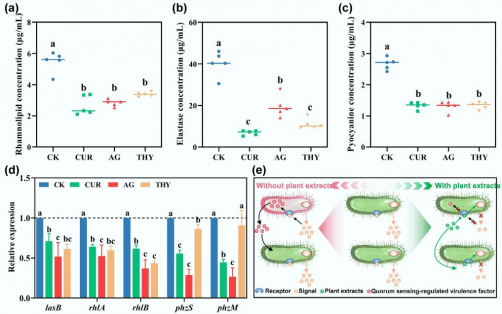
Moreover, key indicators of risk were reduced, with ARGs decreasing by about 20–27%, VFGs by 6–11%, and MGEs by 25–34%. The network analysis highlighted pronounced declines in high-risk HBPs that co-host ARGs and VFGs. Mechanistically, the plant extracts disrupted quorum sensing (QS) by lowering the abundance of QS-related genes and concentrations of acyl-homoserine lactone signals. This disruption led to a downregulation of QS-regulated genes, resulting in reduced virulence factor secretion, an up to 40% inhibition of biofilm formation, and a suppression of up to 90% of conjugative ARG and VFG transfer.
Molecular docking studies confirmed that the plant compounds bind to the QS receptor LasR with higher affinity than native signal molecules, effectively blocking bacterial communication. These findings suggest that plant extracts mitigate soil-borne pathogen risks primarily by interfering with microbial communication and gene exchange, rather than through direct bactericidal effects.
The implications of this research are significant. By employing plant extracts as soil amendments, farmers could reduce the health risks associated with pathogen-laden manure without the adverse effects linked to antibiotics or nanomaterials. This approach disarms pathogens rather than killing them, thus minimizing the selective pressure that often leads to increased antibiotic resistance.
Overall, the study contributes valuable insights into sustainable agricultural practices and highlights the potential for plant-derived compounds to enhance soil health while addressing critical public health concerns.