
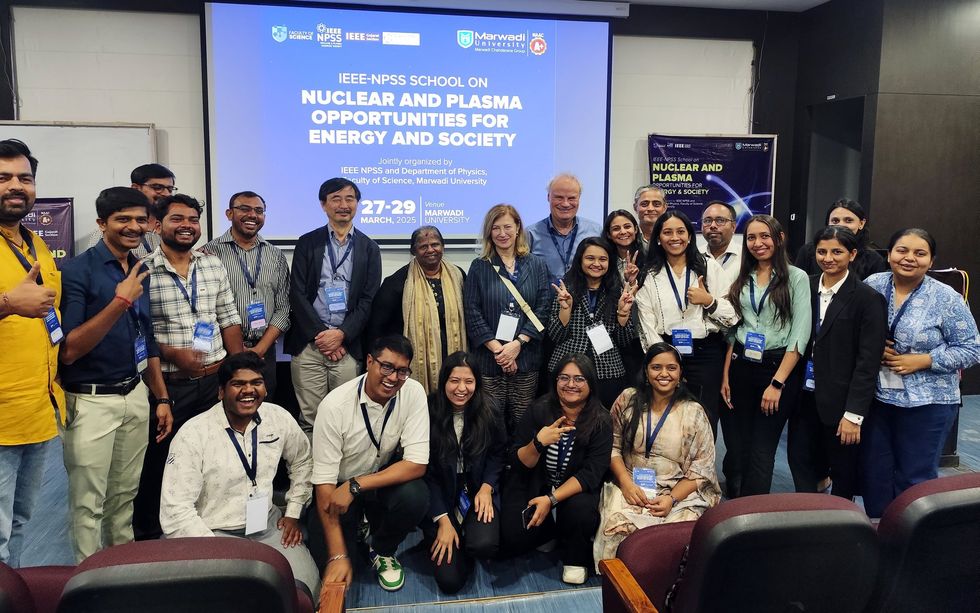
Collaboration has been a cornerstone of success for Professor Cinzia DaVià, who applies this principle across her diverse research projects. Currently a professor of physics at the University of Manchester and a research professor at Stony Brook University, she has made significant contributions to both high-energy physics and portable energy generation solutions. Her work spans from developing silicon sensors for CERN experiments to addressing climate change challenges.
DaVià’s academic journey began in the Italian Dolomites, where her interest in physics was ignited by the documentary series “Astronomia,” a local adaptation of Carl Sagan’s “Cosmos.” She pursued a degree in astronomy and astrophysics at the University of Bologna, driven by a passion for understanding the universe. A pivotal summer internship at CERN shifted her focus toward radiation instrumentation, particularly after her involvement in building experiments for the Large Electron-Positron Collider (LEP).
Career Development at CERN
DaVià’s decade-long tenure at CERN, from 1989 to 1999, was marked by groundbreaking achievements, notably in developing radiation-hardened silicon sensors. These sensors serve as critical components in collider experiments, capturing initial moments of particle creation. Their resilience is vital because radiation can render them ineffective after repeated exposure.
One of her notable contributions involved the “Lazarus effect,” where damaged sensors could be revived by cooling them to temperatures below -143° C. Additionally, DaVià played a key role in transitioning from traditional planar silicon sensors to advanced 3D designs. The collaboration with inventor Sherwood Parker led to sensors that are not only faster but also capable of withstanding intense radiation, thereby enhancing the capabilities of collider experiments.
Despite initial resistance from some in the scientific community, DaVià successfully united a coalition of scientists and industry leaders to push the 3D sensor project forward. This collaboration between competing companies was unprecedented, demonstrating her ability to foster teamwork in the face of skepticism.
Addressing Global Challenges
Beyond her work in particle physics, DaVià is deeply committed to addressing the impacts of extreme weather events on vulnerable populations. Her engagement with sustainable entrepreneurship intensified after attending the American Institute of Architects International symposium in June 2023, where discussions on disaster preparedness resonated with her.
A concept that emerged from these discussions was the development of “smart shelters,” designed to provide power and communications in remote disaster-stricken areas. This idea aligns with the MOVE initiative by IEEE, which supplies mobile power and communication capabilities to disaster-affected communities. DaVià is leading the charge on this project and has organized a conference at CERN scheduled for October 2023, aimed at fostering interdisciplinary collaboration to create effective deployable solutions.
DaVià’s work with IEEE has been instrumental in her professional development. She has served as a distinguished lecturer and is actively involved in various IEEE societies, including the IEEE Society of Social Implications of Technology and the IEEE Women in Engineering group. In recognition of her contributions, she received the 2022 WIE Outstanding Volunteer of the Year Award.
As a cochair of the ATTRACT initiative in the European Union, DaVià promotes advancements in radiation imaging research. She has coauthored over 900 publications, establishing herself as a leading figure in her field.
In summary, Cinzia DaVià exemplifies the power of collaboration in advancing scientific research and addressing global challenges. Her career trajectory, influenced by a passion for physics and a commitment to teamwork, continues to inspire future generations of scientists and researchers.