
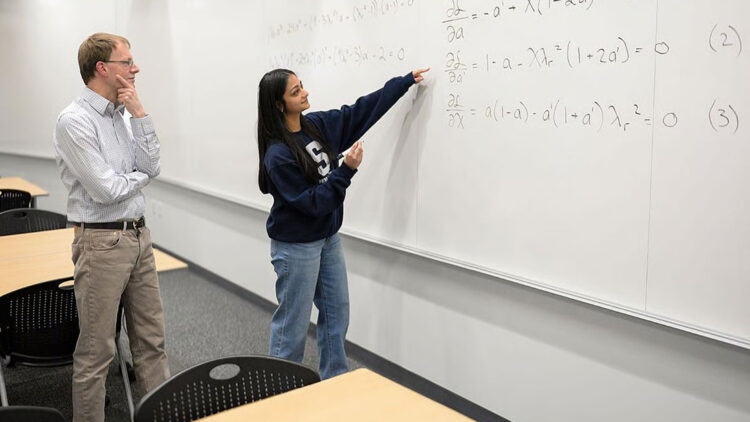
A graduate student at Penn State University has made significant strides in wind turbine efficiency by solving the historic Glauert problem, a mathematical issue that has persisted for over a century. Divya Tyagi’s innovative approach provides a clearer method for calculating the ideal flow conditions around wind turbines, enabling them to harness more energy from the wind.
The Glauert problem, originally formulated by British aerodynamicist Albert Glauert, has long been acknowledged for its contributions to wind energy and rotor design. However, experts have criticized its complexity and lack of clarity. Sven Schmitz, Tyagi’s thesis supervisor, noted that previous attempts to tackle the problem revealed significant gaps. “When I thought about the Glauert problem, I thought steps were missing and it was very complicated,” he explained. Tyagi was the fourth student he challenged to revisit the theory, and she ultimately succeeded in uncovering a more elegant solution.
Revolutionizing Wind Energy Calculation
Tyagi’s work includes an addendum to Glauert’s original theory, where she determines the optimal aerodynamic performance of a wind turbine. By employing a sophisticated mathematical tool known as the calculation of variations, she solved for ideal flow conditions that maximize power output. “You need to understand how large the total load is, which Glauert did not do,” Tyagi stated, emphasizing the importance of this aspect for engineers designing practical turbines.
Tyagi explained that even a minor improvement in power efficiency can have substantial implications. “Improving the power coefficient of a large wind turbine by just 1 percent has significant impacts on the energy production of a turbine,” she noted. This enhancement could potentially increase a turbine’s output enough to power an entire neighborhood, underscoring the real-world relevance of her research.
Acknowledgment and Future Prospects
Tyagi’s achievements have not gone unnoticed. Her thesis earned her the prestigious Anthony E. Wolk Award for the best aerospace engineering work among her peers. Furthermore, her study has been published in the scientific journal Wind Energy Science (WES), allowing other researchers to build upon her findings.
Reflecting on her journey, Tyagi mentioned the extensive time and effort she dedicated to this project. “I would spend about 10 to 15 hours a week between the problem, writing the thesis, and on research,” she recalled, acknowledging the intense mathematical challenge it posed. “But I feel really proud now, seeing all the work I’ve done.”
As she continues her postgraduate training, Tyagi is now focused on computational fluid dynamics simulations. Currently, she is studying airflow around helicopter rotors in a project supported by the United States Navy. This work aims to improve flight simulation and pilot safety by enhancing the understanding of airflow behavior in complex scenarios.
With her groundbreaking improvements to Glauert’s problem, future generations of students may learn from Tyagi’s enhanced model, potentially setting a new standard in wind energy education and application.