
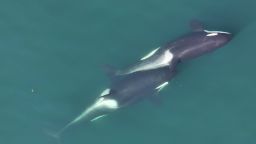
A remarkable alliance between orcas and Pacific white-sided dolphins has been observed off the coast of British Columbia. Researchers documented this unexpected cooperation, where these traditionally rival marine mammals teamed up to hunt for Chinook salmon, a staple in the orcas’ diet. This behavior marks the first recorded instance of such collaboration between the two species, according to a study published on March 15, 2024, in the journal Scientific Reports.
The study, led by Sarah Fortune, who holds the Canadian Wildlife Federation chair in large whale conservation at Dalhousie University, reveals that the dolphins and a local population of killer whales, known as Northern Resident orcas, actively work together during hunts. “Seeing them dive and hunt in sync with dolphins completely changes our understanding of what those encounters mean,” Fortune stated.
To capture these interactions, researchers utilized drone footage and underwater video, attaching suction tags equipped with cameras and hydrophones to the orcas. This technology allowed them to observe the killer whales as they synchronized their movements with the dolphins, both at the surface and during dives of up to 60 meters (197 feet). The underwater footage documented the orcas catching salmon, complete with the telltale signs of their predatory success.
The researchers recorded a total of 258 interactions between the dolphins and orcas over a two-week period from August 15 to August 30, 2020. Each instance of interaction was linked to the orcas engaging in hunting behaviors, suggesting a strategic advantage gained from collaborating with the dolphins. “By hunting with other echolocating animals like the dolphins, they might be increasing their acoustic field of view, providing greater opportunity to detect where the salmon are,” Fortune explained.
This cooperative behavior raises questions about the benefits for both species. While the dolphins benefit from the leftovers of the orcas’ salmon catches, salmon does not form a core part of their diet. Fortune posits that the dolphins may also gain protection from predatory orca pods, such as the Bigg’s or transient killer whales, which specialize in hunting marine mammals, including dolphins.
Brittany Visona-Kelly, a senior manager at Ocean Wise and an expert on orca interactions, noted that the dolphins may initiate these encounters, which could suggest that the orcas tolerate the presence of the dolphins rather than actively seek out cooperation. “Over several years of observations, we concluded that dolphins and porpoises — not killer whales — benefit most from these encounters,” she stated. Visona-Kelly’s work with orcas suggests that the Northern Resident killer whales derive little benefit from these interactions, and that avoiding the dolphins may require more energy than simply allowing them to remain close.
Fortune countered this perspective, stating that her team’s findings challenge the prevailing view. “Under that paradigm, the dolphins would need to be just kind of hanging out at the surface, grubbing scraps, not exerting time and energy in the process, which they certainly are,” she remarked. The research is groundbreaking not only for its findings but also for employing underwater footage to analyze marine mammal behavior.
The cooperation observed between these two species is relatively rare among mammals, although it is more common in the animal kingdom at large. Judith Bronstein, a professor of ecology and evolutionary biology at the University of Arizona, emphasized that while interspecies cooperation can be observed in many forms, it is less common among predators. “What’s cool about this example is that each of the species has different abilities,” she noted, highlighting the benefits of collaboration.
This study sheds light on the complex relationships within marine ecosystems and underscores the need for further research into the interactions between different species. As marine environments face increasing pressures from climate change and human activity, understanding these dynamics could be crucial for conservation efforts in the future.