
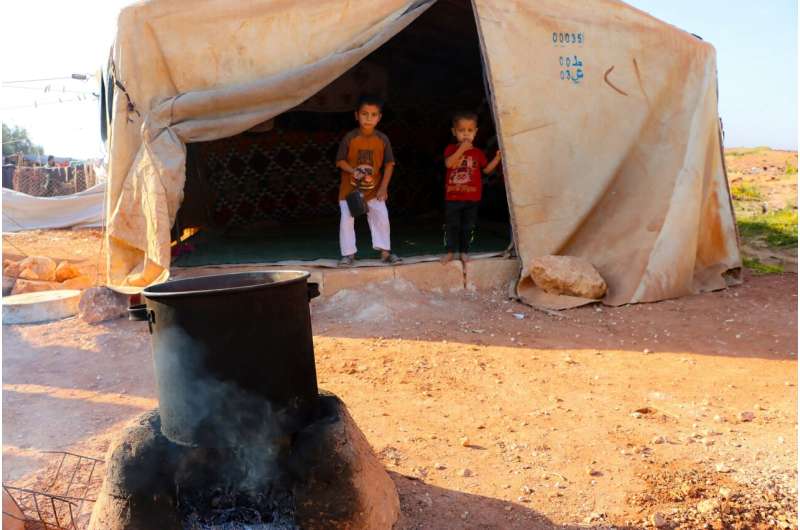
Recent research has revealed that social media sentiment can be a powerful tool in predicting when individuals will move during crises. This advancement is crucial for improving humanitarian responses in situations of forced displacement, which has reached alarming levels globally. According to the United Nations’ refugee agency, the number of displaced individuals worldwide has nearly doubled over the past decade, with one in 67 people fleeing their homes in 2024 alone.
Leveraging Social Media for Humanitarian Aid
The study, co-authored by Helge-Johannes Marahrens from the University of Notre Dame, demonstrates how analyzing social media posts can enhance the timeliness and effectiveness of aid delivery. Published in EPJ Data Science, the research emphasizes the role of computational tools in addressing significant global challenges related to human dignity.
“Traditional data, such as surveys, are extremely difficult to collect during forced migration crises,” said Marahrens, who serves as an assistant professor of computational social science at Notre Dame’s Keough School of Global Affairs. “As early warning systems evolve, artificial intelligence and new digital data can help improve them. Ultimately, this can help strengthen humanitarian responses, saving lives and reducing suffering.”
To support their findings, the researchers analyzed three critical case studies: the displacement of over 10.6 million people in Ukraine following Russia’s invasion in 2022, approximately 12.8 million displaced in Sudan due to civil war in April 2023, and the exodus of around 7 million individuals from Venezuela driven by multiple economic crises.
Insights from Social Media Analysis
The team reviewed nearly 2 million social media posts in three languages on X (formerly Twitter) and found that sentiment—categorized as positive, negative, or neutral—serves as a more reliable indicator of impending movement than specific emotions such as joy, anger, or fear. This predictive capability was particularly useful in estimating the timing and volume of cross-border movements.
After evaluating various methods for analyzing social media data, the researchers concluded that pretrained language models, which utilize deep learning techniques, provided the most effective early warning systems. These AI tools are designed to recognize patterns in text, akin to how the human brain processes language.
Marahrens noted that while social media analysis is particularly effective in conflict scenarios like Ukraine, it is less reliable in economic crises, such as those in Venezuela, which develop more gradually. He cautioned that while these analyses can be insightful, they may also lead to false alarms and should be regarded as preliminary indicators warranting further investigation.
The research suggests a need for collaboration with traditional data sources, including economic indicators and on-the-ground reports, to create a more comprehensive understanding of displacement patterns. Future studies could explore the relationship between sentiment and emotion, enhance automated translation services for broader language analysis, and incorporate data from additional social media platforms.
“Together, these improvements could help strengthen these tools,” Marahrens emphasized, “making them more beneficial for policymakers and humanitarian organizations working with displaced populations.”
Marahrens, who joined the University of Notre Dame in fall 2025, focuses on various issues related to globalization and inequality, applying his expertise in computational social science to numerous research projects. He is affiliated with both the Pulte Institute for Global Development and the Lucy Family Institute for Data & Society.
For more information, refer to the publication: Helge Marahrens et al, “Understanding the role of sentiment and emotion for predicting forced displacement,” EPJ Data Science (2025). DOI: 10.1140/epjds/s13688-025-00587-1.