
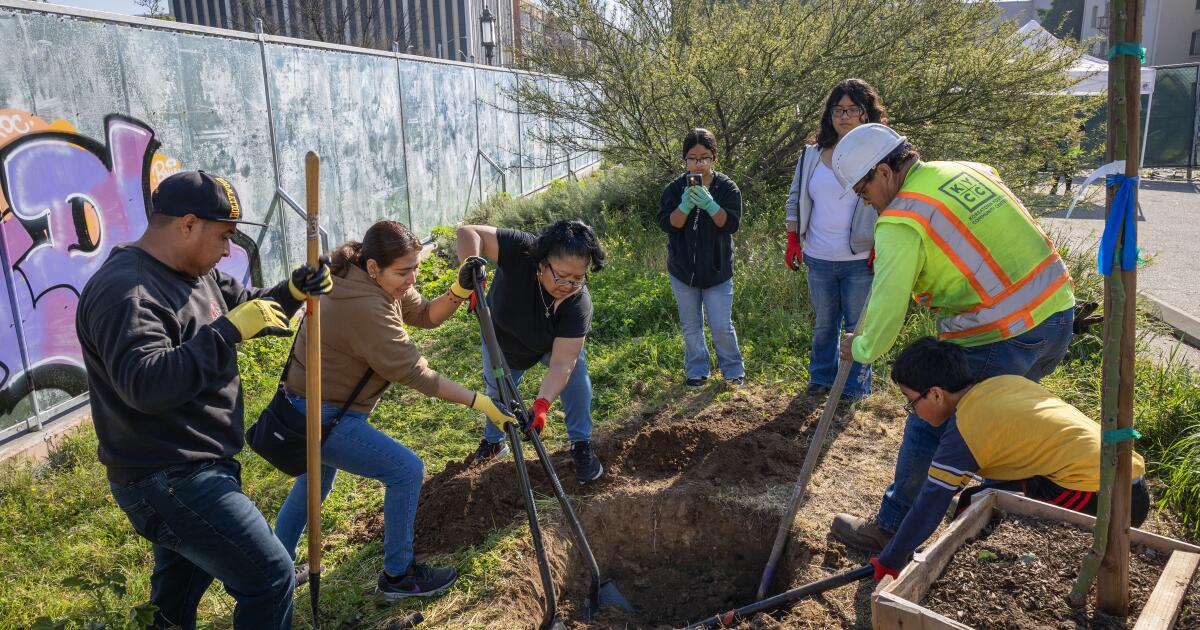
A groundbreaking analysis has revealed that nearly half of the paved surfaces in Los Angeles County may be unnecessary. The study, titled DepaveLA, conducted by the nonprofit Accelerate Resilience L.A., indicates that approximately 44% of the county’s 312,000 acres of pavement could be reconsidered for removal. This first-of-its-kind mapping effort details all paved areas in the county, differentiating between roads, sidewalks, private property, and more.
Researchers categorized pavement into two groups: “core” uses, such as streets, and “non-core” uses, which include surplus parking and private lots. The analysis pairs this mapping with data on heat, flooding, and tree canopy, establishing a framework aimed at improving public health and addressing climate issues. Paved surfaces tend to absorb heat, exacerbating urban heat islands and increasing ozone smog levels, while green areas offer psychological relief and cooler environments.
Brent Bucknum, founder of Hyphae Design Laboratory, emphasized the unexpected concentration of non-core pavement on private properties, revealing that nearly 70% of it falls within this category. Instead of advocating for a blanket removal, the report suggests targeted changes that could significantly impact the environment and community well-being.
One key area identified for potential improvement is parking lots, particularly large commercial and industrial spaces. By redesigning traditional 90-degree parking into angled parking, the study estimates that up to 1,600 acres of pavement could be eliminated, allowing for additional trees and stormwater management without sacrificing parking capacity. Bucknum pointed out the uncomfortable conditions often found in these lots, stating, “I’m often amazed — I’ll drive into a parking lot and there’s beeping, bumper-to-bumper traffic, you’re under this sweltering heat trying to get out of the grocery store.”
Long-standing parking requirements have traditionally linked the number of spaces to a building’s size, a system that has led to excessive paving. Ben Stapleton, CEO of the U.S. Green Building Council California, highlighted that this approach often prioritizes cost-effectiveness over environmental considerations, as asphalt is cheaper and easier to maintain.
Residential properties also present opportunities for reducing pavement. The study found that if every residential parcel created a 6-by-6-foot tree well in their patios, it could result in the removal of approximately 1,530 acres of pavement, while only slightly reducing patio space. Emily Tyrer, director of green infrastructure at TreePeople, noted a troubling trend where residential yards are increasingly paved over instead of being planted with trees and drought-resistant vegetation.
Schools, too, are identified as potential sites for reducing pavement. On average, school campuses in L.A. County are covered in about 40% asphalt, exposing students to extreme heat. At Esperanza Elementary School, a campus near downtown Los Angeles, the area was described as “just a sea of asphalt.” Plans are underway to transform the school grounds into a greener environment, incorporating native plants, shade trees, and natural play areas, providing students with a healthier space.
The idea for the DepaveLA report emerged from years of tree-planting projects that faced challenges due to extensive pavement coverage. Bucknum noted, “We were trying to plant trees, but so much of the city is paved that there was nowhere to put them.” The team recognized the need for a detailed data set to address the issue effectively.
Devon Provo, senior manager of planning and program alignment at Accelerate Resilience L.A., described the report as an opportunity assessment rather than a definitive plan for pavement removal. “This data is relevant to anyone who wants to have a say in reimagining the future of Los Angeles to be cooler, healthier and more vibrant,” Provo said.
While the findings present a compelling case for reassessing pavement use, challenges remain. Olivier Sommerhalder, a principal at the design firm Gensler, noted that businesses may be hesitant to remove pavement without incentives, as there are currently no financial motivations from municipalities to mitigate urban heat.
Carlos Moran, executive director of North East Trees, warned that in some neighborhoods, pavement may cover contaminated soil that cannot be disturbed. “We can’t just rip it out,” he stated, while agreeing that there is excessive pavement in the city.
As the report gains traction, its authors hope it will encourage Angelenos and decision-makers to rethink the role of pavement in urban design. By shifting perceptions of pavement from a default choice to a considered design element, they believe property owners and developers can explore alternatives that enhance the environment and community health.