
Research from the Chinese Academy of Sciences and Ghent University has made significant strides in understanding the origins of flowering plants, known scientifically as angiosperms. Published on January 2, 2026, in the journal Science Advances, the study challenges previous assumptions about whole-genome duplications (WGD) in ancestral angiosperms, suggesting that these plants did not undergo additional duplications in their evolutionary history.
Exploring Ancient Genetic Changes
Angiosperms represent the most diverse category of seed plants, and their evolutionary trajectory has long puzzled scientists. Traditionally, WGD has been viewed as a crucial factor in the development and diversification of both seed plants and angiosperms. However, identifying these ancient WGD events poses significant challenges due to complications arising from gene loss and chromosomal changes that obscure genetic signatures.
In 2011, researchers suggested that two major WGD events occurred: the ζ event in seed plants and the ε event specific to angiosperms. This theory was contested in a 2017 study, which proposed that the signals of these duplications might be artifacts of the methodologies used rather than genuine evolutionary markers. The debate surrounding these claims has persisted, leaving the topic open for further investigation.
Innovative Methodology Using Dosage-Sensitive Genes
To clarify the history of WGDs in seed plants and angiosperms, the current study introduced a novel approach by employing dosage-sensitive genes as evolutionary markers. These genes are integral to protein complexes and regulatory networks, and their expression levels are critical for maintaining cellular balance. As a result, they are more likely to be retained after WGD events.
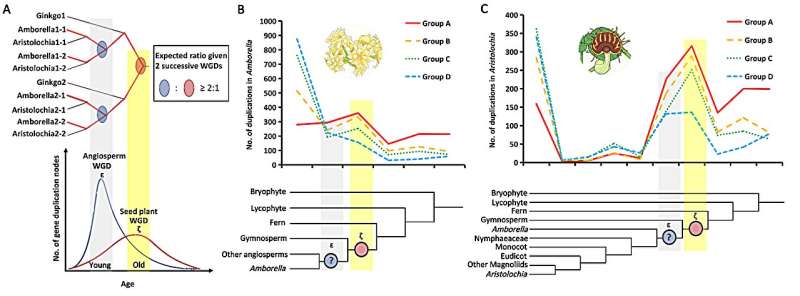
The research team analyzed orthologous gene groups from various angiosperm lineages, quantifying their dosage sensitivity. They classified these groups into four categories, with Group A showing the highest sensitivity and Group D the lowest. Findings indicated that Group A genes exhibited stronger evolutionary constraints, greater interactions among proteins, and wider tissue expression profiles, reinforcing their validity as indicators of WGD events.
Utilizing this framework, the researchers examined the evolutionary histories of two early-diverging angiosperm species—Amborella trichopoda and Aristolochia fimbriata—which lack post-angiosperm WGDs. The analysis revealed a significant peak in duplication corresponding to the ancestral seed plant WGD (ζ event), while evidence for the hypothesized angiosperm-specific WGD (ε event) was substantially weaker. The data showed duplication node ratios much lower than theoretical expectations, further questioning the existence of the ε event.
Through rigorous correlation analysis and probabilistic modeling, the researchers concluded that the retention rates of the ε event among dosage-sensitive genes were too low to support its classification as an independent WGD. This outcome underscores the notion that the evolutionary history of flowering plants may be characterized by a singular ancestral WGD, without further duplications during their development.
This groundbreaking research not only provides clarity on the evolutionary pathways of angiosperms but also highlights the potential of dosage-sensitive genes in unraveling complex genetic histories. The insights gained from this study may shape future investigations into plant evolution and diversity.
For more information, refer to the article by Tao Shi et al, titled “Revisiting ancient whole-genome duplications in the seed and flowering plants through the lens of dosage-sensitive genes,” available in Science Advances (2026). DOI: 10.1126/sciadv.aea9797.