
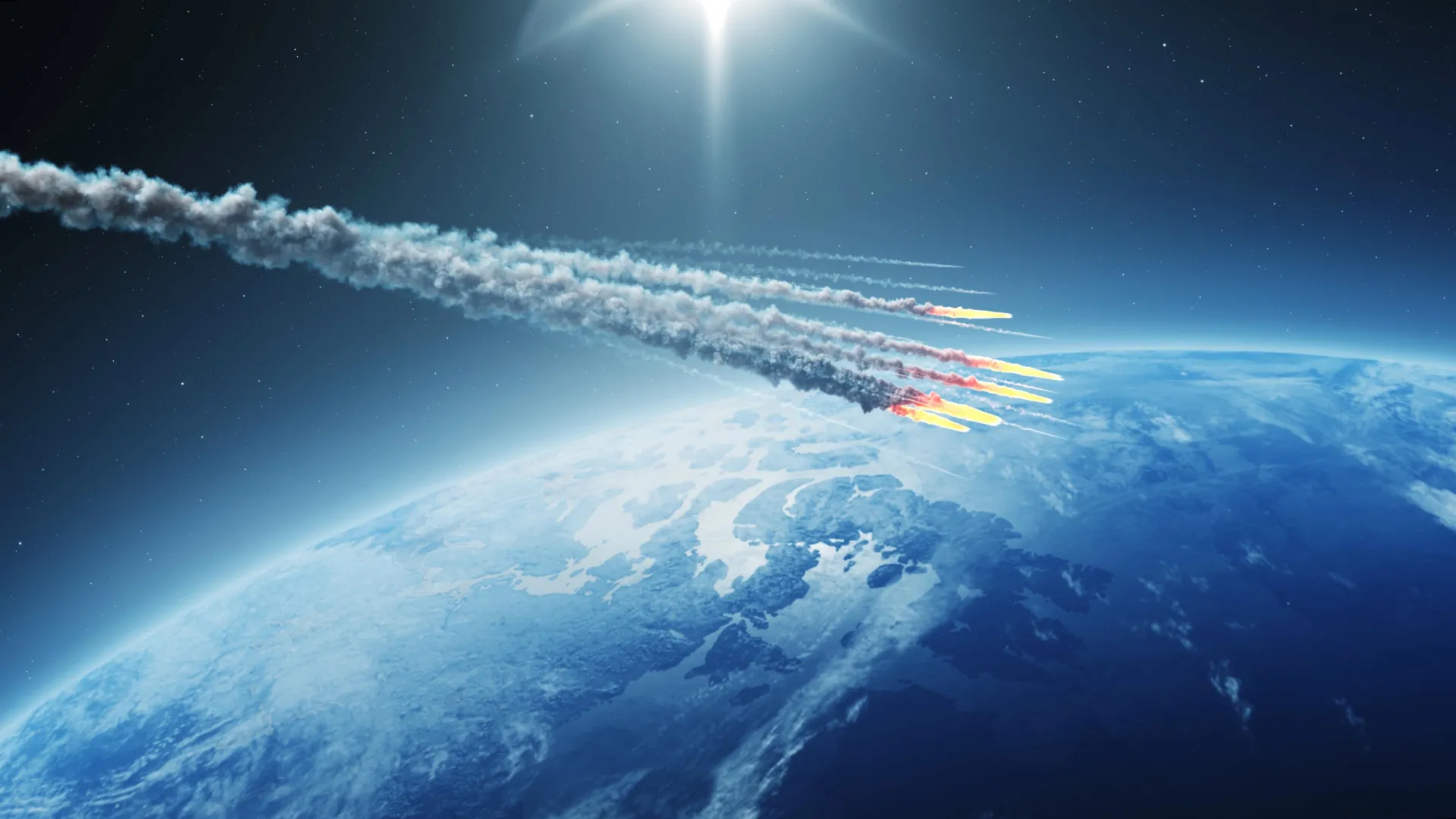
Recent research from the University of California – Santa Barbara suggests that Earth may have been significantly impacted by “invisible” explosions from space, known as cosmic “touchdown airbursts.” These events, which involve the detonation of comets or asteroids above the surface, may occur more frequently and cause greater destruction than previously understood. Unlike traditional impacts that create craters, these airbursts unleash intense heat and pressure without leaving obvious traces, complicating their detection.
James Kennett, an Emeritus Professor of Earth Science at UC Santa Barbara, and his research team advocate for increased scientific scrutiny of these explosive events. “Touchdown events can cause extreme damage through very high temperatures and pressures,” Kennett explained. “And yet they don’t necessarily form a crater, or they form ephemeral surface disturbances, but they’re not the classic major craters that come from direct impacts.”
Evidence of Historical Airbursts
The findings are based on four new studies that present evidence of multiple airburst events from various points in Earth’s history. These explosions occur when an incoming object detonates above the ground, generating heat and shockwaves that can affect large areas. Research has identified signs of these conditions in diverse locations, including deep ocean sediments in the North Atlantic and remnants of an ancient desert city.
One notable study published in the journal PLOS One details the first discovery of impact markers related to airbursts in marine sediments associated with the Younger Dryas Impact Hypothesis (YDIH). Material was recovered from deep-sea cores in Baffin Bay, off the coast of Greenland. Kennett noted the significance of this finding, stating, “It’s the first time we’ve found evidence for the Younger Dryas cosmic impact event in the marine record.”
According to the Younger Dryas hypothesis, around 12,800 years ago, fragments of a comet exploded over Earth, leading to a sudden cooling period that coincided with the extinction of various large animals and significant shifts in human cultures. The explosion likely ignited fires, leaving behind a distinct carbon-rich layer known as a “black mat,” which contains rare elements linked to the original space object.
Challenges in Detecting Airbursts
Cosmic impacts can vary significantly, from the continuous fall of fine extraterrestrial dust to rare, massive collisions. Traditionally, large impacts are associated with craters, providing the most compelling evidence for such events. In contrast, touchdown airbursts pose a greater challenge for detection due to their lack of lasting landscape alterations.
Kennett pointed out, “Previously, there has been no evidence for the Younger Dryas boundary (YDB) event of any crater or possible crater.” This difficulty is compounded for events older than a few thousand years, as they often leave little to no visible evidence after being buried.
Interestingly, a shallow lake near Perkins, Louisiana, may represent the first known crater from the Younger Dryas Boundary. In a recent publication, researchers revisited observations made in 1938 by a local landowner regarding the lake’s circular shape. Detailed studies began in 2006 and continued until 2024, revealing meltglass, spherules, and shocked quartz. Radiocarbon dating indicates these materials are consistent with the Younger Dryas period, although further investigation is needed to confirm the hypothesis of a cosmic impact.
Insights from Historical Events
Shocked quartz is often associated with high-pressure cosmic impacts, typically found in large crater-forming events. However, recent research indicates that airbursts can also produce a variety of fracture patterns in quartz. The team analyzed samples from the site of the Tunguska explosion in 1908 and re-evaluated findings from Tall el-Hammam, an ancient city believed to have been destroyed by a similar event approximately 3,600 years ago.
Kennett emphasized that the Tunguska incident is unique as the only recorded historical touchdown event. Witnesses described a bright fireball, and photographs later captured the vast areas of flattened forest. While extensive research has focused on the visible damage, little attention has been given to microscopic impact evidence. The recent findings at Tunguska included shocked quartz with distinct planar fractures filled with meltglass, tiny impact-formed spheres, and melted metal.
The research also bolsters the case for an airburst over Tall el-Hammam during the Middle Bronze Age. Alongside previously documented spherules, carbon, meltglass, and rare minerals, the team observed shocked quartz displaying diverse crack patterns. These findings suggest complex blast dynamics similar to those at Tunguska.
The collective evidence from these studies indicates that cosmic impacts, especially touchdown airbursts, may be more common and possess greater destructive potential than previously recognized. “They’re far more common, but also possess much more destructive potential than the more localized, classic crater-forming asteroidal impacts,” Kennett stated. He added, “The destruction from touchdown events can be much more widespread. And yet they haven’t been very well studied, so these should be of interest to humanity.”