
Recent advancements in optical microscopy have shed light on the relationship between diffraction patterns and Fourier transforms. Notably, the researcher known as [xoreaxeax] has presented a detailed explanation of this connection, building upon his previous work involving a lens-less optical microscope. This innovative device deduces the structure of specimens by capturing diffraction patterns created when a laser beam passes through the sample.
In a recent demonstration, [xoreaxeax] derived equations for the Fourier transform based on fundamental principles of diffraction. The process begins with the assumption that light behaves as a wave, represented by a sinusoidal function. To simplify calculations, the sine wave is transformed into a complex number expressed in exponential form.
Using the Huygens principle, which states that light emanating from a point in a sample expands in spherical waves, the researcher explains that the wave at a particular location can be calculated as a function of distance. The principle of superposition comes into play when two waves intersect, with the amplitude at that point being the sum of the individual waves. By extending this summation to encompass all light sources emanating from the sample, [xoreaxeax] arrives at an infinite integral that ultimately simplifies to a specific form of the Fourier transform.
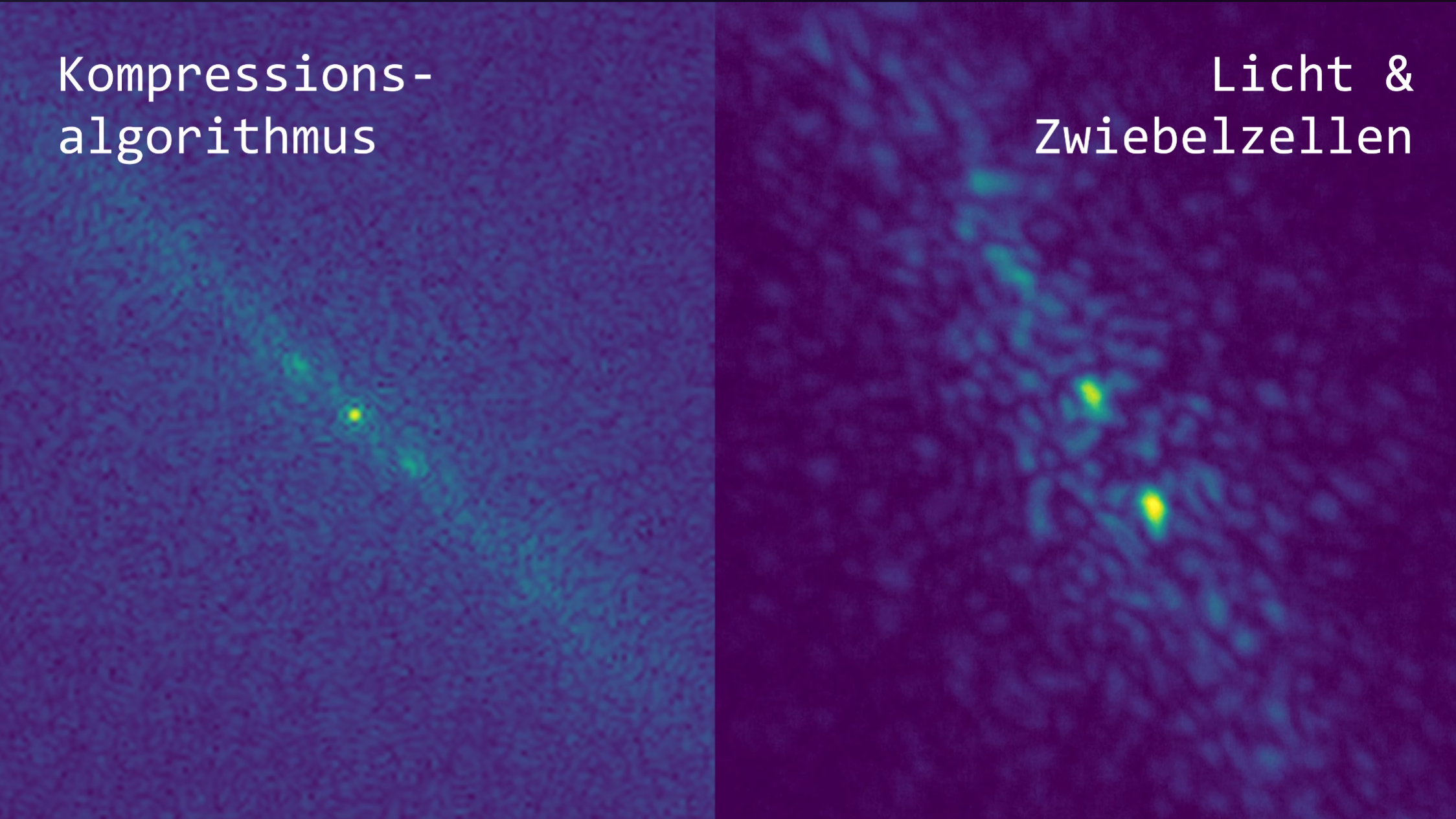
One intriguing outcome of this relationship is illustrated through the JPEG representation of a micrograph of onion cells. JPEG compression processes images by calculating their Fourier transform and storing them as a series of sine-wave striped patterns. When arranged according to stripe frequency and orientation, and shaded based on their contribution to the final image, a speckle pattern emerges with a bright point at the center. This pattern closely resembles the diffraction pattern created when a laser beam is directed through the same onion cells.
For those interested in the original experiment that led to these findings, [xoreaxeax] previously developed a ptychographical microscope that enabled this analysis. Additionally, researchers are exploring the inverse relationship, using physical structures to compute Fourier transforms, further expanding the understanding of this fundamental concept in optics.
This exploration not only enhances the theoretical understanding of diffraction and Fourier transforms but also has practical implications for imaging technologies and data compression methods. As researchers continue to delve into these connections, the impact on fields ranging from microscopy to digital imaging is poised to grow significantly.