
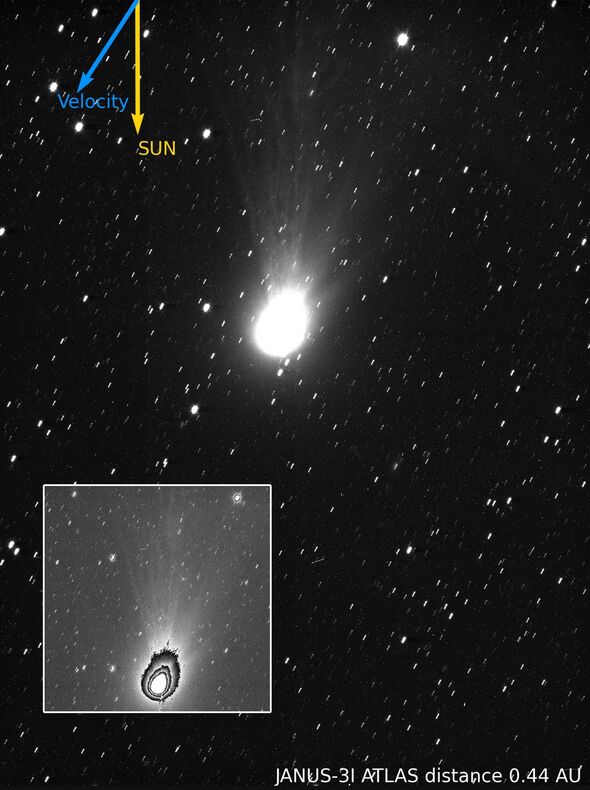
Space scientists have unveiled striking new images of the interstellar Comet 3I/ATLAS, generating renewed discussion about its origins. Captured by the JANUS camera aboard the European Space Agency’s (ESA) Jupiter Icy Moons Explorer (Juice), the images depict the comet expelling gas and dust. The unique characteristics of this object have led some researchers, including Harvard astrophysicist Avi Loeb, to speculate about the possibility of it being an extraterrestrial spacecraft.
The ESA reported on February 26, 2026, that the comet’s nucleus is enveloped in a bright halo of gas, known as the coma, accompanied by a long tail and hints of jets and filaments. The images were taken on November 6, 2025, shortly after the comet’s closest approach to the Sun, which occurred two months prior. At that time, Juice was approximately 66 million kilometers from the comet.
Loeb, who co-authored a recent scientific paper, raised concerns that the object may not be merely a natural comet. He emphasized the potential dangers should his hypothesis prove correct, suggesting that humanity might need to consider defensive measures against what he describes as a possibly hostile spacecraft. The paper warns, “The consequences, should the hypothesis turn out to be correct, could potentially be dire for humanity.”
First observed in July 2025, 3I/ATLAS has exhibited a range of peculiar features. While Loeb acknowledges that it is “most likely” a natural comet, he argues that its unusual glow, trajectory, and path warrant further investigation. Specifically, he points out that the comet follows a retrograde orbit closely aligned with the ecliptic plane, a configuration with only a 0.2% chance of occurring by chance.
Another remarkable aspect of 3I/ATLAS is its “anti-tail,” which displays a sunward jet extending over 310,000 miles, a phenomenon not typically seen in comets. Chemical analysis of the gas plume reveals an abundance of nickel alongside a deficiency of iron, suggesting a composition more akin to industrial alloys than natural origins. Additionally, the comet contains only 4% water, an unusually low percentage for such objects. Initial observations also highlighted a lack of expected cometary activity, such as a clear tail of vapor, leading Loeb to theorize that it might be “powered” or “guided.”
Despite Loeb’s assertions, the broader scientific community remains skeptical. Major space agencies like NASA and ESA continue to classify 3I/ATLAS as a natural comet, albeit with some characteristics that are intriguing yet explainable through conventional science. As researchers analyze the more than 120 images captured by JANUS, the debate over the object’s true nature is likely to continue, keeping both the scientific community and the public captivated by the mysteries of the cosmos.