
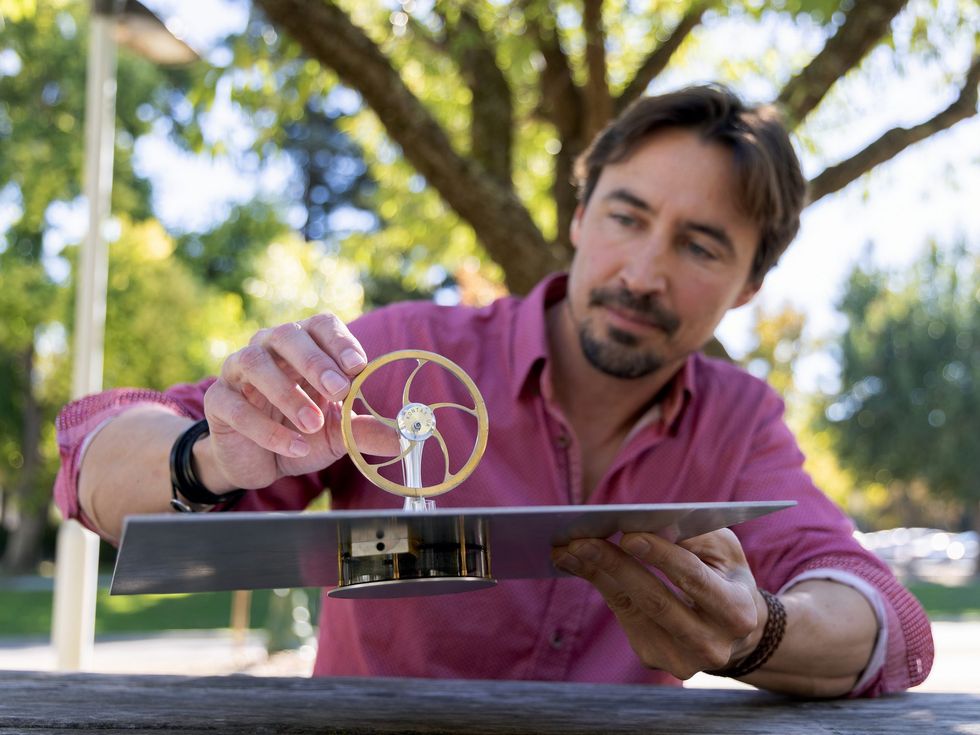
Researchers have developed an innovative device that generates power by beaming heat from its surroundings into outer space. This new technology, which diverges from traditional solar energy methods, offers potential applications in residential heating and greenhouse ventilation.
Instead of harvesting energy from sunlight, these devices absorb ambient heat and release it as specific wavelengths of infrared radiation. This process allows heat to escape into space, effectively cooling the surrounding area. The concept builds on research from 2014, when scientists first created materials capable of cooling buildings without electricity by radiating heat away.
Jeremy Munday, a professor of electrical and computer engineering at the University of California, Davis, explains that this new technology operates similarly to solar cells but in reverse. “Rather than pointing them at a hot object like the sun, you point them at a cool object, like the sky,” he states.
Historically, these devices required rare materials for efficient operation. However, Munday and his team have explored the potential of using Stirling engines, known for their mechanical simplicity and efficiency in small temperature differentials. “They also directly produce mechanical power, which is valuable for applications like air movement or water pumping,” Munday adds.
At the core of the Stirling engine is a gas sealed within an airtight chamber. When heated, the gas expands, increasing pressure and driving a piston to generate power. This contrasts with traditional internal combustion engines that depend on significant temperature differences. The new device leverages ambient heat and radiates energy into space, creating a cooling effect that fuels its operation.
In a series of outdoor nighttime experiments conducted over a year, the researchers demonstrated that the device could achieve more than 10 degrees Celsius of cooling in most months. This cooling can be converted into over 400 milliwatts of mechanical power per square meter, sufficient to directly power a fan or generate electrical current.
While the power output is significantly lower than that of solar photovoltaics—approximately two orders of magnitude less—Munday emphasizes that the goal is not to replace solar energy. “This enables useful work when solar power is unavailable, such as at night, without requiring batteries, wiring, or fuel,” he explains. The device could potentially generate more than 5 cubic feet per minute of airflow, meeting the minimum air circulation requirements set by the American Society of Heating, Refrigerating and Air-Conditioning Engineers for healthy indoor environments.
The researchers believe there are several opportunities to enhance the device’s efficiency. For example, replacing the air in the chamber with gases like hydrogen or helium could reduce friction within the engine. Munday notes, “With more efficient engine designs, we think this approach could enable a new class of passive, around-the-clock power systems that complement solar energy.”
Looking ahead, Munday and his colleagues aim to deploy these devices in real greenhouse settings as a proof-of-concept application. Additionally, they are exploring ways to optimize the technology for daytime use. The team’s findings have been published in the journal Science Advances, marking a significant step toward sustainable energy solutions.