
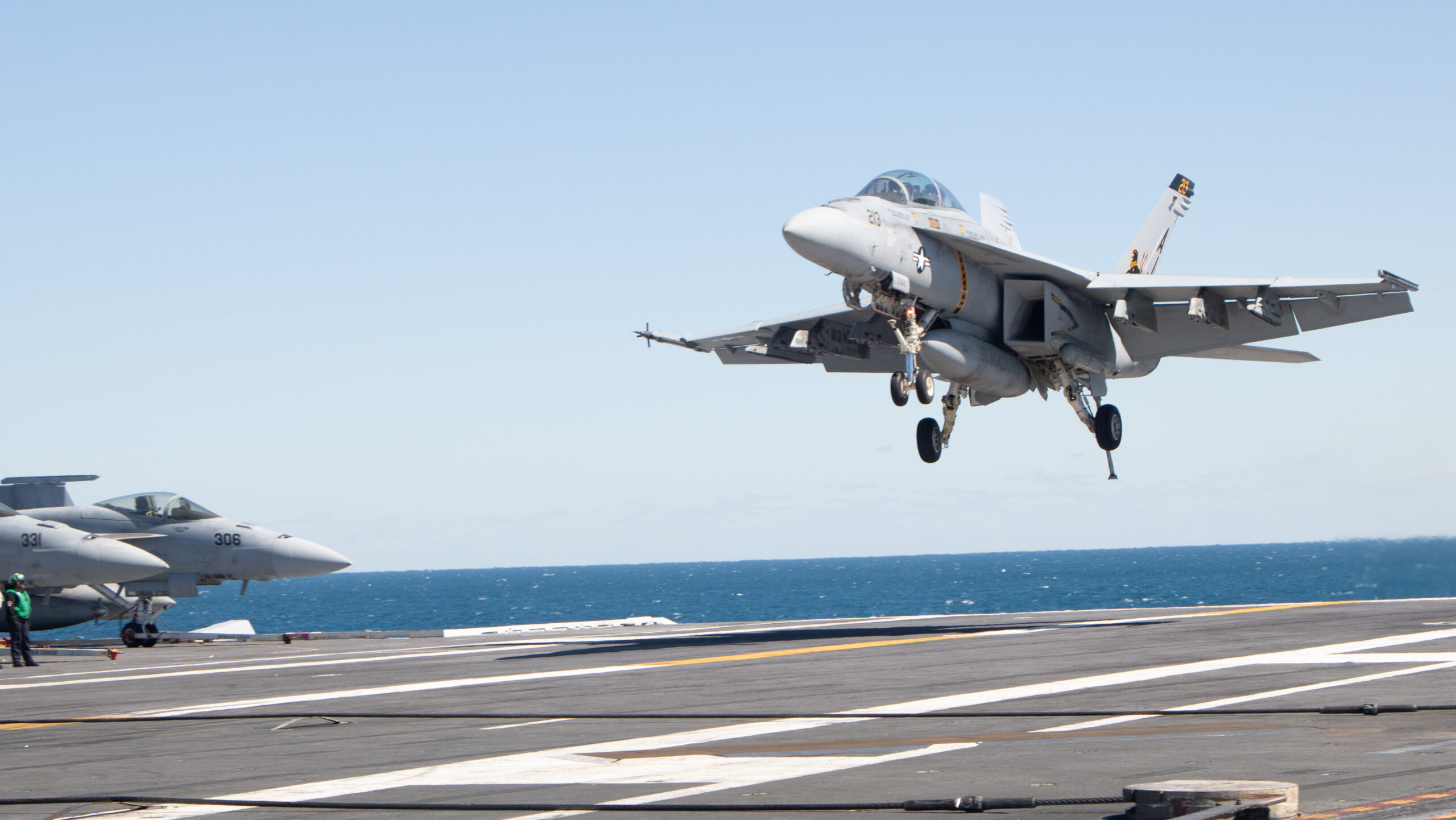
The United States Navy is confronting a critical situation regarding its future air power capabilities. The USS Gerald R. Ford, the newest and largest aircraft carrier, recently arrived in the US Southern Command area after a swift transit from the Mediterranean, following orders from former President Donald Trump. Accompanying the carrier is Carrier Air Wing 8, which includes four squadrons of fighter planes and electronic attack and surveillance aircraft. This deployment aims to enhance strike options and monitor activities termed as “drug boats” by the Pentagon.
Despite the operational capabilities demonstrated by US aircraft carriers in missions such as Operation Rough Rider, a pressing issue looms: the aging fleet of aircraft. The Navy has identified a clear need for the F/A-XX, a next-generation strike fighter. As Adm. James Kilby, acting Chief of Naval Operations, emphasized in June, “We need F/A-XX in the United States Navy. We’re talking about a fight in the Pacific.” Yet, progress on this necessary program is hindered by indecision within the Pentagon.
Concerns about the vulnerability of aircraft carriers to sophisticated Chinese missile systems and discussions around the potential replacement of manned fighters with drones have caused delays. At one point, a controversial idea emerged from the White House suggesting that the US aerospace industry could not simultaneously produce both the Air Force’s F-47 and the Navy’s new stealth aircraft. Meanwhile, China is advancing its own military capabilities, with its new aircraft carrier undergoing sea trials and at least two stealth aircraft in testing.
As it stands, the Pentagon is expected to delay the F/A-XX program by another one to two years, a move that could significantly compromise US naval aviation capabilities.
Strategic Needs in the Pacific
To effectively counter Chinese military advancements, the Navy requires a strike aircraft that offers enhanced survivability and range, alongside advanced missile systems and aerial refueling capabilities. The strategic imperative is to extend the operational range of carrier-based strike fighters, ensuring maximum effectiveness and flexibility during engagements. This approach parallels historical military developments, from the Grumman F6F Hellcat in World War II to the F-14 Tomcat, which was designed to counter Soviet bombers during the Cold War.
Over a decade ago, the Navy recognized the necessity of preparing for the F/A-XX to dominate air battles at extended ranges. The plan involves developing longer-range missiles, a stealthy aerial tanker drone, and a new strike fighter that combines range, payload capacity, and stealth capabilities. The Long-Range Anti-Ship Missile (LRASM), a significant advancement, was showcased by Trump during his visit to the USS George Washington in Japan on October 28, 2022. Furthermore, the F/A-18EF has integrated the SM-6 missile, which boasts a range of approximately 300 miles, with potential for increased distance if modified.
The MQ-25 Stingray drone is also slated to join the fleet by 2026. This aircraft will enhance air refueling capabilities and serve as a communications relay, allowing strike fighters to extend their operational range significantly. Although land-based tankers are essential, the MQ-25 will enable carrier-based aircraft to optimize their missions by providing additional fuel without sacrificing fighter capabilities.
Crucially, the F/A-XX is designed to be larger and stealthier than existing aircraft, with an anticipated combat radius exceeding that of current models. The Navy estimates that if the F/A-XX achieves a 25 percent increase in range over existing fighters like the F-35C and F/A-18EF, it could reach a combat radius greater than 750 nautical miles. When combined with the range of advanced missiles, the potential operational reach could extend to 1,000 miles or more, greatly enhancing the Navy’s tactical options.
Production Timeline and Urgency
The situation is becoming increasingly urgent, as the production of the F/A-18EF is set to conclude in 2027. The F/A-XX has been designated as its successor, and both Boeing and Northrop Grumman have developed mature prototypes, with suppliers and production lines ready for action. An immediate decision to advance to the engineering and manufacturing design phase could initiate the timeline toward low-rate initial production and the first flight of the F/A-XX.
If the Navy has approached the F/A-XX program with the same diligence as the Air Force did with the B-21 requirements, the first flight could occur by 2028 or 2029. The urgency of the situation cannot be overstated; the Pentagon leadership must heed the Navy’s recommendations and expedite the development of the F/A-XX to ensure the United States maintains its strategic advantage in the Pacific and beyond.
Rebecca Grant, a Senior Fellow at the Lexington Institute, underscores the necessity of decisive action in this critical period for naval aviation. The time for complacency has passed; the Navy must act swiftly to secure its future capabilities against evolving global threats.