
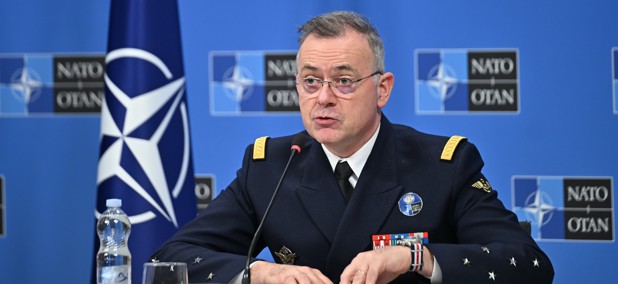
NATO’s ability to deter a Russian attack relies not only on its military strength but also on the speed at which it can integrate new technology into its operations. This was emphasized by Adm. Pierre Vandier, head of NATO’s Allied Transformation Command, during a statement made in Washington on Tuesday. He highlighted that the alliance must match the pace of technological advancements employed by Russia to avoid potential miscalculations, similar to those seen during the 2022 escalation in Ukraine.
Vandier pointed out the ongoing conflict in Ukraine has demonstrated the significance of not merely acquiring new technology but also adapting and reinventing it at the front lines. He noted that Russia is employing similar strategies, enhancing its capabilities in areas such as space-based imagery and drone warfare. If NATO is perceived as lagging behind, it increases the risk of Russia miscalculating its actions, which could have dire consequences for the alliance.
The war in Ukraine has exposed a critical challenge for NATO: the slow and cumbersome processes involved in procuring and developing weapons. According to Vandier, even the most advanced technology can quickly become outdated. “The obsolescence is nearly immediate,” he stated, emphasizing the necessity for engineers and technicians to be closely involved in rapid solution development.
Despite NATO’s historical reputation as a slow-moving bureaucratic organization, Vandier asserts that this image is changing. He referenced the REPMUS 24 exercise in Portugal, which took place in April 2024. During this event, NATO members successfully deployed over 70 autonomous systems in less than three weeks. The previous iteration of this exercise involved more than 276 unmanned systems, showcasing NATO’s evolving capabilities.
In the upcoming months, NATO plans to conduct similar experiments in Romania and Latvia. These exercises aim to test new counter-drone systems and their integration into a cohesive protective framework, often referred to as a “layered defense.” Vandier also spoke about the alliance’s commitment to harnessing artificial intelligence for critical early warning tasks. This initiative, known as SINBAD, aims to utilize satellite imagery to monitor changes in military activity.
As NATO extends its operational focus to the Arctic, Allied Transformation Command is set to develop a range of satellite services to address existing shortfalls in that region. Another innovative project, initiated last April, seeks to leverage large language models to significantly reduce the time and manpower required for advanced wargame planning. Vandier explained that creating a large-scale scenario typically involves 18 months of work for 60 personnel. The goal is to streamline this process to under two months with half the workforce.
The urgency for NATO to adapt quickly to emerging threats cannot be overstated. As geopolitical tensions continue to evolve, the alliance’s ability to innovate and respond swiftly will play a crucial role in maintaining deterrence against potential aggressors.