
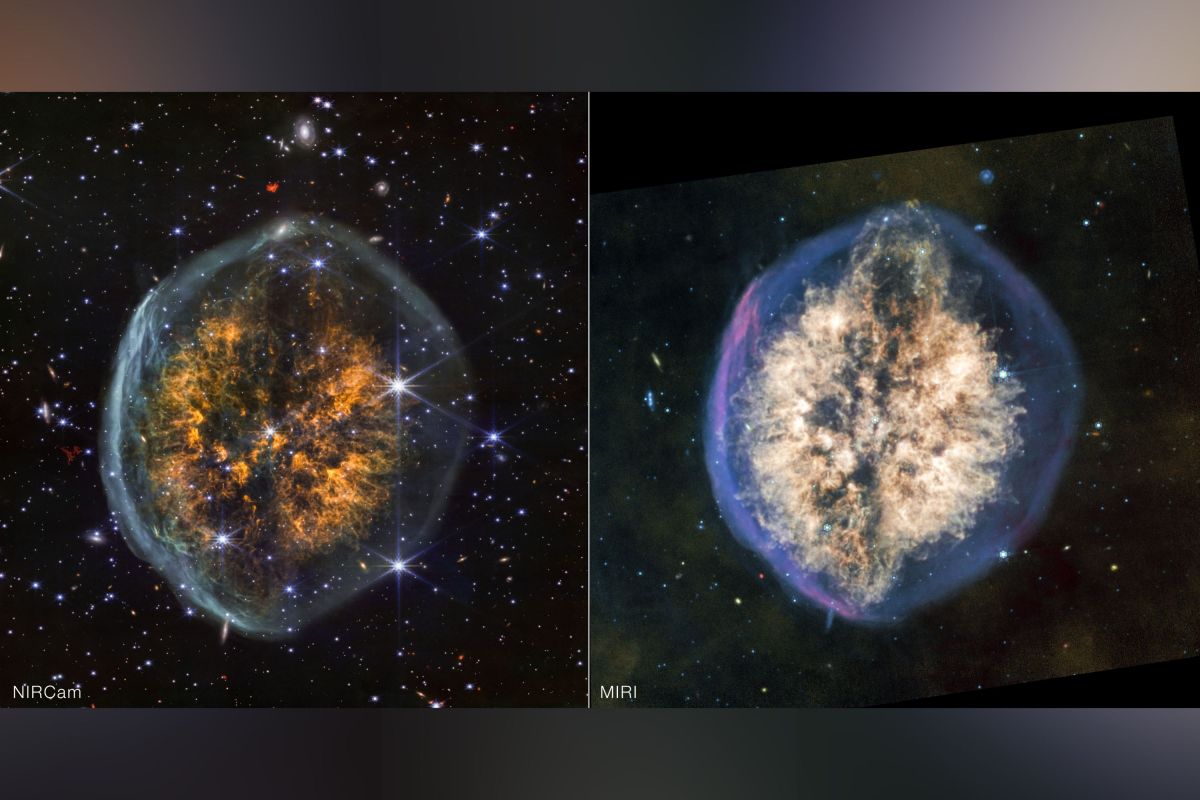
NASA’s James Webb Space Telescope has unveiled breathtaking images of a little-studied nebula known as PMR 1, also referred to as the “Exposed Cranium” nebula. The nebula’s striking appearance, marked by its split hemispheres and dark central lane, has drawn comparisons to a transparent skull encasing a brain. This discovery sheds light on the intricate processes involved in the evolution of dying stars.
The images captured by Webb reveal a relatively brief phase in the lifecycle of a star, providing valuable insights into how stars expel their outer layers. Observations were made using both the near-infrared camera (NIRCam) and the mid-infrared instrument (MIRI), showcasing the nebula’s brain-like interior, which is divided by a prominent dark vertical lane. According to NASA, the outer shell resembles a skull largely composed of hydrogen, while the inner cloud contains a mixture of gases.
Insights from Webb’s Observations
The observations suggest that the central dark lane may be associated with an outburst or twin jets originating from the central star. MIRI highlights apparent gas ejections at the top of the nebula, while side-by-side comparisons with NIRCam images reveal an abundance of stars and background galaxies. PMR 1 is located in the Vela constellation, approximately 5,000 light-years from Earth, and Webb’s composite image spans about 3.2 light-years.
As for the star’s ultimate fate, NASA has not yet determined its mass, leaving open the possibility that it could become a dense white dwarf similar to our sun or culminate in a supernova explosion if it possesses sufficient mass. The nebula was initially revealed in infrared light over a decade ago by the now-retired Spitzer Space Telescope.
Community Reactions and Future Events
In response to the new findings, NASA’s Webb Telescope shared on social media, “A brain-new image from Webb! What looks like a brain is actually a dying star blowing off a shell of gas, and within that shell, a cloud of various gases.” This engaging portrayal has sparked interest and discussion among astronomy enthusiasts.
Looking ahead, NASA has also outlined an upcoming total lunar eclipse scheduled for March 3, 2024. This event will be visible across the Pacific, with viewing opportunities in eastern Asia and Australia in the evening, overnight across the ocean, and before dawn for North and Central America, as well as far western South America. The agency has provided a timeline for the eclipse, detailing the various phases:
– Penumbral eclipse begins at 12:44 a.m. PST / 3:44 a.m. EST / 08:44 UTC, marking the onset of subtle dimming as the moon enters Earth’s penumbra.
– Partial eclipse starts at 1:50 a.m. PST / 4:50 a.m. EST / 09:50 UTC, as the moon enters the umbra and a dark shadow appears on the lunar disk.
– Totality commences at 3:04 a.m. PST / 6:04 a.m. EST / 11:04 UTC, when the entire moon is shrouded in the umbra, taking on a coppery red hue.
– Totality concludes at 4:03 a.m. PST / 7:03 a.m. EST / 12:03 UTC, with the red coloration fading and the shadow reappearing on the opposite side.
– The partial eclipse ends at 5:17 a.m. PST / 8:17 a.m. EST / 13:17 UTC, leaving only subtle dimming in the penumbra.
– The penumbral eclipse finishes at 6:23 a.m. PST / 9:23 a.m. EST / 14:23 UTC, marking the conclusion of the event.
These celestial phenomena serve as a reminder of the vast and dynamic universe we inhabit, with NASA continuing to provide valuable insights into the processes that govern star formation and evolution. As the agency embarks on new explorations, the findings from the James Webb Space Telescope will undoubtedly enhance our understanding of the cosmos.